Solana Staking Lockup: How Warmup & Cooldown Actually Work | CryptoLurk
Solana Staking Lockup: How Warmup & Cooldown Actually Work
CrisCoin 10 min readSolana
Solana has no fixed staking lockup period.
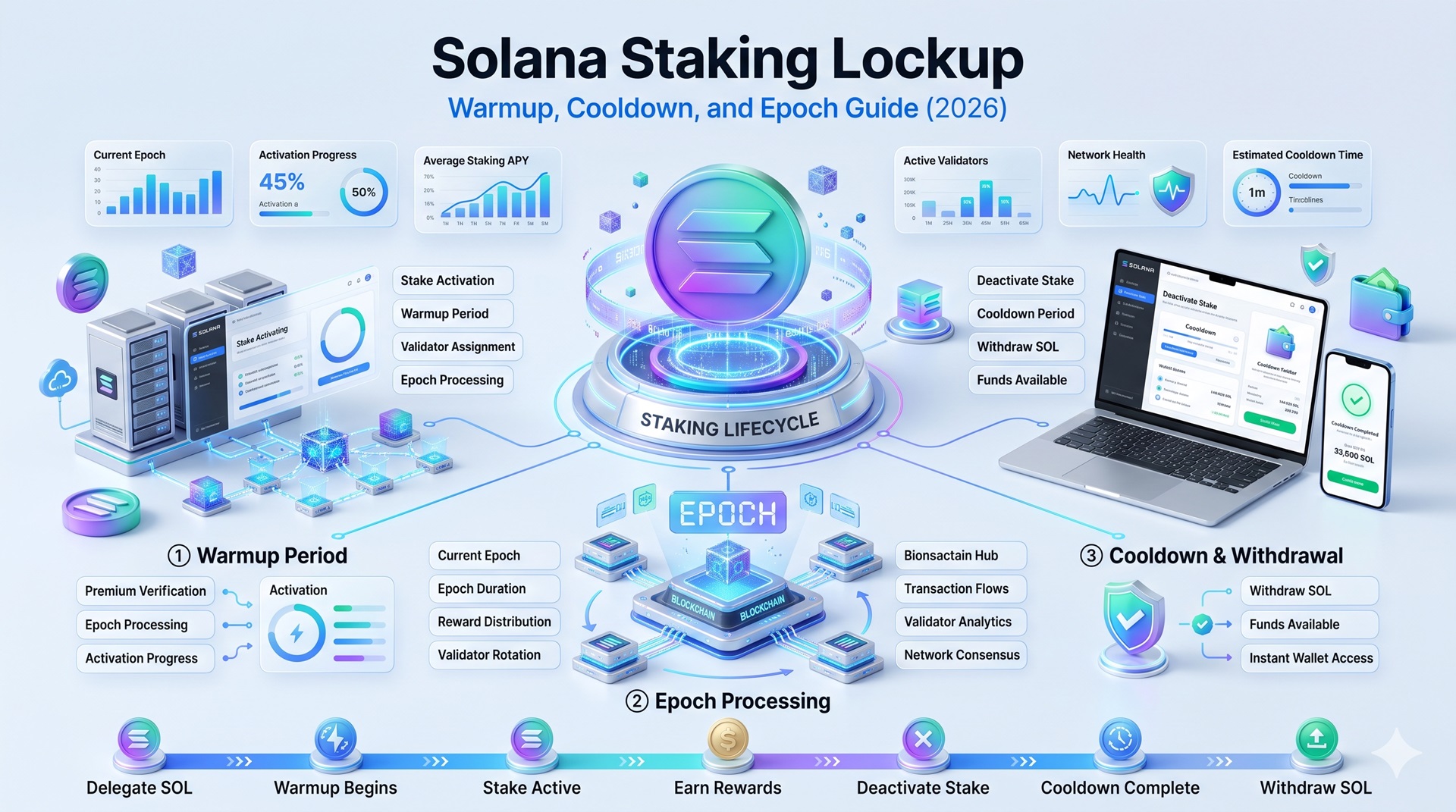
Instead of locking your SOL for a set number of weeks or months, the network uses epoch-based warmup and cooldown windows that govern when your stake activates and when it becomes withdrawable, each lasting roughly 2-3 days. You can unstake at any time, but your SOL is not instantly available.
This guide explains how the warmup and cooldown actually work, the 25% per-epoch limit that can stretch them, and the genuinely optional on-chain lockup feature that most guides never mention.
What “Solana Staking Lockup” Actually Means
The Solana staking lockup is not a contractual term you agree to; it is the time your SOL spends moving through epoch-based activation and deactivation windows. There is no lockup period for Solana in the traditional sense, but staked tokens can only change state when a new epoch begins, which creates an effective delay on both ends. Your SOL stays in your custody the entire time; you are delegating to a validator, not transferring ownership.
This matters because most staking products in traditional finance lock funds rigidly for a defined period. Solana instead aligns all stake changes to epoch boundaries to keep the validator set stable and rewards fair. The result feels like a short lockup, but it is really a processing window: when you stake, your SOL warms up; when you unstake, it cools down; and in between it earns and remains yours.
Warmup vs Cooldown at a Glance
The two windows that make up Solana’s effective lockup are the warmup on entry and the cooldown on exit, and both follow the same epoch-boundary logic. Knowing which is which clarifies the entire staking lifecycle.
Window
When It Applies
What Happens
Typical Duration
Warmup (activation)
After you delegate
Stake is delegated but not yet earning
Until next epoch, ~2-3 days
Active (bonded)
After warmup completes
Stake earns rewards each epoch
Open-ended, your choice
Cooldown (deactivation)
After you unstake
Stake stops earning, awaits withdrawal
Until next epoch, ~2-5 days
During warmup, your SOL is delegated but not yet participating in consensus or earning, which Solana labels “activating.” During cooldown, your stake is “deactivating” and has already stopped earning. Only after cooldown completes does the SOL unbond and become withdrawable.
How Solana Epochs Create the Lockup
The entire lockup behavior flows from Solana’s epoch system, so understanding epochs explains every timing question. An epoch is a fixed period of approximately 432,000 slots, which works out to roughly 2-3 days depending on network conditions. Stake activation and deactivation take effect only at epoch boundaries, which is precisely why warmup and cooldown windows exist when you stake or unstake.
The rule is simple in principle: stake delegated during one epoch becomes active at the start of the next, and stake deactivated during one epoch becomes inactive at the start of the next. So your actual wait depends on when within the current epoch you act. Delegating just before an epoch boundary means a short warmup; delegating just after one means waiting nearly the full epoch. The same logic applies in reverse for cooldown, which is why quoted durations span a range rather than a fixed number.
Timing Tip: This timing variability is worth planning around rather than fighting. Because you can see where the network is in the current epoch using a block explorer, you can time a deposit or an unstake to minimize idle time. Staking right before a boundary shortens the warmup; unstaking right before a boundary shortens the cooldown.
Why the 25% Per-Epoch Limit Can Extend Your Wait
There is a second mechanism that can stretch warmup or cooldown beyond a single epoch, and most stakers never hear about it until it affects them. The protocol enforces a rule that no more than 25% of the total active stake can change state within a single epoch, a safeguard that prevents sudden fluctuations in network security and staking distribution. If the amount of stake activating or deactivating in an epoch exceeds this threshold, only a portion completes its transition at the boundary.
Heads Up: When this happens, the remaining stake stays in a pending warmup or cooldown state and must wait until the next epoch boundary to finalize. During periods of heavy staking or unstaking, your transition can span multiple epochs, which is the main reason unbonding is sometimes cited as taking up to around five days.
The Two Different Things People Call a Solana Lockup
Here is the distinction almost every guide misses: on Solana, “lockup” refers to two completely different things, and confusing them leads to real misunderstanding. The first is the de facto lockup everyone experiences, the epoch-based warmup and cooldown described above, which is not a true lockup at all but a processing delay. The second is an actual, optional on-chain lockup feature built into stake accounts that genuinely restricts withdrawal until a set time.
The Optional On-Chain Lockup
A stake account can carry a lockup that prevents withdrawal before a particular date or epoch
While locked, the account can still be delegated, un-delegated, or split
Only withdrawal or updating the withdraw authority is blocked
Can only be added when the stake account is first created
Can later be modified by the lockup authority or custodian set at creation
This feature matters most for vesting arrangements, team allocations, and institutional custody, where SOL must remain unwithdrawable until a cliff date. For an ordinary staker delegating from Phantom, no such lockup is applied, which is why the everyday experience is governed entirely by the epoch warmup and cooldown rather than a true lockup.
Can You Unstake Solana Anytime?
You can initiate unstaking at any time, but your SOL only becomes available once the cooldown completes, so “anytime” applies to starting the process, not to instant access. When you decide to unstake, you submit a deactivation transaction that marks your stake account as deactivating, and the SOL does not become immediately available. Deactivation is processed at the epoch boundary following your transaction, after which the SOL is in cooldown for the remainder of that window.
A critical detail is that rewards stop accruing immediately when you deactivate, before your funds are accessible, so the cooldown is idle time. There is no way to cancel a deactivation once submitted; the stake completes its cooldown regardless. For stakers who need genuine instant liquidity, the only way to escape the epoch cycle entirely is liquid staking.
Does Liquid Staking Avoid the Solana Lockup?
Liquid staking lets you skip the epoch-based lockup entirely, which is its core advantage for stakers who value flexibility. When you stake through a liquid staking protocol, you receive a token such as JitoSOL or mSOL that represents your staked position and continues earning while remaining freely tradable. To exit, you swap that token back to SOL on a decentralized exchange instantly, bypassing both the warmup on entry and the cooldown on exit.
The tradeoff is that liquid staking introduces smart contract risk and a protocol layer, and the instant swap depends on available DEX liquidity. But for the specific problem of the lockup, it is the only base-layer-free solution: the warmup and cooldown windows are protocol rules that cannot be sped up on native stake, so a tradeable liquid token is the practical way to maintain continuous liquidity while staying staked.
It is worth being precise about what liquid staking actually removes. It does not eliminate the underlying epoch mechanics; the protocol still stakes and unstakes the pooled SOL on the network according to the same warmup and cooldown rules. What it removes is your personal exposure to those windows, because you hold a token whose liquidity comes from a secondary market rather than from the protocol’s own redemption queue.
Common Solana Staking Lockup Mistakes
The errors below stem from treating the lockup as a fixed term rather than a variable epoch window, and each one risks idle capital or a mistimed exit.
Mistake
Result
Prevention
Assuming a fixed lockup length
Capital idle longer than expected
Track the epoch you stake or unstake in
Ignoring the 25% per-epoch limit
Transition spans multiple epochs
Expect longer waits during heavy activity
Expecting instant withdrawal after unstaking
Confusion over the cooldown
Plan for a 2-5 day cooldown
Forgetting rewards stop at deactivation
Lost yield during cooldown
Unstake only when ready to exit
Confusing epoch cooldown with the lockup feature
Misunderstanding withdrawal limits
Know the two meanings of lockup
Unstaking for short-term liquidity needs
Avoidable idle dead time
Use a liquid staking token instead
What the Solana Staking Lockup Cannot Guarantee
The lockup mechanics are deterministic in design but variable in duration, and no wallet can promise an exact wait time. Because warmup and cooldown depend on where you are in the epoch and on the network-wide 25% limit, the same action can complete in one epoch or several. The typical 2-3 day window can stretch toward five days or more during periods of heavy staking or unstaking, and epoch length itself varies slightly with network performance.
Protocol parameters can also evolve. Solana’s staking rules, inflation schedule, and proposals around slashing such as SIMD-0204 continue to develop, so any specific timing or rule here is a current snapshot rather than a permanent guarantee. Liquid staking removes the lockup but substitutes smart contract risk, liquidity risk, and potential price deviation on exit.
Not Financial Advice: The dollar value of your SOL when it finally unbonds depends on the market price at that moment, which can move during the cooldown. This guide is educational and not financial advice.
Frequently Asked Questions
There is no fixed lockup period for staking Solana. Instead, the network uses epoch-based warmup and cooldown windows, each lasting roughly 2-3 days, that govern when your stake activates and when it becomes withdrawable. Your SOL stays in your custody throughout.
Your SOL is effectively locked through a warmup of roughly 2-3 days when you stake, then earns for as long as you stay active, then a cooldown of about 2-5 days when you unstake. Only the warmup and cooldown windows are fixed by the epoch system.
You can start unstaking at any time by submitting a deactivation transaction, but your SOL is not instantly available. It enters a cooldown processed at the next epoch boundary and becomes withdrawable only after that completes, which usually takes 2-5 days.
Warmup is the activation window after you delegate, during which your SOL is delegated but not yet earning. Cooldown is the deactivation window after you unstake, during which your stake has stopped earning and awaits withdrawal. Both align to epoch boundaries.
The protocol limits how much of the total active stake can change state in a single epoch to prevent sudden fluctuations in network security and staking distribution. If activations or deactivations exceed the threshold, the excess waits until the next epoch, extending your transition.
Yes. Liquid staking tokens like JitoSOL and mSOL trade freely on exchanges, so you can swap to SOL instantly instead of waiting through warmup or cooldown. The tradeoff is smart contract risk, a protocol fee, and reliance on DEX liquidity for the instant exit.
You earn only while your stake is active. SOL in the warmup period earns nothing until activation completes, and rewards stop the moment you deactivate, even though funds remain locked through the cooldown. Liquid staking tokens keep earning until you swap them.
Yes, separately from the epoch cooldown, stake accounts can carry an optional on-chain lockup that blocks withdrawal until a set date or epoch. It is used for vesting and custody, can only be added at account creation, and does not apply to ordinary wallet staking.
Bottom Line: Solana’s lockup is really a 2-5 day epoch-based processing window, not a fixed term. Time your stake and unstake around epoch boundaries, and use liquid staking if you need instant liquidity.