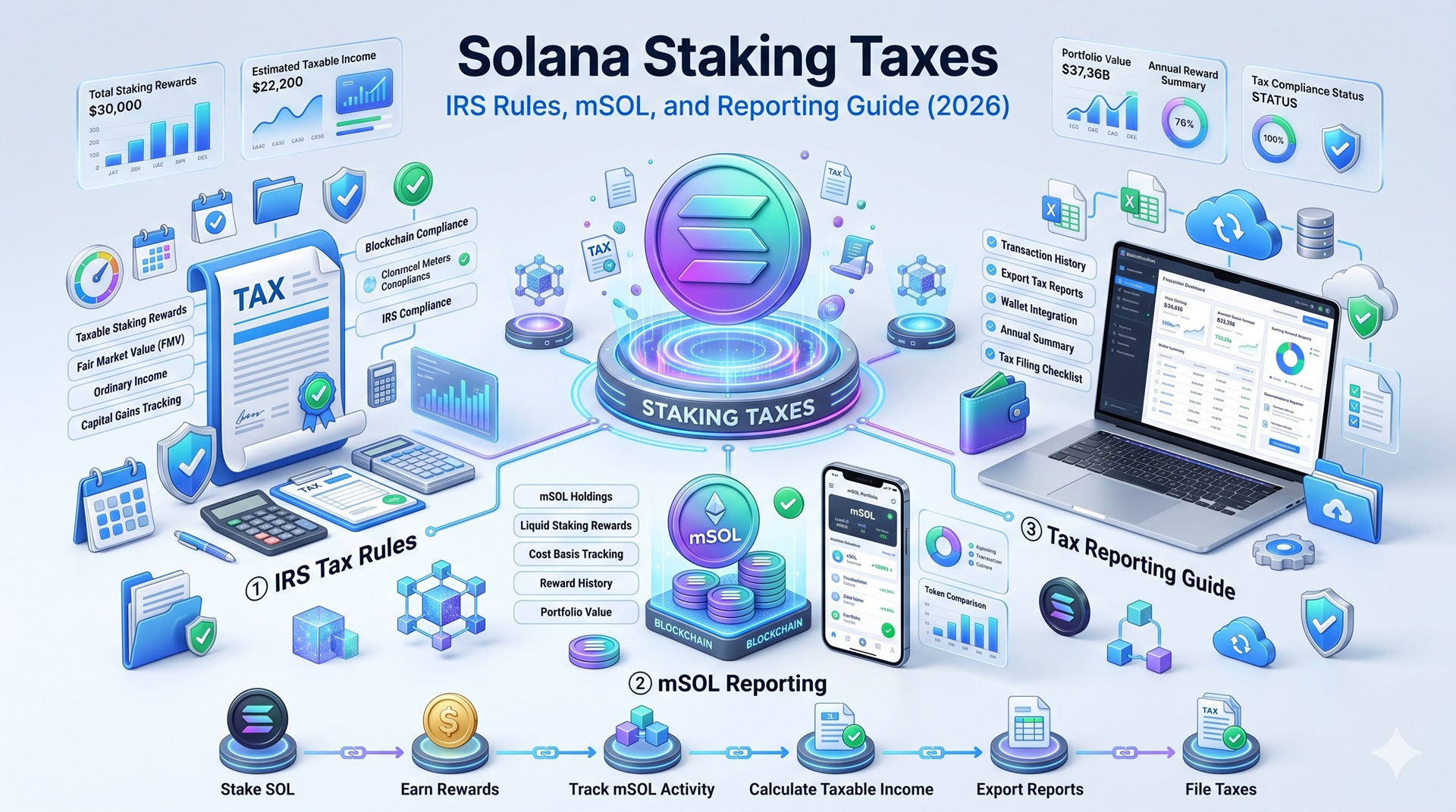
Solana staking rewards are taxed as ordinary income at their fair market value the moment they land in your stake account, then taxed again as capital gains when you sell.
Because Solana pays rewards every epoch, roughly every 2-3 days, a single stake account can generate well over 120 separate taxable income events in a year, which makes Solana one of the hardest assets to report correctly.
This guide covers when SOL staking is taxed, how to report it, the liquid staking gray area around mSOL and JitoSOL, and the airdrop dimension unique to Solana.
What “Solana Staking Taxes” Actually Means
Solana staking taxes consist of two separate layers. The first layer is income tax: when you receive staking rewards, their fair market value counts as ordinary income. The second layer is capital gains tax: when you later sell, trade, or spend that reward SOL, the difference between the sale price and the value already reported as income is a capital gain or loss.
The IRS classifies SOL as property under Notice 2014-21, which is why the same rules that apply to stocks or real estate apply to staking rewards.
Income at Receipt vs Capital Gains on Disposal
Tax Event
When It Triggers
Tax Type
Value Used
Income recognition
When rewards hit your stake account
Ordinary income
FMV at receipt
Capital gain or loss
When you sell, trade, or spend SOL
Capital gains
Sale price minus cost basis
Cost basis set
At the moment of income recognition
N/A
Equals the FMV reported as income
If you receive SOL worth $40 as a staking reward, you report $40 of ordinary income, and $40 becomes the cost basis. Sell it later for $60 and you have a $20 capital gain; sell for $30 and you have a $10 capital loss.
When Are Solana Staking Rewards Taxable?
Solana staking rewards are taxable as ordinary income at the fair market value on the day they are received, under IRS Revenue Ruling 2023-14. Rewards are credited to your stake account every epoch without any on-chain claim transaction, so the income event happens automatically as each reward accrues.
No Minimum Threshold: Whether you earned $20 or $20,000 in staking rewards, you must include it on your tax return as ordinary income, regardless of whether you ever sell.
Why Solana Staking Creates 120+ Taxable Events a Year
Because rewards are paid per epoch, every roughly 2-3 day reward is ordinary income at its value that day, which can mean 120 or more taxable events a year per stake account. Each event needs a fair market value in fiat recorded at the moment it accrued.
Solana’s speed compounds the problem: a single trading session on a DEX like Jupiter can generate dozens of additional swaps, each a separate taxable event.
Why Tax Software Is Effectively Mandatory
These tools sync your Solana wallet address, fetch rewards per epoch, classify DeFi interactions, and export the relevant tax forms automatically. The realistic alternative to software is error.
How to Report Solana Staking on Your Taxes
Most individual stakers report reward income on Form 1040 Schedule 1 as Other Income, entering the total fair market value of all SOL rewards received during the year. Business stakers report on Schedule C instead.
Form
Purpose
Who Files
Schedule 1, Other Income
Report reward FMV as ordinary income
Casual individual stakers
Schedule C
Report rewards as business income, deduct costs
Business stakers
Form 8949
Itemize each disposal of SOL
All who sell, trade, or spend
Schedule D
Summarize total capital gains and losses
All who sell, trade, or spend
Swaps Are Disposals: Trading one token for another is itself a disposal, not a tax-free move. Swapping SOL for a stablecoin, or routing through a DEX into another asset, realizes a capital gain or loss on the SOL given up.
How Are mSOL and JitoSOL Taxed?
Liquid staking is the biggest gray area in Solana taxation because the IRS has not provided definitive guidance. Under the conservative approach, depositing SOL for mSOL is a taxable swap. Under the alternative position, mSOL is merely a receipt for your staked SOL, so no taxable event occurs at deposit.
Worked Comparison
100 SOL bought at $50 each, deposited into Marinade at $150/SOL
Swap interpretation: realizes a $10,000 taxable gain immediately
Receipt interpretation: no gain until you sell or redeem the mSOL
The conservative swap treatment is the safer default
Are Solana Airdrops Taxable?
Solana airdrops are generally treated as income, taxed based on their fair market value at the time of receipt, the same as staking rewards. This value also becomes your cost basis for any future sale.
Solana’s 2024 airdrop wave created taxable income even for people who never sold the tokens, and more are expected. Plan for the tax impact before claiming an airdrop, since the income event triggers at receipt regardless of whether you sell.
How to Reduce Solana Staking Taxes Legally
Legitimate Strategies
Hold reward SOL longer than 12 months for lower long-term capital gains rates where applicable
Harvest losses by selling assets at a loss to offset gains in the same year
Track per-wallet cost basis accurately under Revenue Procedure 2024-28
Keep close records separating reward basis from purchased SOL basis
Consider liquid staking to potentially defer the income event until disposal
What Solana Staking Tax Rules Cannot Guarantee
The income-at-receipt rule under Revenue Ruling 2023-14 is clear for native rewards, but liquid staking sits in a gray area with no definitive guidance. DeFi interactions, composable multi-protocol transactions, and restaking add further classification complexity.
Tax rules also change, and 2026 brought tighter wallet-level reporting and increased IRS scrutiny of staking activity.
Educational Note: This article is educational and not personalized tax advice; consulting a qualified crypto tax professional before filing is strongly advisable.
Frequently Asked Questions
Yes. Solana staking rewards are taxable as ordinary income at their fair market value when received, under IRS Revenue Ruling 2023-14. There is no minimum threshold, so all rewards must be reported, and a later sale of that SOL is a separate capital gains event.
They are taxed at the moment they are credited to your stake account, which happens automatically each epoch, roughly every 2-3 days, without any claim transaction. The fair market value on the day of receipt is the income amount and also becomes your cost basis.
Report reward income on Form 1040 Schedule 1 as Other Income using the FMV at receipt, and report each disposal on Form 8949 and Schedule D. Business stakers use Schedule C. Exchanges may issue 1099-MISC for income and 1099-B for transactions.
Because rewards are paid every epoch, roughly every 2-3 days, a single stake account can generate 120 or more separate income events per year, each needing a fair market value recorded at receipt. This volume is why dedicated tax software is effectively necessary.
The IRS has not issued definitive guidance. Conservatively, depositing SOL for mSOL or JitoSOL is a taxable swap; alternatively, the token is treated as a receipt for staked SOL with no event at deposit. These tokens appreciate over time, which can defer the tax event until you sell.
Yes, Solana airdrops are generally taxed as ordinary income at their fair market value when received, and that value becomes your cost basis for future sales. Solana’s frequent airdrops mean stakers should plan for the tax impact before claiming, since the income triggers at receipt.
No, the same value is not taxed twice. You pay income tax on the reward when received, then capital gains tax only on any appreciation above that value when you sell. The reported income becomes your cost basis, which prevents genuine double taxation.
Hold reward SOL longer than 12 months for lower long-term rates where applicable, harvest losses to offset gains, track per-wallet cost basis accurately, and keep meticulous records. Liquid staking may defer the income event until disposal. Avoiding reporting entirely is not a legal option.