Where to Stake Cardano (ADA) in 2026: Best Venues Compared
Where to Stake Cardano (ADA) in 2026: Best Venues Compared
CrisCoin 9 min readCardano
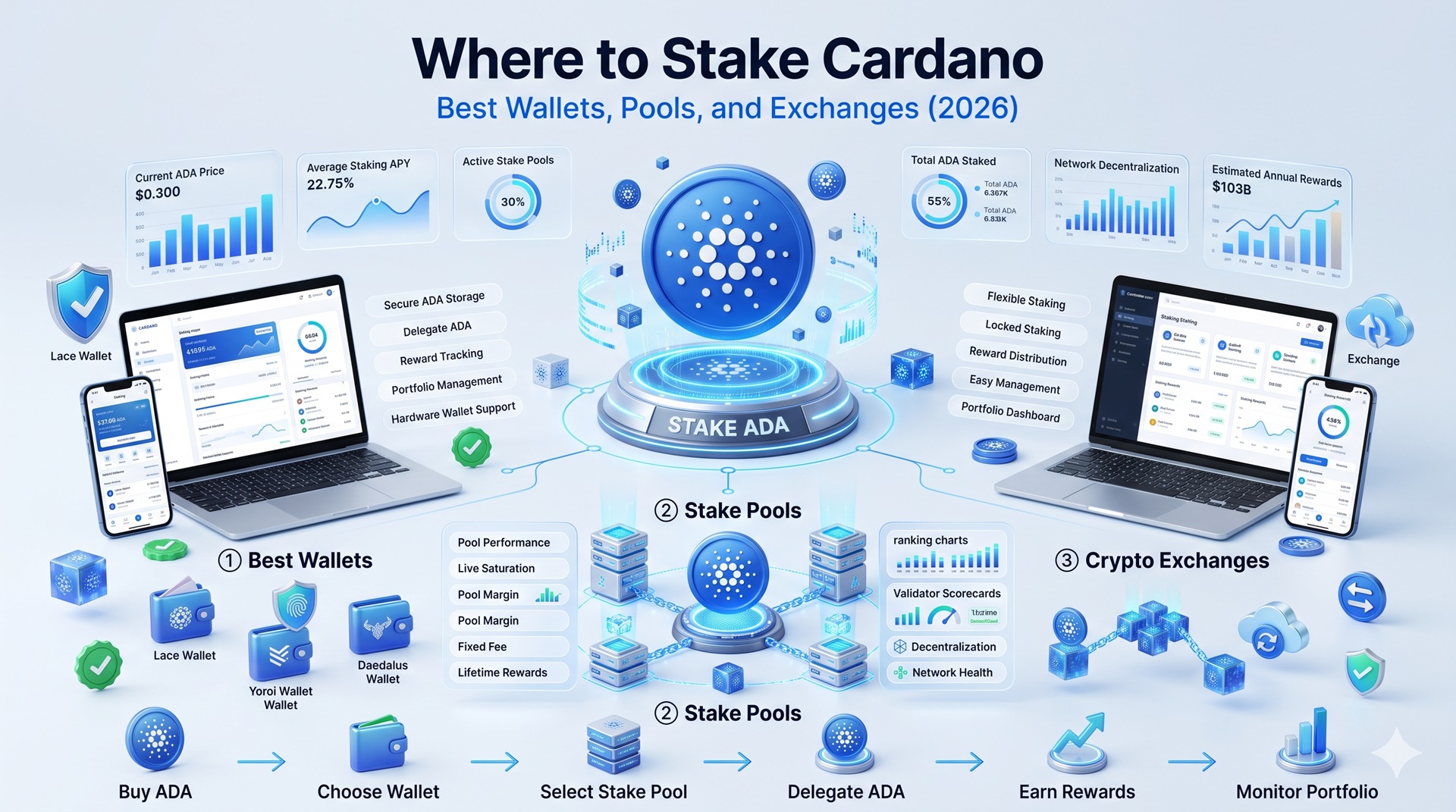
You can stake Cardano through a native wallet, a hardware wallet, or a centralized exchange.
Cardano’s design makes this an unusually low-risk decision: your ADA never leaves your wallet when you stake natively, there is no lockup, and there is no slashing. The harder choice is not where to hold your ADA but which stake pool to delegate to.
This guide compares every place to stake ADA in 2026 and explains how to pick a pool that actually maximizes your yield.
What “Where to Stake Cardano” Actually Means
Staking Cardano means delegating your ADA to a stake pool that produces blocks under Cardano’s Ouroboros proof-of-stake protocol, and in return you earn a share of the rewards that pool generates. Unlike most other staking systems, your ADA never leaves your wallet during native delegation.
The question of where to stake splits into two separate decisions: which venue you use to hold and delegate your ADA, and which of Cardano’s roughly 3,000 stake pools you delegate to. The venue affects custody and convenience; the pool affects your yield.
The Three Ways to Stake ADA
Venue Type
Custody
Reward Range
Best For
Native wallet
Self-custody, ADA stays in wallet
~3-5%
Hands-on holders wanting full control
Hardware wallet + app
Self-custody, cold storage
~3-5%
Security-focused long-term holders
Centralized exchange
Custodial, exchange holds ADA
~1.5-6%
Beginners prioritizing simplicity
Where to Stake Cardano Natively From a Wallet
The main Cardano-native wallets are Lace, Yoroi, and Daedalus, each letting you delegate your full balance to a stake pool while your ADA stays in your address. Exodus is a popular multi-asset alternative that delegates on your behalf, with estimated returns around 4%, though it manages pool selection behind the scenes.
Daedalus is a full-node wallet that downloads the entire Cardano blockchain, offering maximum trustlessness at the cost of disk space and sync time. Yoroi and Lace are light wallets that connect to the network without storing the full chain, making them faster to set up.
Where to Stake Cardano With a Hardware Wallet
A device like Ledger lets you keep your ADA’s private keys offline while still delegating to a stake pool, which minimizes the risk of a hack draining your funds. You pair Ledger with a Cardano-native app to stake, installing the Cardano app through Ledger Live and then delegating to a chosen pool.
Where to Stake Cardano on Exchanges
Binance, Bitget, Bybit, and Kraken all support ADA staking, with the exchange automatically delegating your tokens to a pool. Kraken historically paid rewards almost immediately rather than requiring a warm-up, with payouts arriving twice weekly, while reward rates across exchanges generally range from roughly 1.5% to 6%.
The Tradeoff: With exchange staking, the platform holds your ADA on its balance sheet, so you rely on its solvency and security, and exchanges typically take a commission from your rewards that can meaningfully reduce your net yield.
Venue
Custody
Warm-up
Reward Notes
Lace / Yoroi / Daedalus
Self-custody
~20 days on some wallets
Full pool choice, ~3-5%
Ledger + app
Self-custody, cold
Standard epoch warm-up
Same rewards, top security
Binance / Kraken / Bitget
Custodial
Often immediate
One-click, commission applies
Choosing the Right Pool Matters More Than Choosing the Venue
Because every native venue lets you delegate to any pool, the pool’s characteristics, not the wallet, determine your actual returns. Three pool factors matter most: saturation, fees, and performance.
Factors to Weigh
Saturation level: Favor pools below their saturation cap so rewards are not diluted
Pool fees: Compare the fixed fee and margin percentage, since both cut your net yield
Pledge: A higher operator pledge signals commitment and can improve rewards
Blocks produced: Consistent block production indicates a reliable, well-run pool
Decentralization: Supporting smaller quality pools strengthens the network
Tools like ADApools.org aggregate data from every Cardano pool, letting you compare saturation, fees, pledge, and block history before delegating.
Is Staking Cardano Worth It in 2026?
The current average staking yield on Cardano sits between roughly 3% and 5% annually depending on the pool and network parameters. This is not life-changing yield on its own, but compounded over time and combined with any ADA price appreciation, it adds up meaningfully.
Because ADA never leaves your wallet, there is no lockup, and Cardano’s Ouroboros protocol has no slashing penalties, the downside is limited mainly to choosing a poorly performing pool.
Common Cardano Staking Mistakes
Mistake
Result
Prevention
Delegating to an oversaturated pool
Diluted, reduced rewards
Check saturation on ADApools.org
Choosing on APY headline alone
High fees erode returns
Compare fixed fee and margin
Staking on a high-commission exchange
Large cut of rewards lost
Prefer native staking or low-fee venues
Ignoring pool block performance
Missed rewards from poor uptime
Favor consistent block producers
Feeding already-giant pools
Worsens centralization
Support smaller quality pools
What Cardano Staking Cannot Guarantee
No venue or pool can guarantee a fixed return, and the quoted 3-5% range is an estimate that moves with network conditions. A pool that performs well today can degrade, change its fees, or become oversaturated.
Exchange staking adds counterparty risk, where the platform’s solvency becomes your exposure, and regulatory treatment of exchange staking has shifted over time in some jurisdictions.
Educational Note: This guide is educational and not financial advice.
Frequently Asked Questions
The best place depends on your priority. Native wallets like Lace, Yoroi, or Daedalus suit hands-on holders wanting full custody and pool choice, hardware wallets like Ledger suit security-focused holders, and exchanges like Binance or Kraken suit beginners who accept custodial risk for simplicity.
No. With native staking, your ADA never leaves your wallet; you only delegate it to a stake pool while retaining full custody. You can spend, send, or move your ADA at any time, since there is no lockup and no unstaking process required.
No, Cardano has no lockup period. Your ADA stays liquid and fully under your control while delegated, and you can redelegate or stop staking whenever you want.
Native Cardano staking typically yields around 3% to 5% annually, depending on your pool’s performance, saturation, and fees. Exchanges range more widely, from roughly 1.5% to 6%, but often take a larger commission that reduces your net yield compared to native staking.
Compare saturation, fees, pledge, and block performance. Favor pools below their saturation cap, with low fixed fees and margin, a solid operator pledge, and consistent block production. Tools like ADApools.org let you check all of these before delegating.
Saturation is a pool’s optimal stake capacity. Once a pool exceeds it, rewards per delegator start to decline, so delegating to an oversaturated pool reduces your yield. Choosing a pool below its saturation cap keeps your rewards from being diluted.
Native wallet staking keeps your ADA in self-custody, lets you choose any pool, and usually offers better net yield. Exchange staking is more beginner-friendly but custodial and often higher-fee. For control and lower cost, a native or hardware wallet is generally the better choice.
No, Cardano’s Ouroboros protocol has no slashing penalties, so your staked ADA cannot be confiscated for pool misbehavior. The main risk is delegating to a poorly performing or oversaturated pool, which reduces rewards rather than threatening your principal.