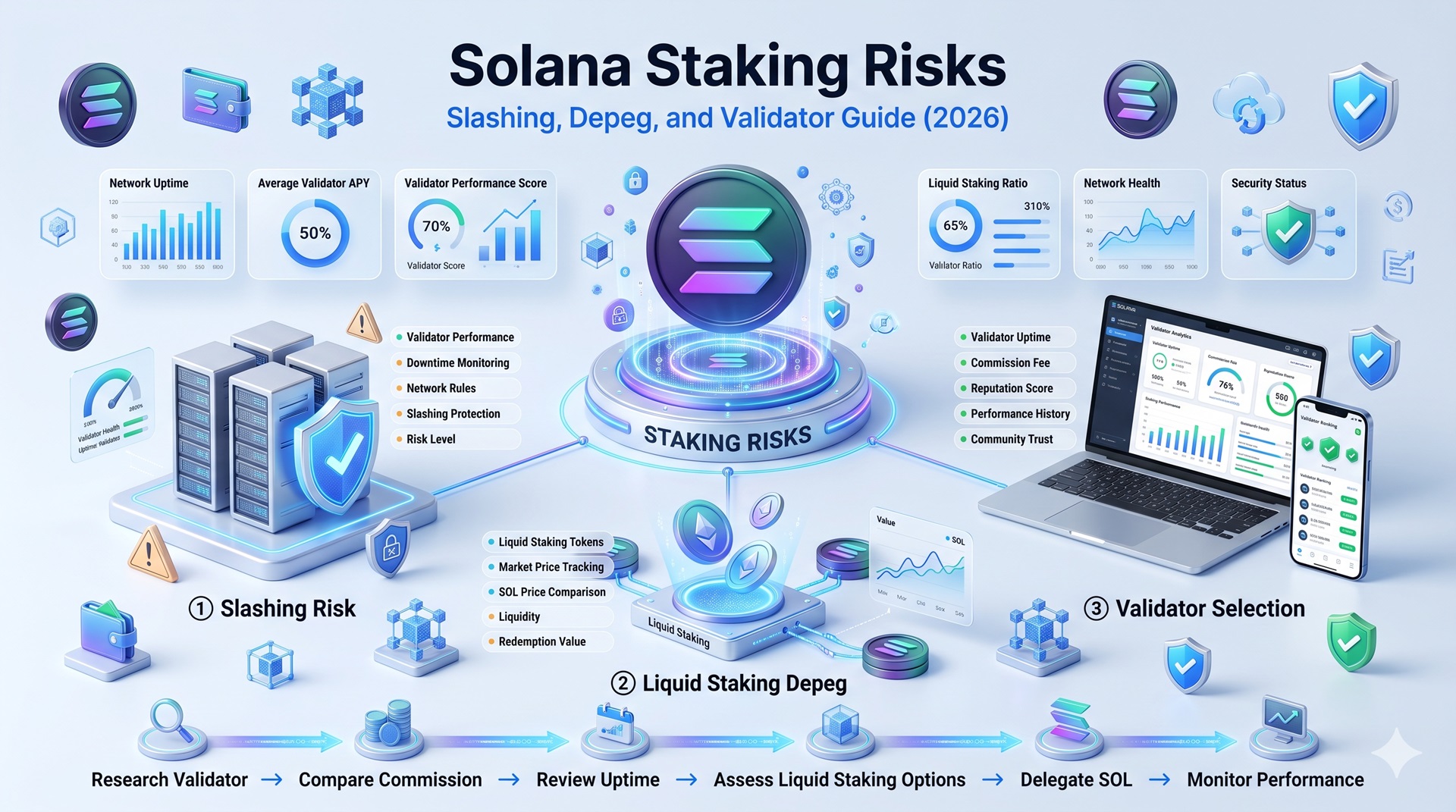
The biggest risks in Solana staking are not what most beginners fear.
With native staking, your principal is generally safe because slashing on Solana has historically been rare, so the real exposures are validator downtime cutting your rewards, the 2-3 day unbonding lockup trapping you during a crash, and SOL’s own price volatility. Liquid staking adds a different layer entirely: smart contract bugs, depeg risk, and protocol centralization.
This guide breaks down every Solana staking risk by category and explains how to reduce each one.
What “Solana Staking Risks” Actually Means
Solana staking risk is the set of ways your delegated SOL can lose value or fail to earn, and it splits cleanly into risks that threaten your rewards and risks that threaten your principal. Understanding which is which prevents both complacency and unnecessary fear.
With native delegation, your SOL never leaves your wallet and your principal is largely protected; the main threats are reduced rewards and temporary illiquidity. With liquid staking and DeFi, you add genuine principal-loss vectors through smart contracts and token depegs.
The distinction matters because the risk conversation around Solana is often muddled. A staker who hears “staking has risks” and pictures losing all their SOL to slashing is misjudging the actual threat model, while one who assumes liquid staking is identical to native is underestimating it.
The Two Categories of Staking Risk
Every Solana staking risk falls into one of two buckets, and sorting them this way clarifies how seriously to treat each.
Native staking is dominated by reward and liquidity risks, with principal largely safe. Liquid staking and restaking introduce principal risks through smart contracts and depegs. Exchange staking adds counterparty risk, where the platform’s solvency becomes your exposure.
Does Solana Have Slashing?
Slashing is the risk stakers ask about most, and the honest answer in 2026 is nuanced rather than a simple yes or no. For most of Solana’s history, slashing has been extremely rare and has never occurred at scale, which is why many guides state that native staking puts your principal effectively out of reach. The realistic loss paths have instead been wallet compromise or signing a malicious transaction that changes your stake authority.
Evolving Rules: Some recent analyses report that Solana’s slashing is now active for double-signing offenses with small but non-zero penalties, while others maintain there is no active automatic slashing and that the capability could be activated by a future governance vote. Either way, choose reliable validators with a long track record.
How Native and Liquid Staking Risks Differ
Native staking exposes you to validator performance and a lockup; liquid staking trades the lockup for a stack of new risks in exchange for flexibility.
Risk
Native Staking
Liquid Staking
Principal slashing
Minimal, validator-tied
Inherited from underlying validators
Smart contract risk
None
Yes, protocol code can fail
Depeg risk
None
Yes, LST can trade below SOL
Unbonding lockup
2-3 day cooldown
Avoidable via instant DEX swap
Composability risk
None
Added if used in DeFi
Liquid staking removes the cooldown, since you can sell the LST on a DEX or swap through a liquidity layer like Sanctum for near-instant exit, but it adds smart contract risk, depeg risk, and composability risk if you deploy the token in DeFi. The flexibility is real, but it is paid for in additional risk surface.
Validator Downtime and Network Outage Risk
The most common real-world risk for native stakers is not losing principal but earning less because of validator or network problems. If your validator has excessive downtime, you earn reduced rewards, since a validator that is offline during an epoch earns nothing and neither do its delegators.
Network-level outages are a separate, broader risk. Solana has experienced multiple significant downtime events since 2021, and during an outage reward accrual is temporarily suspended. Past outages, including notable ones in 2022, were resolved without loss of staked funds; your principal stays safe while rewards simply pause.
Mitigating Validator and Outage Risk
Practical Steps
Check uptime and vote success on a staking dashboard before delegating, and redelegate if performance degrades
Review commission history to avoid validators that quietly raise fees over time
Avoid over-concentrated validators to reduce correlated failure
Keep some SOL unstaked so an outage or cooldown does not leave you fully illiquid
Prefer operators that publish infrastructure details
What Is LST Depeg Risk?
Depeg risk is the defining principal risk of liquid staking, and it became concrete during recent market stress. It is the chance that a liquid staking token trades below the value of the SOL it represents, which happens when liquidity is thin, redemption is slow, or selling pressure spikes.
Not Hypothetical: During the October 2025 crash, several LSTs temporarily lost their pegs as roughly $19.5 billion in liquidations hit the market. Sanctum’s INF pool helped stabilize prices by providing SOL liquidity from its reserve to meet withdrawal demand.
Centralization and Inflation Reform Risk
The Jito client now runs roughly 95% of stake, which means a bug or outage affecting Jito-Solana could affect most of the network at once. This concentration is a structural fragility that diversifying your own validator cannot fully escape.
Governance proposals such as SIMD-0411 could meaningfully cut nominal yields; some analyses suggest staking yields could fall 30% or more over three years if such a proposal passes. This is not a loss of principal but a structural reduction in future rewards.
Common Solana Staking Risk Mistakes
Mistake
Result
Prevention
Assuming staking can lose all principal
Unnecessary fear, missed yield
Understand native principal is largely safe
Treating liquid staking as identical to native
Underestimated risk
Account for contract and depeg risk
Ignoring validator uptime
Reduced rewards
Monitor and redelegate as needed
Staking 100% with no liquidity buffer
Trapped during a crash
Keep some SOL unstaked
Using unaudited LST protocols
Higher exploit risk
Stick to battle-tested protocols
Chasing the highest LST yield blindly
Depeg and thin-liquidity exposure
Weigh liquidity depth, not just APY
What Solana Staking Risk Management Cannot Guarantee
No amount of careful validator selection or protocol vetting can make staking risk-free. Even with a flawless validator, a network outage can pause your rewards, an inflation reform vote can cut your future yield, and SOL’s market price can fall far more than any APY compensates for.
Liquid staking and restaking compound the uncertainty: each additional protocol layer inherits the smart contract risk of every protocol beneath it. The honest position is that staking is generally low-risk to principal when done natively with a reputable validator, moderately riskier through liquid staking, and never entirely without risk.
Educational Note: This guide is educational and not financial advice; assess your own risk tolerance before staking.
Frequently Asked Questions
Native Solana staking is relatively safe for your principal, since your SOL stays in your wallet and slashing has historically been rare. The main risks are reduced rewards from validator downtime, a 2-3 day unbonding lockup, and SOL price volatility. Liquid staking adds smart contract and depeg risk.
You are unlikely to lose principal with native staking under normal conditions, but you can lose value through SOL price decline, reduced rewards from a poor validator, or, with liquid staking, smart contract exploits and LST depegs. The unbonding lockup can also trap funds during a crash.
Slashing on Solana has historically been extremely rare. Reports in 2026 differ on whether automatic slashing is now active for double-signing offenses with small penalties, or whether the capability remains dormant pending governance. Either way, the risk is tied to validator behavior, so choosing reliable validators mitigates it.
Depeg risk is the chance a liquid staking token trades below the value of the SOL it represents, caused by thin liquidity, slow redemption, or heavy selling. During the October 2025 crash, several Solana LSTs temporarily lost their pegs amid large liquidations before recovering.
Yes. Liquid staking adds smart contract risk, depeg risk, and composability risk on top of the baseline native staking risks. The tradeoff is flexibility, since you receive a tradeable, composable token instead of a locked stake account, allowing near-instant exit via a DEX swap.
During a Solana network outage, reward accrual is temporarily suspended but your staked principal stays safe. Past outages, including those in 2022, were resolved without loss of funds. For liquid stakers, an outage may temporarily affect the secondary-market price of LSTs.
If your validator is offline during an epoch, it earns no rewards and neither do you. Persistent downtime or low vote credits materially reduces your returns over time. Monitoring uptime and redelegating to a reliable validator is the main way to protect your yield.
Choose validators with strong uptime and reasonable commission, avoid over-concentrated validators, keep some SOL unstaked for liquidity, and stick to audited, battle-tested protocols if you use liquid staking. Weigh an LST’s liquidity depth, not just its headline APY, to limit depeg exposure.