How Solana Staking Rewards Work (And How to Calculate Yours)
How Solana Staking Rewards Work (And How to Calculate Yours)
CrisCoin 9 min readSolana
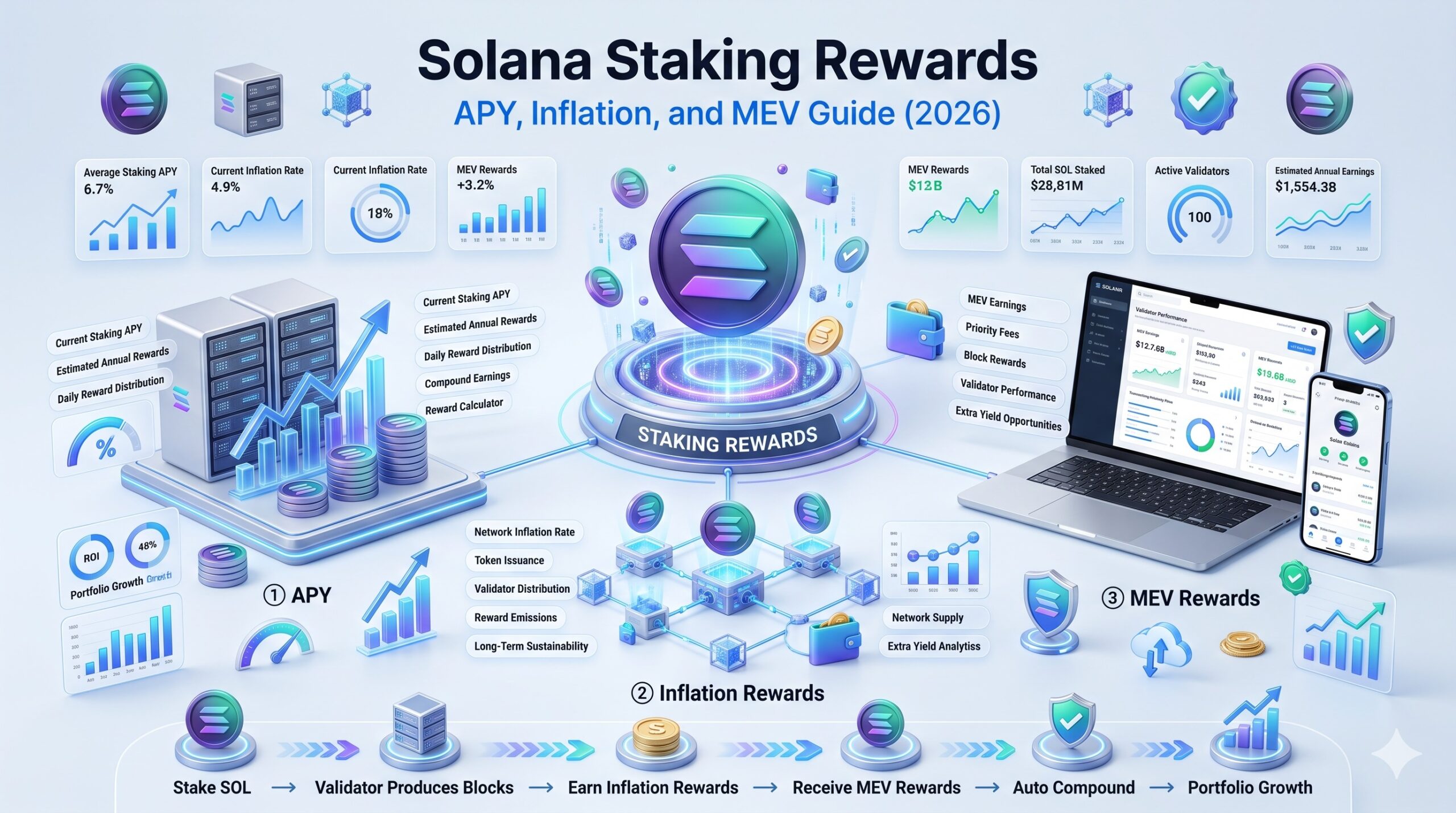
Solana staking rewards come from three sources stacked together: protocol inflation, MEV tips, and a small share of transaction fees.
These blend into an APY that typically lands between 5% and 9% depending on your validator and whether you use liquid staking. Rewards are paid every epoch, roughly every 2-3 days, and compound automatically when you stake natively.
This guide breaks down exactly how the yield is calculated, why the inflation schedule matters, and what realistically determines the number that hits your stake account.
What “Solana Staking Rewards” Actually Means
Solana staking rewards are the share of newly issued SOL and network revenue you earn for delegating your SOL to a validator that secures the network. Your tokens never leave your wallet; you retain full ownership and only assign voting weight.
The rewards are not a fixed interest rate. They are a function of how much SOL the network is issuing through inflation, how much total SOL is staked, your validator’s commission, and that validator’s uptime. Because all of these move over time, the advertised APY is an estimate that changes each epoch rather than a guaranteed yield.
Rewards Are Paid Per Epoch and Compound Automatically
An epoch lasts roughly 2-3 days, and at the end of each one, rewards are calculated based on your validator’s uptime, participation, and commission, then distributed proportionally to your delegated stake. With native staking, those rewards are added directly to your stake account, so they compound automatically into a growing base with no manual claiming and no gas cost.
Auto-Compounding Advantage: Each epoch’s rewards become part of the stake earning the next epoch’s rewards, steadily increasing your effective yield over a year. Some sources note certain native setups require manual re-delegation to compound, but the standard wallet stake account compounds on its own.
The Three Components That Actually Make Up Your Yield
Most stakers think of Solana rewards as a single APY number, but the yield is actually built from three distinct components.
Component
Source
Who Receives It
Inflation rewards
Newly issued SOL from protocol
Validators and delegators
MEV tips
Jito tip distribution from block ordering
Shared with delegators if validator opts in
Priority and base fees
Transaction fees paid by users
Currently the validator only
The first and largest component is inflation, distributed according to relative stake weight and vote credits. The second is MEV, distributed through the Jito tip program depending on your validator’s policy. The third is transaction fees, where half of the base fee is burned and the rest currently flows to the block-producing validator rather than delegators.
How MEV Boosts Your Rewards
MEV is the component that separates a good yield from a great one, and it can add roughly 1.5% on top of base inflation rewards. A validator that shares 100% of MEV tips can push a base inflation APR near 4.16% up to an effective APY around 5.7%, while a validator with no Jito tips delivers only the inflation component.
A subtle detail: a validator’s commission on MEV rewards can differ from its commission on inflation rewards, which is why checking both policies matters when optimizing yield.
How Solana Staking Rewards Are Calculated
Your APY is approximately the network inflation rate divided by the staking ratio, multiplied by one minus your validator’s commission.
Worked Example
Inflation at 4.5%, 70% of SOL staked, 5% validator commission
Base yield: 4.5% / 0.70 ≈ 6.43%
After 5% commission: roughly 6.1% APY
Add MEV tips and the effective APY rises further
Scenario
Inflation APR
Commission
MEV Tips
Effective APY
0% commission, full MEV
4.5%
0%
~1.5%
~6-7%+
Low commission with MEV
4.5%
5%
~1.5%
~5.7%
Mid commission, no MEV
4.5%
7%
None
~4.16%
The staking ratio is the variable stakers most often ignore. Because inflation is a fixed pool divided among all stakers, a higher percentage of staked supply spreads the same rewards thinner, lowering everyone’s individual yield.
Why the Solana Inflation Schedule Matters
Inflation was first activated on mainnet at the start of 2021 at 8%, and it decreases by 15% per year until it settles at a terminal rate of 1.5%. In 2026 the annual inflation rate sits around 4% to 5%, which is why native yields cluster in the 5% to 7% range before MEV.
Downward Trend: The base component of your rewards will keep shrinking as the schedule steps toward 1.5%. MEV and fee revenue become relatively more important to total yield over time.
Native vs Liquid Staking Rewards
Native staking typically yields around 5% to 7% APY and compounds into your stake account, but locks your SOL through the epoch cooldown when you exit. Liquid staking can push yields higher, often 7% to 9%, because tokens like JitoSOL capture additional MEV revenue on top of standard inflation.
With an LST, rewards manifest as the token’s exchange rate against SOL drifting upward rather than your balance growing. The tradeoff is smart contract risk and a protocol layer.
Common Solana Staking Rewards Mistakes
Mistake
Result
Prevention
Treating APY as fixed
Surprise when yield drops
Track the declining inflation schedule
Ignoring MEV sharing
Missing ~1.5% of yield
Choose a Jito MEV-sharing validator
Overlooking commission on MEV
Lower net MEV than expected
Check MEV commission separately
Assuming all natives compound
Rewards sit idle uncompounded
Confirm auto-compounding or re-delegate
Staying unstaked to stay liquid
Dilution against staked holders
Use an LST to stay liquid and earning
Comparing gross not net APY
Misjudged real returns
Compare yield after commission
What Solana Staking Rewards Cannot Guarantee
No staking setup can promise a fixed APY, because every component of the yield fluctuates. Inflation rewards decline on a fixed schedule, MEV tips vary with network activity, and the staking ratio shifts as more or less SOL is staked.
Solana does not currently implement slashing for delegators, so a validator’s poor performance reduces your rewards rather than destroying your principal. However, a delinquent validator can still cut your yield to near zero through downtime.
Educational Note: Treat staking rewards as a way to accumulate more SOL rather than guaranteed income. This guide is educational and not financial advice.
Frequently Asked Questions
Native Solana staking typically yields around 5% to 7% APY, while liquid staking with MEV capture can reach 7% to 9%. Your actual rate depends on the inflation rate, the percentage of SOL staked network-wide, your validator’s commission, and its uptime.
Your APY is approximately the network inflation rate divided by the staking ratio, multiplied by one minus your validator’s commission, plus any MEV tips. For example, 4.5% inflation with 70% staked and 5% commission yields roughly 6.1% before MEV.
Rewards are paid once per epoch, roughly every 2-3 days. At each epoch boundary, rewards are calculated from your validator’s uptime and commission and distributed to your stake account, where they compound automatically with native staking.
With native staking, rewards are added directly to your stake account each epoch and compound automatically with no manual claiming or gas cost. Some setups may require manual re-delegation, and liquid staking compounds through the token’s rising exchange rate.
MEV is value captured from transaction ordering, distributed to delegators through the Jito tip program after each epoch. It can add roughly 1.5% on top of base inflation rewards, but only if your validator runs the Jito client and shares tips with delegators.
Inflation rewards are a fixed pool divided among all stakers, so a higher staking ratio spreads the same rewards thinner and lowers individual yield. This also means staying unstaked dilutes your share, since you earn none of the issuance.
Yes. Solana’s inflation began at 8% in 2021 and decreases 15% per year toward a terminal rate of 1.5%. In 2026 it sits around 4-5%, so the inflation component of rewards will keep shrinking, making MEV and fees relatively more important.
In many jurisdictions staking rewards are taxable as income at their fair market value when received, then as capital gains when sold. Tax treatment varies by country, so check your local rules. This is general information, not tax advice.