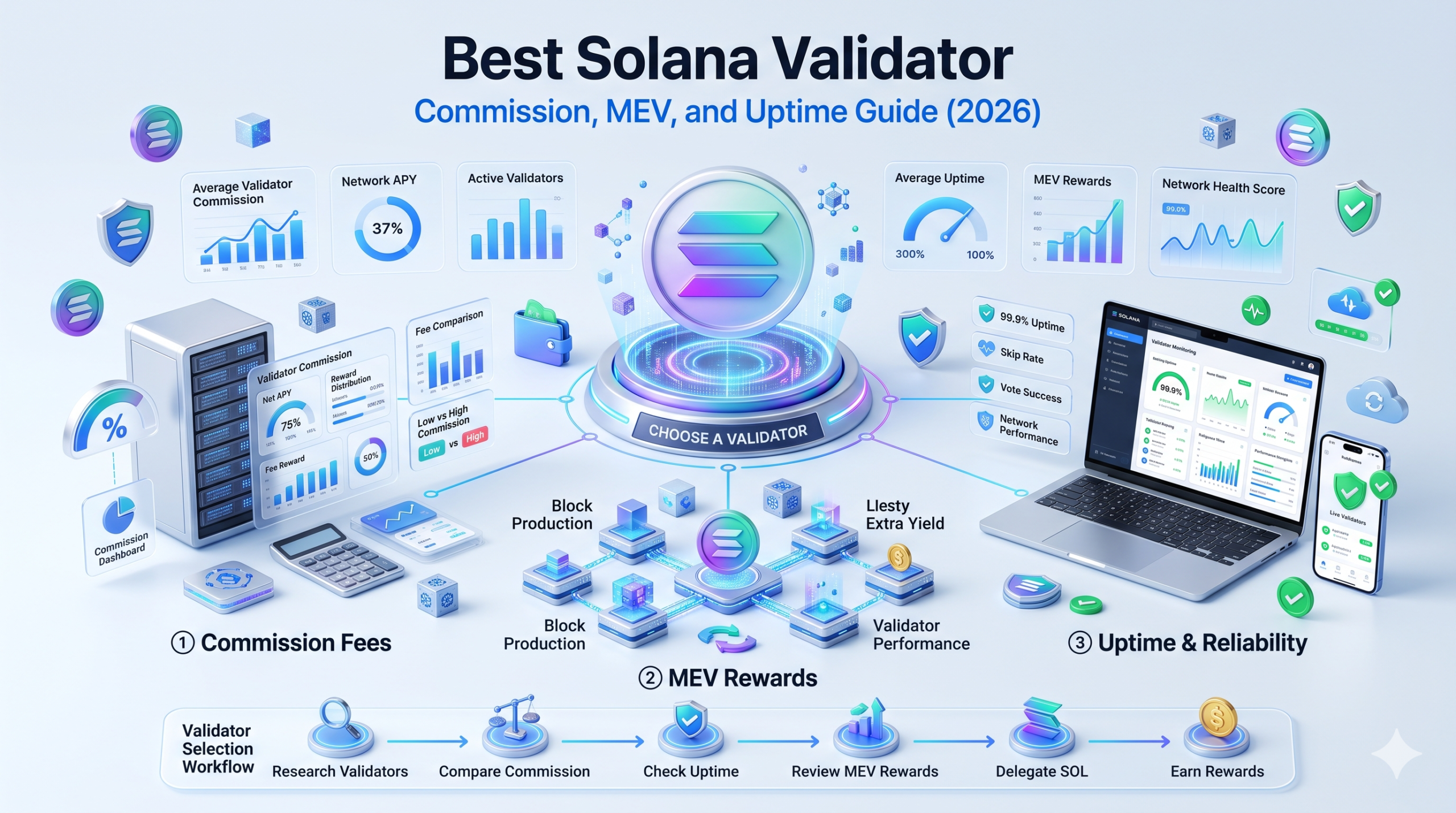
The best Solana validator is not the one with the highest advertised APY.
It is the one with low commission, full MEV reward sharing, near-perfect uptime, and a position that supports network decentralization rather than worsening it. Your choice directly shapes both your long-term yield and the health of the network.
This guide explains the exact metrics that separate a strong validator from a profit-maximizing one, and how to evaluate any validator before you delegate.
What Makes a Solana Validator “Best”
A Solana validator is a server that validates transactions and produces blocks, and when you stake, you delegate your SOL to one of them to share in its rewards. The validator earns inflation issuance, transaction priority fees, and MEV, then passes a portion to you after taking its commission.
The core criteria that define a strong validator are consistent across every serious analysis: delegator commission, MEV reward sharing, technical reliability, transparency, and decentralization contribution.
The Five Metrics That Define a Good Validator
Metric
What It Measures
Why It Matters
Commission
Percentage taken from your rewards
Directly reduces your net yield, permanently
MEV reward sharing
Whether MEV is passed to delegators
Can add roughly 0.5-1% to your yield
Uptime
Validator availability and vote success
Downtime means missed rewards
Transparency
Public history and honest behavior
Reduces hidden skimming risk
Decentralization
Stake concentration and location
Affects network health and resilience
Why Commission and MEV Sharing Matter More Than Headline APY
Commission is the percentage a validator deducts from your base staking rewards, and it is constant; while yield fluctuates with network parameters, the commission structure stays fixed, so over time it has a measurable, compounding impact on total returns.
Validator
Commission
MEV Sharing
Helius
0%
Full
Vladika
0%
100%
Phantom
4%
96%
Solflare
6%
Retains MEV
Everstake
7%
Retains MEV
Figment / Ledger
7%
Partial
A validator charging 0% commission with full MEV sharing returns the maximum reward share your stake generates. By contrast, a commercial validator that charges 6-7% and retains MEV can quietly cut your effective yield well below the network base, even if its uptime is excellent.
Compounding Effect: On a base yield of 6%, a 0%-commission full-MEV validator delivers close to the full 6% plus any MEV premium, while a 7%-commission validator that keeps its MEV delivers roughly 5.6% before withheld MEV. Over multiple years, that gap widens into a materially different SOL balance.
How to Evaluate a Solana Validator’s Uptime
Uptime is the performance metric that turns a good commission policy into actual rewards, because a validator that is offline earns nothing for you regardless of its fee. You want a validator with near-100% uptime and a proven track record of producing blocks and voting reliably.
You can verify uptime and vote performance yourself using public analytics. Tools like Solana Compass, Solana Explorer, and StakeView surface each validator’s vote success rate, block production, total active stake, and commission.
Reading Validator Analytics Dashboards
Some platforms label validators as “Honest,” a designation indicating the absence of suspicious or extractive mechanisms and confirming transparent reward distribution. When reading a dashboard, focus on three figures together: the commission percentage, the recent vote success rate, and the validator’s total active stake.
How Validator Choice Affects Solana Decentralization
Your validator choice is not only a personal yield decision; it is a vote on Solana’s decentralization, and concentrating stake among large validators is bad for the network. Spreading stake across smaller, high-performance validators strengthens Solana’s resilience.
Location diversification matters too. Validators distributed across different geographic regions and data centers reduce the risk that a single regional outage disrupts a large share of the network.
Validator vs Stake Pool vs Liquid Staking
Direct delegation to one validator gives you full control and the cleanest economics, but concentrates your performance risk on that one operator’s uptime. A stake pool or a liquid staking token like JitoSOL or mSOL spreads your stake across many validators automatically, trading some control for diversification.
Middle Path
Split SOL across two or three carefully chosen validators instead of one
Captures most of the clean economics of direct delegation
Reduces single-operator risk without adding a smart contract layer
Requires a separate stake account per validator
Common Solana Validator Selection Mistakes
Mistake
Result
Prevention
Choosing on APY alone
High commission erodes returns
Compare commission and MEV sharing
Picking the largest validator
Worsens centralization
Favor smaller high-uptime validators
Ignoring MEV reward sharing
Missing 0.5-1% extra yield
Prefer full MEV sharing validators
Skipping uptime verification
Missed rewards from downtime
Check vote success on dashboards
Trusting reputation over data
Outdated performance assumptions
Verify current metrics before staking
Overlooking location diversity
Correlated outage risk
Favor geographically diverse validators
What the Best Solana Validator Cannot Guarantee
No validator can guarantee a fixed return, and even a 0% commission, full-MEV-sharing operator delivers yields that move with network conditions. A validator’s published APY is a snapshot at the time of writing, not a contract, and it will drift as the inflation schedule steps down over time.
Performance can also change. A validator with excellent historical uptime can degrade, change its commission, or alter its MEV policy, so choosing a validator is a relationship to monitor, not a one-time decision.
Educational Note: Treat validator selection as a way to optimize a modest base yield rather than a path to outsized returns. This guide is educational and not financial advice.
Frequently Asked Questions
The best validator combines 0% or low commission, full MEV reward sharing, near-100% uptime, and a position that supports decentralization. Validators like Helius and Vladika illustrate the delegator-focused model with 0% commission and full MEV sharing, but you should verify current metrics before delegating.
Evaluate five factors together: commission rate, MEV reward sharing, uptime and vote success, transparency, and decentralization contribution. Check these on dashboards like Solana Compass or StakeView, and favor a low-commission, full-MEV-sharing validator with strong uptime that is not already oversized.
Solana validator commissions typically range from 0% to 10%. Some delegator-focused validators charge 0%, while commercial validators often charge 4% to 7%. Because commission is constant while yield fluctuates, it has a compounding impact on your long-term returns.
MEV reward sharing is whether a validator passes Maximum Extractable Value, captured from transaction ordering, to its delegators. Some validators share 100% of MEV, some share partially, and some retain it. Full MEV sharing can add roughly 0.5% to 1% to your yield.
Yes, significantly. The validator’s commission directly reduces your net yield, its MEV policy determines whether you receive extra rewards, and its uptime determines whether your stake earns at all. A poorly chosen validator can cut your effective yield well below the network base.
Delegating to already-large validators concentrates stake and makes the network more fragile, while spreading stake to smaller high-performance validators strengthens resilience. Geographic diversification also matters, since distributed validators reduce the risk of correlated regional outages.
Direct delegation to one validator gives the cleanest economics but concentrates risk on that operator’s uptime. A stake pool or liquid staking token spreads your stake across many validators for diversification, at the cost of smart contract risk. The choice depends on whether you value control or convenience.
Use public analytics tools like Solana Compass, Solana Explorer, or StakeView to view a validator’s vote success rate, block production, total active stake, and commission. Checking these figures before delegating prevents choosing a validator with hidden downtime or unfavorable economics.