Cosmos Staking Risks: Slashing, Unbonding & How to Manage Them | CryptoLurk
Cosmos Staking Risks: Slashing, Unbonding & How to Manage Them
CrisCoin 12 min readCosmos
Cosmos staking carries genuine risks that lower-yield, no-lockup chains do not, and its high APR is compensation for accepting them.
The two that matter most are slashing, which permanently destroys a percentage of your staked ATOM if your validator misbehaves, and the 21-day unbonding period that freezes your capital when you exit. Worse, your ATOM remains slashable even while it is unbonding.
This guide breaks down every Cosmos staking risk, explains the worst-case trap most stakers miss, and shows how to manage each one.
What “Cosmos Staking Risks” Actually Means
Cosmos staking risk is unusual among major proof-of-stake networks because it includes both a real principal-loss mechanism and a hard liquidity lock. Unlike Cardano, where staking cannot reduce your principal and there is no lockup, Cosmos has slashing that can permanently destroy part of your stake and a mandatory 21-day unbonding period during which your ATOM is frozen. These two features are the price of Cosmos’s high yield, and understanding them is essential before delegating.
The risks split into a few clear categories: principal risks like slashing, liquidity risks like the 21-day unbonding, reward risks like validator downtime, and external risks like market price and custodial exposure. Sorting them this way matters because they call for different responses.
The Risk Categories at a Glance
Every Cosmos staking risk falls into one of these buckets, and sorting them clarifies how seriously to treat each and how to respond.
Risk Type
Examples
How to Manage
Principal risks
Slashing, cross-chain slashing
Choose reliable validators, diversify
Liquidity risks
21-day unbonding lock
Keep a liquid reserve, use liquid staking
Reward risks
Validator downtime, jailing
Pick high-uptime validators
External risks
Market price, custodial, regulatory
Self-custody, accept price volatility
Principal risks threaten the ATOM itself, liquidity risks threaten your access to it, reward risks reduce what you earn, and external risks sit outside staking mechanics but still affect your outcome. Cosmos is one of the few networks where all four are meaningfully present.
How Cosmos Slashing Destroys Principal
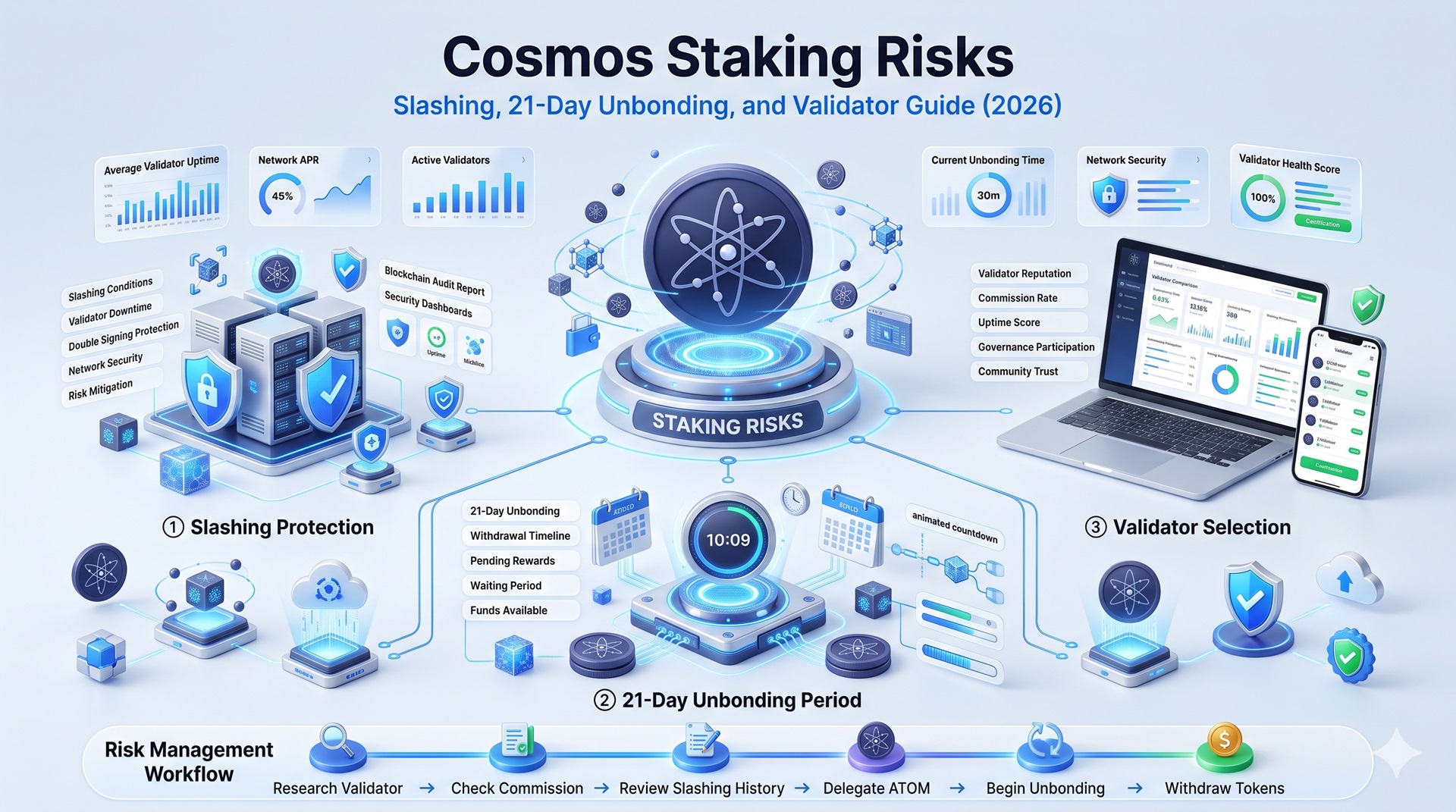
Slashing is the defining principal risk of Cosmos staking, and unlike reduced rewards, it permanently destroys tokens. When you stake, you trust a validator to behave correctly, and if it double-signs a block, goes offline at critical times, or otherwise misbehaves in protocol-defined ways, the network slashes the stake, permanently destroying a percentage of the tokens bonded by that validator and all of its delegators. The penalty is not redistributed; it is burned, and you lose your share alongside the operator.
The Two Slashing Conditions
Downtime — a validator fails to sign enough blocks, triggering a small ~0.01% penalty plus jailing (temporary removal)
Double signing — a validator signs conflicting blocks, triggering a 5% slash plus permanent tombstoning (banned forever)
A real example saw a validator’s double-sign event cause a 5% loss for all its delegators, with its stake collapsing from 2 million ATOM to 500,000 as delegators fled. This is why checking a validator’s slashing history is the single most important safeguard.
Which One to Fear: A 0.01% downtime slash is almost negligible in dollar terms. A 5% double-sign slash on a large position is a serious, permanent loss that no recovery can reverse. A single past double-sign event should remove a validator from your shortlist completely.
Why You’re Still Slashable During the 21-Day Unbonding
The trap most Cosmos stakers never see coming is that beginning to unstake does not remove your slashing exposure: your ATOM remains at risk of slashing even during the 21-day unbonding period. This means you can be in the worst possible position, with your capital frozen, earning no rewards, unable to sell, and still exposed to losing a percentage of it to a slashing event, all at the same time. The unbonding period protects the network, not you.
This combination is what makes Cosmos’s risk profile genuinely distinct. On most networks, exiting a stake at least ends your exposure to validator penalties. On Cosmos, if the validator you were delegated to double-signs during your 21-day unbonding window, you can still be slashed even though you are in the process of leaving.
The practical implication is that validator quality matters right up until your unbonding completes, so you cannot treat the decision to unstake as the moment your risk ends. The only way to fully escape both the lock and the lingering slashing exposure is to avoid native unbonding altogether by using liquid staking, which swaps the position rather than unbonding it.
The 21-Day Unbonding and Liquidity Risk
The 21-day unbonding period is Cosmos’s defining liquidity risk, and it has real consequences in volatile markets. During that three-week window, your capital is frozen: it earns no rewards and cannot be transferred or sold, so if the token price drops sharply you cannot exit and must watch the decline from the sidelines with no ability to cut losses. This dynamic played out repeatedly across the 2022 to 2023 bear market, as ATOM holders waited out unbonding windows while prices fell.
Planning Rule: A common rule is to never delegate ATOM you might need within about 25 days, the 21-day unbonding plus a buffer, and to keep a liquid ATOM reserve for unexpected needs.
Validator, Centralization, and Cross-Chain Risks
Beyond slashing and unbonding, several validator-level and structural risks deserve attention. Validator downtime is a reward risk: if your validator is jailed for missing blocks, no rewards are paid to its delegators during the jailing period, so an unreliable validator quietly erodes your yield even without a slashing event.
Validator centralization is a network risk, since top validators controlling a large portion of stake can lead to governance capture, which is why diversifying across several validators strengthens both your position and the network.
Interchain Security adds a newer dimension. Because validators can now validate consumer chains for extra rewards, a validator overextended across many chains creates new slashing risk, and as cross-chain slashing rolls out in 2026, a validator’s misbehavior on a consumer chain can propagate to your bonded ATOM on the Hub.
Liquid staking, meanwhile, substitutes smart contract risk and depeg risk for the unbonding lock: liquid staking protocols can be hacked, so using only audited platforms like Stride matters, and a liquid token can trade below the value of the ATOM it represents during stress.
A governance-related risk also deserves a mention. Validators vote on protocol proposals on behalf of their delegators unless you override them, so a validator’s governance choices indirectly represent your stake. A validator that votes against your interests, or that is passive and never participates, weakens both the network and your voice in it.
Common Cosmos Staking Risk Mistakes
The errors below leave stakers exposed to slashing, locked out of liquidity, or earning less than they expect, each with a clear fix.
Mistake
Result
Prevention
Ignoring slashing history
Principal loss from a bad validator
Verify a clean record on Mintscan
Staking ATOM you may need soon
Funds frozen for 21+ days
Keep a liquid reserve, plan 25 days ahead
Assuming unbonding ends slashing risk
Still slashable while exiting
Choose reliable validators until exit completes
Concentrating in one validator
Full exposure to one slashing event
Diversify across 3-5 validators
Using unaudited liquid staking
Smart contract and depeg risk
Stick to audited protocols like Stride
Overlooking ATOM price volatility
Dollar value falls despite yield
Treat staking as ATOM accumulation
What Cosmos Staking Risk Management Cannot Guarantee
No amount of careful validator selection makes Cosmos staking risk-free, and treating any setup as safe is itself a risk. Even a validator with a flawless history can suffer a future outage or double-sign event, and slashing permanently burns a percentage of your principal when it happens. The 21-day unbonding cannot be shortened, slashing exposure persists through it, and Interchain Security adds a cross-chain slashing surface that careful Hub-only analysis can miss.
Not Financial Advice: The dollar value of your ATOM depends far more on its market price than on the staking yield, and much of the high APR is nominal, offsetting inflation rather than representing pure gain. This guide is educational and not financial advice; assess your own risk tolerance before staking.
Frequently Asked Questions
Cosmos staking carries real risks that some chains do not, including slashing that can permanently destroy part of your stake and a 21-day unbonding lock. It is reasonably safe with careful validator selection and liquidity planning, but it is riskier than no-slashing, no-lockup networks like Cardano.
Yes, through slashing. If your validator double-signs or suffers serious downtime, a percentage of your staked ATOM is permanently destroyed, and that loss is shared by all the validator’s delegators. You can also lose value to ATOM’s price falling, especially while locked in the 21-day unbonding.
Slashing is a protocol penalty that permanently destroys a percentage of staked tokens when a validator misbehaves. Downtime causes a small slash of about 0.01% plus jailing, while double signing causes a 5% slash plus permanent tombstoning. Delegators lose their share alongside the validator.
Yes. Your ATOM remains slashable during the entire 21-day unbonding period, so if your validator double-signs while you are exiting, you can still lose a percentage of your stake. The unbonding period protects the network, not you, which is why validator quality matters until the exit completes.
The unbonding period freezes your capital for three weeks, during which it earns nothing, cannot be sold, and remains slashable. If the market drops sharply, you cannot exit to cut losses. Plan by keeping a liquid reserve, not staking ATOM you may need within 25 days, or using liquid staking.
Choose validators with a clean slashing history and high uptime, diversify across three to five validators, keep a liquid ATOM reserve, and avoid staking funds you may need within 25 days. For liquidity, use audited liquid staking like Stride, and use a hardware wallet for self-custody.
No, it changes them. Liquid staking avoids the 21-day unbonding lock by giving you a tradeable token, but it adds smart contract risk, since protocols can be hacked, and depeg risk, since the token can trade below ATOM’s value. Use only audited platforms, and understand you still hold underlying slashing exposure.
Interchain Security lets validators secure consumer chains for extra rewards, but it expands the slashing surface. A validator overextended across many chains is riskier, and as cross-chain slashing rolls out in 2026, a validator’s misbehavior on a consumer chain can propagate to your bonded ATOM on the Hub.
Bottom Line: Cosmos’s high APR comes with real principal risk. Diversify across reliable validators, plan liquidity around the 21-day unbonding, and never assume unstaking ends your slashing exposure.