Cosmos Staking Rewards: How Much You Can Earn (APR Explained) | CryptoLurk
Cosmos Staking Rewards: How Much You Can Earn (APR Explained)
CrisCoin 11 min readCosmos
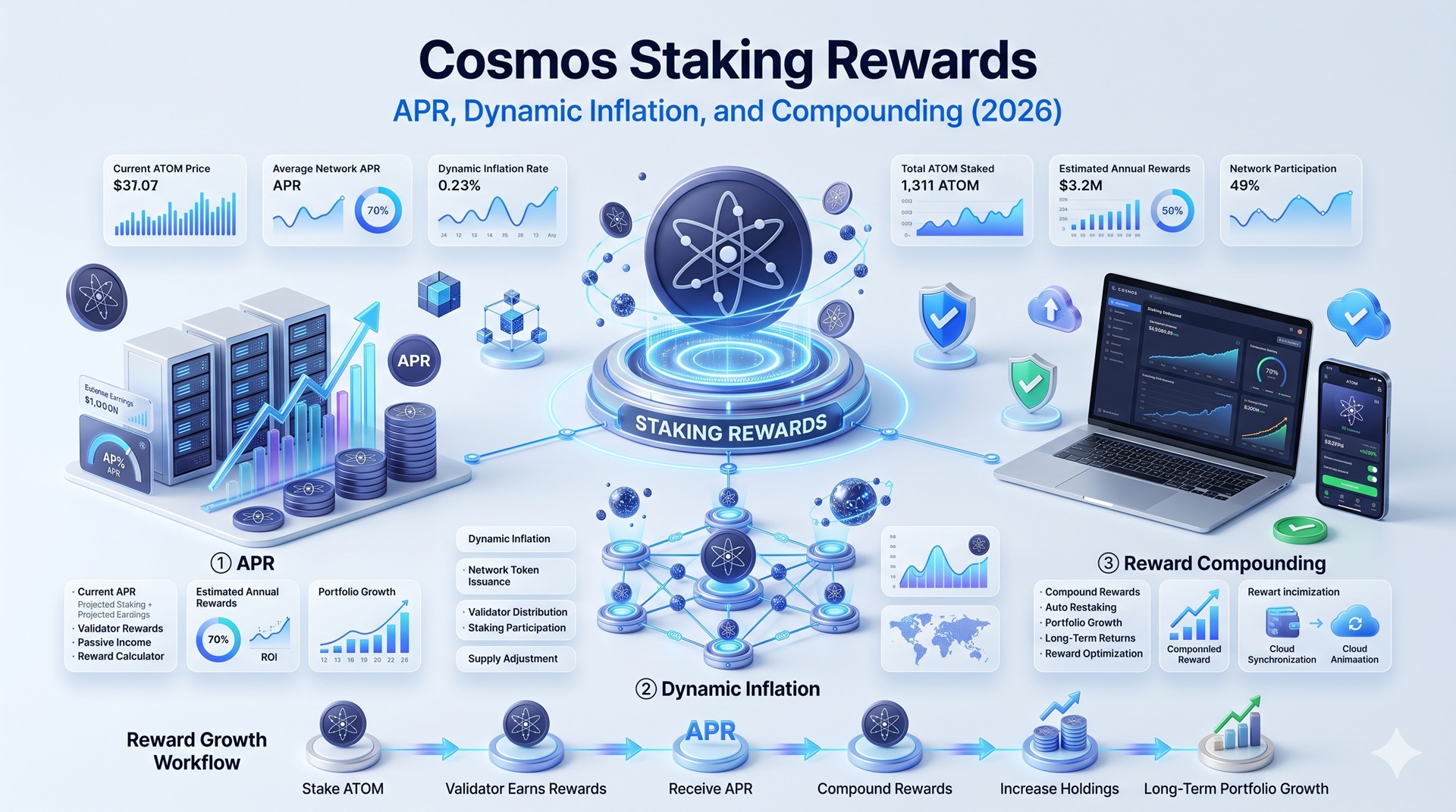
Cosmos staking pays one of the highest yields in major proof-of-stake, a gross APR usually between roughly 8% and 20% that becomes about 9% to 12% net after validator commission and the 2% community tax.
The reason the rate is so high and keeps moving is Cosmos’s dynamic inflation, which automatically adjusts between 7% and 20% to push the network toward a 67% bonded ratio. Rewards accrue every block but do not compound on their own.
This guide explains exactly where the rewards come from, why the rate moves, and how compounding with REStake lifts your real return.
What “Cosmos Staking Rewards” Actually Means
Cosmos staking rewards are the ATOM you earn for delegating your stake to a validator that secures the Cosmos Hub, paid continuously from network inflation, transaction fees, and increasingly Interchain Security revenue. When you delegate, you assign your ATOM’s staking power to one or more validators without transferring your tokens, and you earn rewards proportional to your stake roughly every 6 to 7 seconds, paid in ATOM. The validator takes a commission, and a small network-wide tax is removed, with the rest distributed to delegators.
The rewards are not a fixed interest rate. They are the output of a dynamic system that adjusts issuance based on how much of the total ATOM supply is staked. Because of this, the advertised APR is a moving figure that changes as the bonded ratio, inflation parameters, and fee revenue shift.
Where Cosmos Rewards Come From
Cosmos rewards draw from three sources stacked together, and knowing them explains both the high yield and its variability.
Reward Source
What It Is
Trend
Network inflation
New ATOM issued each block
Dynamic, 7-20% by bonded ratio
Transaction fees
Gas fees from network activity
Grows with usage
Interchain Security
Fees from consumer chains
Growing as more chains join
Inflation is the primary driver of Cosmos’s high yield, since ATOM has no hard-capped supply and instead issues new tokens to reward stakers. Transaction fees add a smaller, usage-dependent layer. Interchain Security is the newest source, where consumer chains that rent the Hub’s security pay fees that supplement inflation rewards, a component that has been growing through 2026.
Why Cosmos’s Reward Rate Moves — The Bonded Ratio Explained
The single most important thing to understand about Cosmos rewards is that the inflation rate is dynamic, designed to steer the network toward having two-thirds of all ATOM staked. ATOM does not have a fixed inflation rate; instead, issuance moves between a 7% floor and a 20% ceiling based on the bonded ratio, the share of total supply that is currently staked. The protocol uses this band as a thermostat to target roughly 67% of supply being bonded.
The mechanism works in two directions. When less than two-thirds of all ATOM is staked, the inflation rate gradually rises toward its 20% maximum, increasing rewards to attract more stakers. When more than two-thirds is staked, inflation gradually falls toward its 7% minimum, since the network no longer needs to incentivize additional bonding.
The Counterintuitive “Fewer Stakers, Higher Reward” Effect
A consequence of this design surprises many stakers: rewards are calculated from the total supply but distributed only to those who actually stake, so the fewer people stake, the higher the effective rate for those who do. If the bonded ratio falls, not only does inflation rise toward 20%, but that larger pool of new ATOM is also split among fewer stakers, compounding the effect.
Why Staying Unstaked Is Costly: Because rewards come largely from inflation, an unstaked holder is diluted every block by the new ATOM going to stakers, while staked holders at least keep pace with issuance. A large part of the high APR is nominal, compensating for inflation rather than representing pure profit.
How Cosmos Staking Rewards Are Calculated
Your actual reward rate is the network’s gross rate adjusted by several factors, the most important being validator commission and the community tax. Before rewards reach you, a community tax of 2% is removed at each block and sent to the community pool, and your validator deducts its commission, typically in the 3% to 10% range. The result is that a gross APR of, say, 12% to 16% commonly nets out to roughly 9% to 12% in your wallet.
Several other variables shape your realized yield. Validator uptime matters directly: if your validator is jailed for downtime, no rewards are paid to its delegators during the jailing period.
A Worked Example
Network’s gross rate: 15%
2% community tax removed first at the protocol level
Validator charging an 8% commission takes its cut of what remains
After both deductions, your in-wallet rate lands meaningfully below 15%
This is exactly why two stakers on the same network can report different yields: one chose a 5% commission validator and the other a 10% one. Always read a quoted APR as a gross, pre-deduction figure unless the source explicitly states it is net.
How Compounding Lifts Your Cosmos Returns
Cosmos rewards do not compound automatically, which means an inattentive staker earns the simple rate while an active one earns meaningfully more. Rewards accrue every block but sit as claimable rewards rather than being added to your stake, so to compound you must claim them and re-delegate, which requires two transactions and their fees.
REStake solved this by automating compounding through Cosmos’s Authz module, periodically claiming and re-delegating your rewards on your behalf without taking custody of your keys.
Real Uplift: Staking ATOM at around 16% APR can rise by roughly 1.4% in effective APY by enabling REStake-style auto-compounding, because your accrued rewards are regularly added back to your principal to earn further rewards.
If you prefer to compound manually, the key is choosing the right interval, because each claim-and-redelegate cycle costs two transaction fees. Compounding too often wastes ATOM on fees relative to the small reward batches you are reinvesting; compounding too rarely leaves rewards sitting idle and uncompounded.
Common Cosmos Staking Rewards Mistakes
The errors below cause stakers to earn less than they could or to misread their real yield, each with a simple fix.
Mistake
Result
Prevention
Treating APR as fixed
Surprise as the rate moves
Track the bonded ratio and inflation
Not compounding rewards
Lower effective APY
Use REStake or claim and re-delegate
Ignoring the 2% community tax
Overestimated net yield
Subtract tax and commission from gross
Staying unstaked to stay liquid
Diluted by inflation
Stake or use a liquid staking token
Delegating to a jailed validator
Gaps in reward accrual
Choose high-uptime validators
Confusing gross with net APR
Misjudged real returns
Compare yield after all deductions
What Cosmos Staking Rewards Cannot Guarantee
No staking setup can promise a fixed APR, because every component of the Cosmos yield moves. Inflation adjusts with the bonded ratio between 7% and 20%, fee revenue depends on network usage, and Interchain Security income varies with consumer-chain activity. A 15% figure today reflects current conditions and will shift as the bonded ratio drifts and governance adjusts parameters, so any quoted rate is a snapshot, not a contract.
Not Financial Advice: Slashing can reduce your principal, a jailed validator pauses your earnings, and the 21-day unbonding means you cannot instantly exit to capture or protect a yield. Treat staking as a way to accumulate more ATOM and protect your share, not as guaranteed income. This guide is educational and not financial advice.
Frequently Asked Questions
Cosmos staking pays a gross APR usually between roughly 8% and 20%, netting about 9% to 12% after validator commission and the 2% community tax. With auto-compounding via REStake, effective APY can be a little higher. Your exact rate depends on the bonded ratio, inflation, and your validator.
Rewards come from network inflation, transaction fees, and Interchain Security revenue. The gross rate is set by dynamic inflation and the bonded ratio, then a 2% community tax and your validator’s commission are deducted. Uptime, block time, and your compounding behavior also affect the final yield.
Because ATOM inflation is dynamic, moving between 7% and 20% to target a 67% bonded ratio. When less than two-thirds of supply is staked, inflation rises to attract stakers; when more is staked, it falls. As the bonded ratio drifts, your APR moves with it continuously.
No. Rewards accrue every block but sit as claimable rewards, so to compound you must claim and re-delegate them, or use REStake to auto-compound via the Authz module. Auto-compounding can lift effective APY by roughly 1.4 percentage points on a high base rate.
The community tax is a 2% cut of inflation rewards and fees removed at each block and sent to the Cosmos Hub community pool, which funds ecosystem development. It is deducted before rewards reach delegators, so your net yield is the gross rate minus this tax and your validator’s commission.
Rewards are calculated from the total supply but distributed only to those staking, so a smaller pool of stakers shares the issuance, raising each one’s effective rate. A lower bonded ratio also pushes inflation up toward 20%, compounding the effect for those who remain staked.
Partly. Much of the high APR is nominal, compensating for ATOM’s inflation rather than being pure profit, since unstaked holders are diluted by new issuance. Staking primarily protects your proportional share of the network, and the real return is the margin above the inflation you would otherwise lose.
Interchain Security lets consumer chains rent the Hub’s security and pay fees that supplement your inflation rewards, so your staked ATOM can earn from multiple chains. This adds a growing extra reward layer, though it also expands the slashing surface if your validator misbehaves on a consumer chain.
Bottom Line: Cosmos’s headline APR is dynamic, not fixed. Track the bonded ratio, pick a low-commission reliable validator, and enable auto-compounding to capture the highest realistic net yield.