How to Choose the Best Cosmos Validator (2026 Guide) | CryptoLurk
How to Choose the Best Cosmos Validator (2026 Guide)
CrisCoin 12 min readCosmos
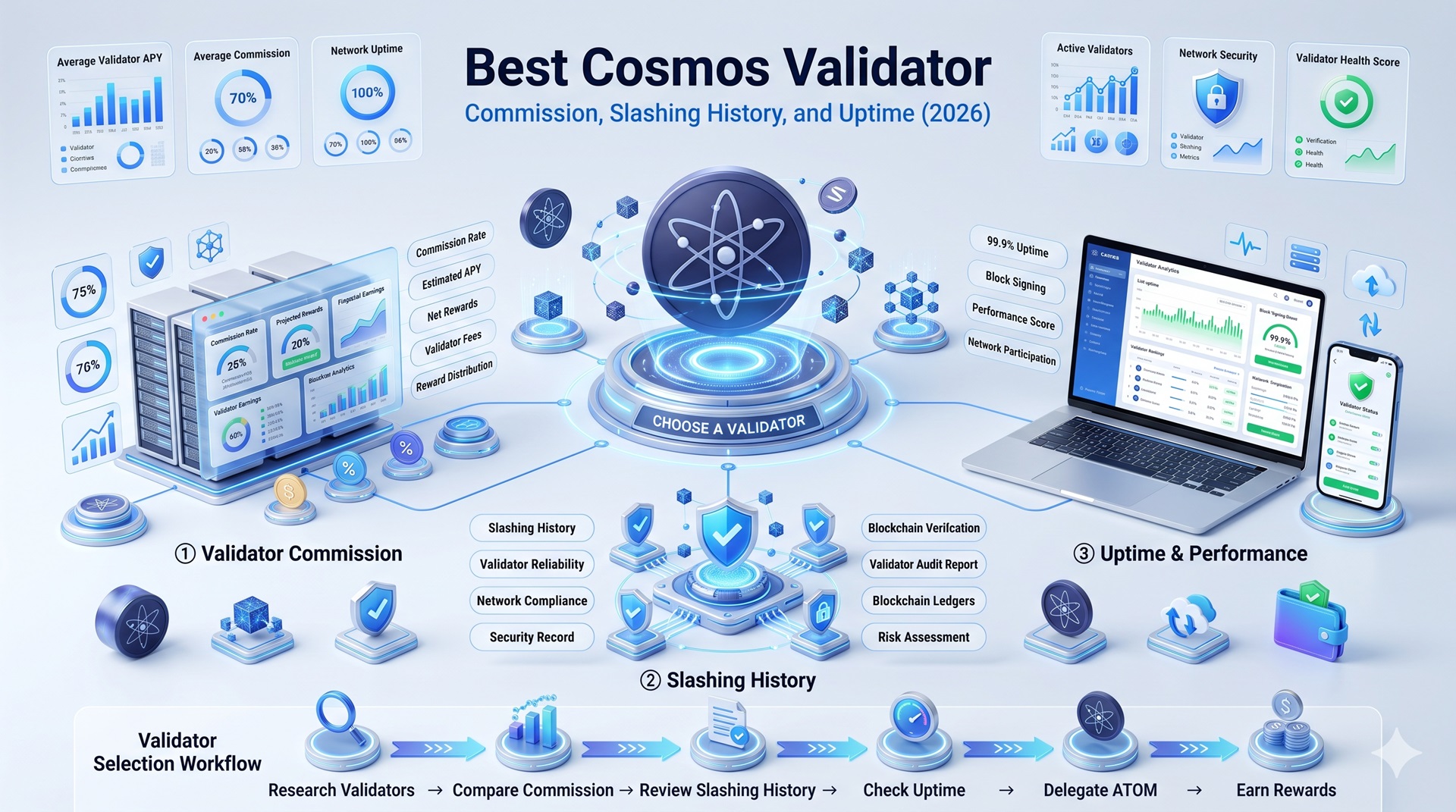
The best Cosmos validator combines a clean slashing history, near-100% uptime, a reasonable commission, meaningful self-bonded stake, and active governance participation.
Because Cosmos has real slashing, your validator choice protects your principal, not just your yield, so a careless validator can directly cost you ATOM. With only 180 active validators and a hard-coded 5% minimum commission, the field is more constrained than on many chains.
This guide explains exactly which validator metrics matter, how slashing penalties actually work, and the new Interchain Security tradeoff that reshapes the choice in 2026.
What “Best Cosmos Validator” Actually Means
A Cosmos validator is a high-performance node that proposes and votes on new blocks for the Cosmos Hub, and when you stake, you delegate your ATOM to one to share in its rewards. The validator earns rewards from network inflation and fees, then shares them with delegators minus a commission. So the best validator is the one that maximizes your reliable net rewards while minimizing the risk that its behavior costs you principal through slashing.
Two structural facts shape the field. First, the Cosmos Hub has a capped active set of 180 validators, so only the top validators by stake are actively earning and securing the chain. Second, the Hub enforces a hard-coded minimum commission of 5%, meaning no validator can charge less, which rules out the race-to-zero commissions seen on some chains.
The Metrics That Define a Good Validator
These metrics together determine whether a validator serves your interests, and weighing them as a set is the reliable way to choose.
Metric
What It Measures
Why It Matters
Slashing history
Past downtime or double-sign events
Clean record signals reliability
Uptime
Consistent block signing
Downtime means missed rewards and jailing
Commission
Validator’s cut, 5% minimum
Directly reduces your net yield
Self-bonded stake
Validator’s own staked ATOM
Skin in the game aligns incentives
Governance participation
Voting on proposals
Active validators support network health
Slashing history and uptime protect your principal and rewards, commission sets your net yield, self-bonded stake signals commitment, and governance participation reflects a validator’s contribution to the ecosystem. A strong validator scores well across all five, not just on the lowest commission.
How Cosmos Slashing Penalties Actually Work
Understanding the exact slashing penalties is essential because they explain why validator reliability matters so much on Cosmos. There are two slashing conditions, and they carry very different severities.
The Two Slashing Conditions
Downtime — missing more than 500 of the last 10,000 blocks, resulting in a ~0.01% slash plus jailing (temporary removal, can be manually unjailed)
Double-sign — signing conflicting blocks, resulting in a 5% slash plus permanent tombstoning (banned forever)
Both penalties hit delegators, not just the validator: when slashing happens, you lose a portion of your staked ATOM alongside the operator. A real 2025 example saw a validator suffer a double-sign event that caused a 5% loss for all its delegators, with its stake collapsing from 2 million ATOM to 500,000 within weeks as delegators fled.
Jailing vs Tombstoning: Jailing is temporary — the validator can fix its infrastructure and unjail. Tombstoning is permanent — a single past double-sign event should disqualify a validator from your shortlist, whereas an old, isolated jailing for downtime, long since resolved, is a much milder concern.
How to Evaluate a Cosmos Validator
Evaluating a validator takes only a few minutes using public explorers, and doing it well protects both your rewards and your principal. Tools like Mintscan, Ping.pub, and Cosmos Directory let you inspect each validator’s uptime, commission, self-bonded stake, slashing history, and governance voting record.
Signals of a Trustworthy Validator
Near-100% uptime with no recent jailing
A clean slashing history with no past double-sign events — the single biggest red flag
Meaningful self-bonded stake, showing skin in the game
A reasonable commission, generally in the 5% to 8% range
Active governance voting plus a public website and visible community presence
On Commission: Because the Hub enforces a 5% floor, a validator advertising the bare minimum is not automatically best. A reliable validator charging 6% to 8% with a flawless record usually beats a riskier one at exactly 5%.
Interchain Security — Why Your Validator Choice Now Earns (and Risks) More
A 2026 development changes the validator calculation in a way most guides have not caught up to: Interchain Security lets your validator choice earn rewards from multiple chains at once, but it also introduces a new slashing surface. Under Interchain Security, consumer chains lease security from the Cosmos Hub’s validator set, and validators who stake ATOM can opt to validate these consumer chains, such as Neutron, to earn additional rewards.
The catch is the emerging cross-chain slashing risk. As cross-chain slashing rolls out in 2026, a validator’s misbehavior on a consumer chain can also affect your ATOM stake on the Hub, not just its rewards there. So a validator that runs many consumer-chain nodes offers more reward potential but a larger surface area for operational mistakes that could slash your principal.
The practical takeaway is to weigh a validator’s Interchain Security participation against its operational track record. If a validator validates several consumer chains and has a long history of perfect uptime and no slashing, it can meaningfully increase your rewards. If its record is shorter or spottier, the added cross-chain exposure may not be worth the extra yield.
Should You Use One Validator or Several?
Spreading your stake across multiple validators is widely recommended on Cosmos specifically because of slashing risk. Delegating to several validators mitigates the chance that a single slashing event hits your entire stake, since only the portion delegated to the offending validator is penalized.
How many validators to use scales sensibly with how much ATOM you hold. A small holder might reasonably keep everything with a single excellent validator, since the management overhead can outweigh the marginal slashing protection on a small balance. A larger holder has more to lose from any single slashing event and benefits more from spreading across three or four reputable validators with different infrastructure and geographic footprints.
Common Cosmos Validator Selection Mistakes
The errors below expose stakers to slashing or lower rewards, each with a clear fix.
Mistake
Result
Prevention
Ignoring slashing history
Principal loss from a bad validator
Verify a clean record on Mintscan
Choosing the lowest commission only
May signal unsustainable fee-dumping
Favor a reliable 5-8% validator
Concentrating all stake in one validator
Full exposure to one slashing event
Spread across 2-3 validators
Overlooking self-bonded stake
Less operator skin in the game
Prefer validators with their own ATOM staked
Ignoring governance participation
Supports passive, less-engaged operators
Check voting records on explorers
Missing Interchain Security exposure
Unrecognized cross-chain slashing risk
Weigh consumer-chain involvement vs track record
What the Best Cosmos Validator Cannot Guarantee
No validator can guarantee a fixed return or zero risk, and even a flawless operator delivers yields that move with network inflation, commission, and the staking ratio. A quoted APY is a snapshot, and your realized return after commission and any slashing can be lower. A validator with a perfect history can still suffer a future outage or double-sign event, so delegation is a relationship to monitor across time, not a one-time decision.
Not Financial Advice: Slashing is a genuine principal risk that careful selection reduces but cannot eliminate. The dollar value of your ATOM depends far more on its market price than on which validator you choose. This guide is educational and not financial advice.
Frequently Asked Questions
The best validator has a clean slashing history, near-100% uptime, a reasonable commission of around 5% to 8%, meaningful self-bonded stake, and active governance participation. Reliability and a clean record matter more than the lowest fee, since Cosmos slashing can cost you principal.
Use explorers like Mintscan or Ping.pub to check uptime, slashing history, commission, self-bonded stake, and governance voting. Favor validators with a flawless record, a reasonable commission, their own ATOM staked, and a public presence. Avoid the largest validators to support decentralization.
Cosmos Hub enforces a hard-coded minimum commission of 5%, and validators commonly charge between 5% and 10%. A reasonable, sustainable commission with a strong track record is preferable to the bare minimum, since unsustainably low fees can be a red flag for fee-dumping.
You lose a portion of your staked ATOM alongside the validator. Downtime causes a small slash of about 0.01% plus jailing, while double signing causes a 5% slash plus permanent tombstoning. This is why checking a validator’s slashing history before delegating is essential.
Self-bonded stake is the ATOM a validator has staked from its own holdings. A higher self-bond signals skin in the game, since the operator stands to lose its own funds if the node is slashed. It is a strong indicator that a validator is motivated to maintain reliable performance.
Several. Spreading your stake across two or three reputable validators limits the damage if any one is slashed, since only the portion delegated to that validator is penalized. With negligible minimums and free redelegation, diversification is practical and is the standard best practice.
Interchain Security lets consumer chains lease security from the Cosmos Hub’s validators. Validators who opt to validate consumer chains earn extra rewards shared with delegators, but cross-chain slashing, rolling out in 2026, means a validator’s consumer-chain misbehavior can also affect your ATOM stake.
Yes. You can redelegate your stake from one validator to another almost instantly, with no 21-day unbonding wait and no gap in rewards. This lets you respond quickly if your validator raises its commission, degrades in performance, or stops participating in governance.
Bottom Line: Check slashing history first, uptime and self-bond second, and treat commission as a tiebreaker — not the primary filter. Diversify across a small set of vetted validators.