Where to Stake Cosmos (ATOM): Best Options Compared 2026 | CryptoLurk
Where to Stake Cosmos (ATOM): Best Options Compared 2026
CrisCoin 12 min readCosmos
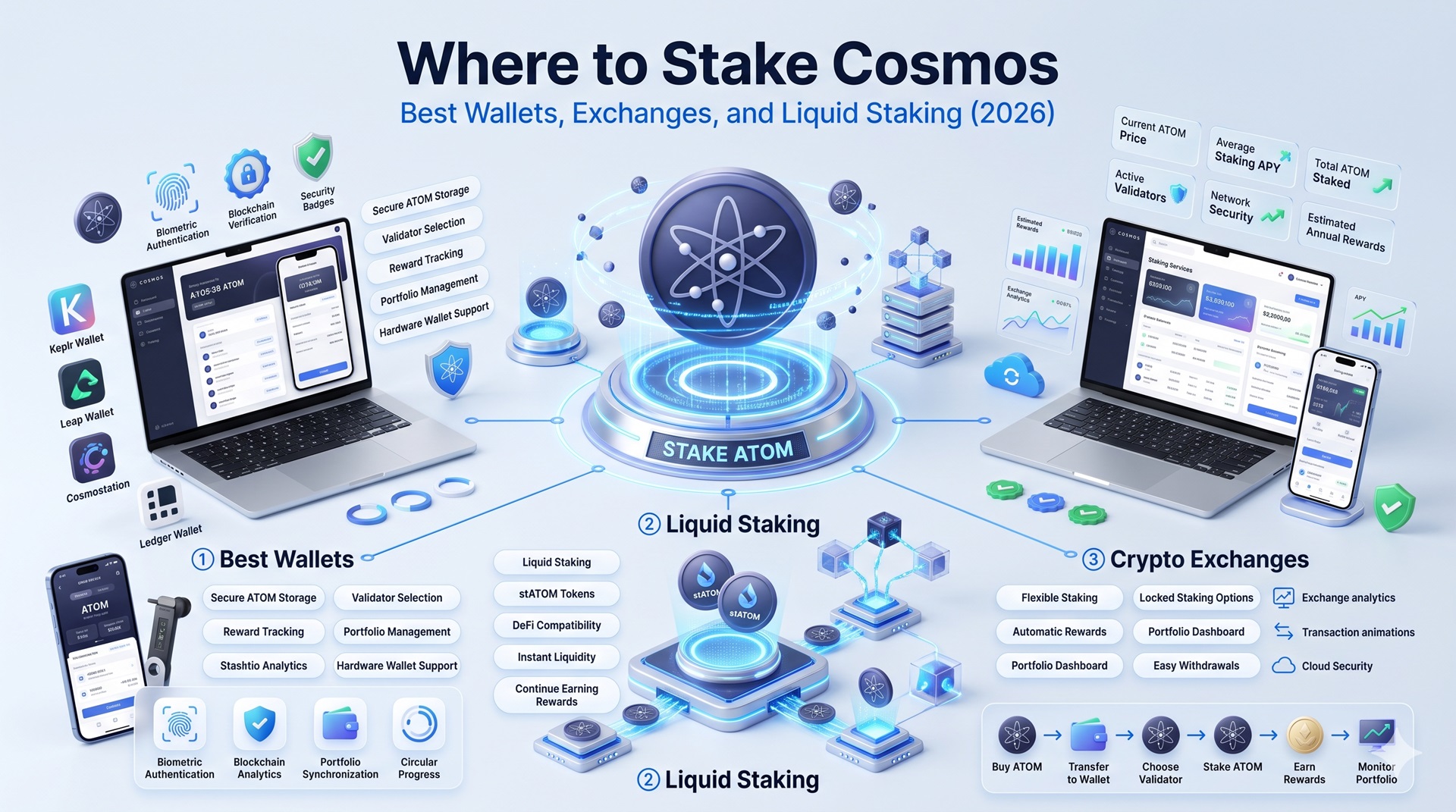
You can stake Cosmos ATOM four ways: through a self-custody wallet like Keplr, a centralized exchange like Coinbase, a liquid staking protocol, or your own validator node.
Cosmos pays an unusually high staking yield, often in the range of 14% to 21%, far above Solana or Ethereum, but that yield comes with two catches: a 21-day unbonding period when you exit, and real slashing risk.
This guide compares every place to stake ATOM in 2026 by APY, custody, fees, and how each handles the 21-day lock.
What “Where to Stake Cosmos” Actually Means
Staking Cosmos means delegating your ATOM to a validator that secures the Cosmos Hub under its delegated proof-of-stake consensus, in return for a share of staking rewards. Validators build and verify blocks, and by delegating your ATOM to one, you contribute to the network’s security and decentralization while earning yield.
Cosmos stands apart from networks like Cardano in two important ways. First, exiting a stake requires a 21-day unbonding period during which your ATOM earns nothing and cannot be moved. Second, Cosmos has real slashing, meaning a validator’s serious misbehavior can cost you a portion of your stake. These two facts make where and with whom you stake more consequential than on no-lockup, no-slashing chains.
The Four Ways to Stake ATOM
These four methods form the complete map of where ATOM staking happens, and each trades convenience, custody, and flexibility differently.
Method
Custody
Typical APY
Best For
Self-custody wallet
You hold keys
~15-21% before fees
Control and higher yield
Centralized exchange
Exchange holds ATOM
~2-16% after commission
Beginner simplicity
Liquid staking
Smart contract, tradeable token
Variable, near native
Liquidity despite the 21-day lock
Run your own validator
Full self-operation
Highest, minus costs
Technical, large stakers
Self-custody wallet delegation gives the most control and the highest net yield. Exchange staking is the simplest but custodial and often lower-yielding after commission. Liquid staking hands you a tradeable token so you are not stuck behind the 21-day unbonding. Running your own validator node is the most decentralized but demands hardware and expertise.
Where to Stake Cosmos From a Self-Custody Wallet
Self-custody wallet staking is the most direct place to stake ATOM and usually delivers the highest net yield while keeping you in control of your keys. Keplr is the most popular choice, a non-custodial wallet recommended by the Cosmos Hub that connects to hundreds of chains and serves over a million users across desktop and mobile.
Hardware wallet staking adds cold-storage security to the same self-custody model. Ledger lets you stake ATOM directly on the Cosmos Hub with a validator selection utility, delegating to a validator of your choice for roughly 20% APY minus the validator’s fee, while keeping your private keys offline. Other wallets like Cosmostation, Leap, Tangem, and Atomic Wallet offer similar native delegation.
Why Self-Custody Wins: When native rates sit in the high teens and exchanges skim a 15% to 20% commission off the top, the gap between staking yourself and staking through a custodian compounds into a substantial difference over a year, especially the more ATOM you hold.
Choosing a Cosmos Validator
Because Cosmos has real slashing, your validator choice carries more weight than on networks without it. The factors that matter are commission rate, uptime and reliability, and how much stake the validator already holds. A lower commission leaves more reward for you, strong uptime avoids missed rewards, and avoiding the largest validators supports decentralization while reducing concentration risk.
Slashing makes reliability paramount. A validator that double-signs or suffers prolonged downtime can be slashed, and that penalty is passed to its delegators, so a careless validator can cost you principal, not just rewards. This is why many stakers spread their ATOM across several reputable validators rather than concentrating it.
Where to Stake Cosmos on Exchanges
Centralized exchanges are the simplest place to stake ATOM, trading custody and yield for one-click convenience. Coinbase lets users stake ATOM with as little as $1, paying around 5% APY with first rewards after roughly 7 to 14 days and then about every 3 days, while taking a commission of around 20% of rewards. Binance offers fixed staking periods of 30, 60, 90, or 120 days, with longer commitments earning higher APY. OKX offers ATOM staking in a range of roughly 9.5% to 16.7% depending on the active validator.
US Caveat: Following SEC litigation, Kraken no longer permits US residents to stake ATOM, though it continues internationally with around 12% to 15% APY, a 15% commission, and notably instant unstaking with no early-exit penalty.
The defining feature of all exchange staking is custody: the platform holds your ATOM, so you rely on its security and solvency. Exchange staking suits beginners, but it generally yields less after commission and offers no validator choice.
Why the 21-Day Unbonding Makes Liquid Staking Worth Considering
The 21-day unbonding period is the single factor that most distinguishes Cosmos staking, and it is why liquid staking deserves serious consideration when deciding where to stake. With native delegation, exiting means your ATOM is locked for 21 days, earning nothing and untradeable, so if the market moves against you mid-unbonding, you simply have to wait it out.
Liquid staking solves this. When you stake through a liquid staking protocol such as Stride, you receive a liquid token like stATOM that represents your staked ATOM and keeps earning rewards while remaining tradeable. To exit, you swap the liquid token for ATOM on a decentralized exchange instead of waiting out the 21-day unbonding, and you can also use the token as collateral or in DeFi in the meantime.
REStake — Auto-Compounding Middle Path
Powered by Cosmos’s Authz module
Auto-compounds your staked ATOM by periodically claiming and re-delegating rewards
Never takes custody of your keys
Raises effective APY through compounding
Does not remove the 21-day unbonding when you eventually exit
Is Staking Cosmos Worth It in 2026?
Whether ATOM staking is worth it depends on weighing its high yield against its higher risk profile. Cosmos offers a relatively high APY compared with Solana’s roughly 6.5% and Ethereum’s roughly 3%, which is a strong incentive to stake rather than hold idle ATOM, especially since the network’s inflation means unstaked ATOM is diluted over time.
The tradeoffs are the 21-day unbonding lock and real slashing risk, neither of which exists on a chain like Cardano. This makes Cosmos staking better suited to holders who do not need quick liquidity and who are willing to choose validators carefully or use liquid staking to manage the lock.
Nominal vs Real Yield: Much of Cosmos’s headline APY is nominal rather than purely real, since it is funded substantially by token issuance. Staking protects your proportional share of the network rather than handing you pure profit — but not staking is actively costly since unstaked ATOM is diluted every block.
Common Cosmos Staking Mistakes
The errors below cause ATOM stakers to lose yield, get caught by the unbonding lock, or take avoidable slashing risk.
Mistake
Result
Prevention
Ignoring the 21-day unbonding
Funds locked when you need them
Use liquid staking if you may exit fast
Delegating to one large validator
Concentration and slashing risk
Spread across reputable validators
Not auto-compounding
Lower effective APY
Use REStake or a compounding tool
Chasing exchange simplicity blindly
Lower yield after high commission
Compare net APY against native staking
Overlooking slashing risk
Principal loss from bad validator
Choose high-uptime, reliable validators
US stakers assuming Kraken works
Service not permitted in the US
Verify platform availability first
What Cosmos Staking Cannot Guarantee
No venue or validator can guarantee a fixed return, and the wide APY range across platforms reflects how much yields fluctuate with validator behavior, network inflation, and commission. A quoted 20% figure is a snapshot, not a contract, and your realized yield after commission and any slashing can be meaningfully lower.
Not Financial Advice: Slashing is a genuine principal risk that careful validator selection reduces but cannot fully eliminate. The dollar value of your ATOM depends far more on its market price than on the staking yield. This guide is educational and not financial advice.
Frequently Asked Questions
It depends on your priority. Self-custody wallets like Keplr or Ledger offer the highest net yield and full control, exchanges like Coinbase suit beginners who accept custodial risk and lower yield, and liquid staking suits those who want to avoid the 21-day unbonding lock while still earning.
Native staking through a wallet often yields around 15% to 21% before validator fees, far higher than Solana or Ethereum. Exchanges pay less after commission, from roughly 2% on some platforms to around 16% on others. Actual yields fluctuate with validator behavior and network conditions.
Yes. Cosmos has a 21-day unbonding period, during which ATOM you unstake is locked, earns nothing, and cannot be moved. This discourages destabilizing mass withdrawals. Liquid staking avoids the lock by giving you a tradeable token, and some exchanges like Kraken offer instant unstaking.
Keplr is the most popular and is recommended by the Cosmos Hub, offering non-custodial staking across many chains with validator choice. Ledger adds cold-storage security with a validator selection utility, while Cosmostation, Leap, and Tangem are solid alternatives for native ATOM delegation.
Yes, through liquid staking. Protocols like Stride give you a liquid token such as stATOM that you can trade or swap back to ATOM instantly on a decentralized exchange, bypassing the 21-day unbonding. Some exchanges also offer instant unstaking, though availability varies by region.
Yes. Unlike Cardano, Cosmos has real slashing, so a validator that double-signs or suffers prolonged downtime can be penalized, and that penalty is passed to its delegators. Choosing reliable, high-uptime validators and spreading stake across several reduces this principal risk.
US residents can stake ATOM on platforms like Coinbase and through self-custody wallets such as Keplr and Ledger. However, following SEC litigation, Kraken no longer permits US residents to stake ATOM, so verify a platform’s US availability before relying on it.
REStake uses Cosmos’s Authz module to auto-compound your staked ATOM by periodically claiming and re-delegating rewards on your behalf, without taking custody of your keys. This raises your effective APY through compounding while you remain natively staked with your chosen validator.
Bottom Line: Self-custody wallets pay the highest net yield, exchanges are simplest but cost more, and liquid staking solves the 21-day lock problem. Pick based on how much control and liquidity you actually need.