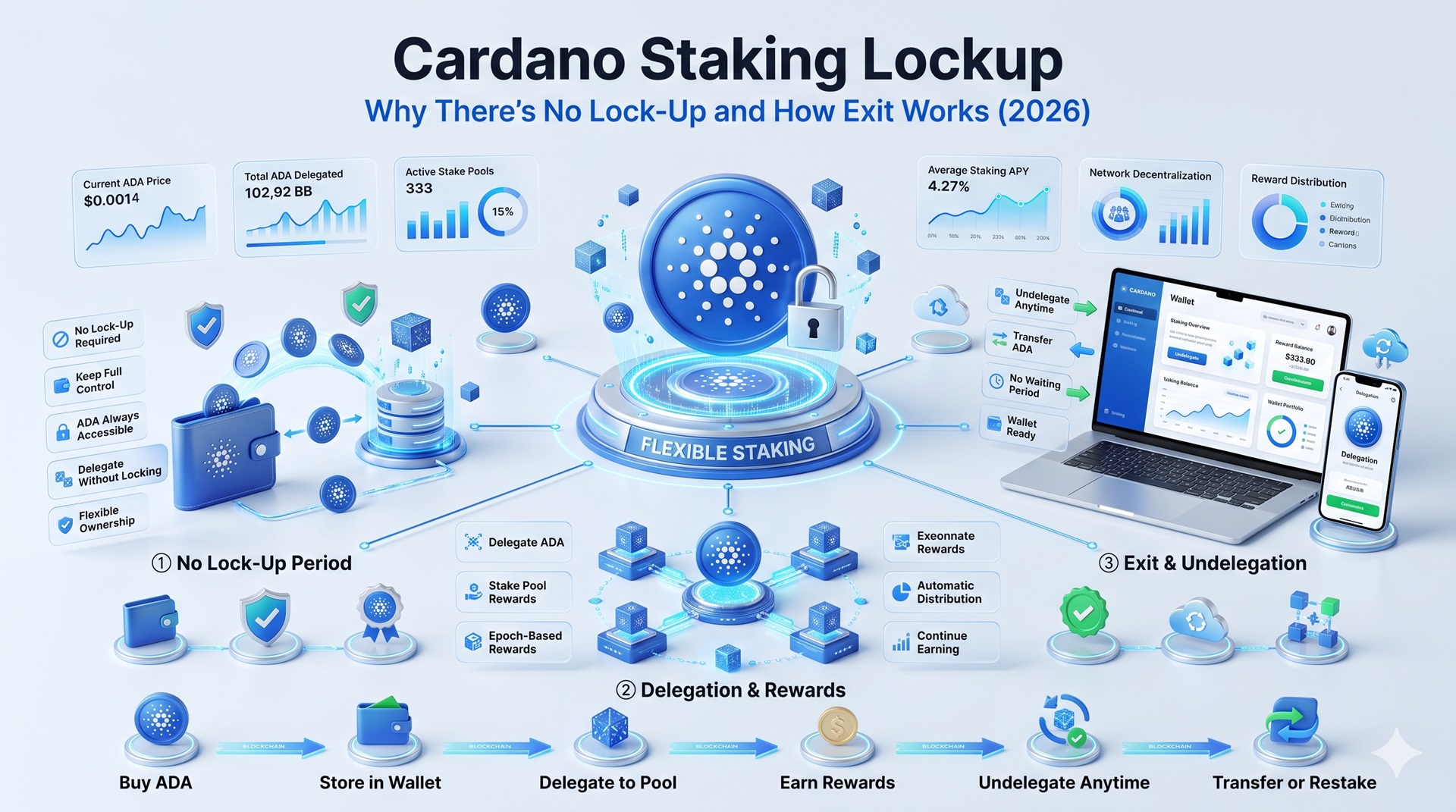
There is no bonding, no unbonding, and no cooldown: your ADA never leaves your wallet, so you can spend, sell, or transfer it at any moment, even while it is earning rewards. This makes Cardano one of the most flexible staking systems in crypto.
The only times a lockup enters the picture are when you opt into a locked staking product on an exchange, and people often mistake Cardano’s first-reward delay for a lockup when it is nothing of the sort. This guide explains exactly why there is no lock-up, the exceptions, and how exit actually works.
What “Cardano Staking Lockup” Actually Means
A staking lockup, on most networks, is a period during which your staked tokens are frozen and cannot be sold, transferred, or withdrawn. On Cardano, that concept simply does not apply to native staking. When you stake ADA, it never actually leaves your wallet; you are only assigning your stake’s voting weight to a pool.
This is a deliberate design feature of Cardano’s Ouroboros proof-of-stake protocol. There is no bonding period before your stake counts and no unbonding period when you exit, so your tokens are transferable immediately.
Why No Lockup Is Needed: Stake is measured through epoch snapshots and the protocol has no slashing, so there is no need to freeze funds to enforce good behavior. Delegation only points your stake’s weight at a pool without ever moving the underlying ADA.
How Cardano Compares to Lockup-Based Networks
Feature
Lockup-Based Networks
Cardano (Native)
Bonding period
Often required before earning
None, stake counts at epoch turn
Unbonding / cooldown
Days to weeks to withdraw
None, ADA transferable immediately
Token custody
Funds often sent to a contract
ADA never leaves your wallet
Slashing
Stake can be penalized
None on Cardano
On networks like Ethereum or Solana, exiting a stake means waiting through an unbonding or cooldown queue. On Cardano, there is nothing to wait for, because your ADA was liquid the entire time it was delegated.
Why People Think Cardano Has a Lockup — and Why It Doesn’t
The confusion comes from two specific sources: the first-reward delay, and exchange-based locked staking products, which are an opt-in choice rather than a feature of Cardano itself.
Because of how Cardano snapshots the network at epoch boundaries, there is a waiting period of roughly 15 to 20 days, about three to four epochs, before your first rewards arrive. New stakers sometimes interpret this delay as their funds being locked, but it is not: during that entire waiting period your ADA remains fully spendable and transferable.
Exchange Products Are Different: Some exchanges offer locked staking products where you voluntarily agree to freeze your ADA for a fixed term for a higher yield. On Binance, for example, Simple Earn offers a Flexible option withdrawable anytime, and a Locked option with 7 to 120 day periods. That lockup is a product you opted into, not a property of Cardano’s protocol.
How Exit Works on Cardano
Exiting a Cardano stake is immediate because there is no unstaking period to wait through. To stop staking entirely, you deregister your staking key, which ends your delegation and returns your refundable 2 ADA deposit.
Exit Action
Network Wait
Notes
Spend or move staked ADA
None
ADA is always liquid in your wallet
Withdraw rewards
None
Rewards move to spendable balance instantly
Deregister staking key
None
Ends delegation, refunds 2 ADA deposit
Switch pools (redelegate)
Until next epoch
Stake moves at the epoch boundary
This instant-exit property has a practical consequence: there is no penalty for treating staking as an always-on default. Since your ADA stays liquid, the rational choice is to keep it delegated continuously, earning rewards right up until the moment you actually want to spend or sell.
Does Exchange Staking Change the Lockup?
Whether a lockup applies on an exchange depends entirely on which product you choose. A flexible product mirrors Cardano’s native behavior, letting you withdraw anytime, while a locked product trades that flexibility for a higher advertised yield over a fixed term.
Major exchanges differ in their approach. Some, like Coinbase, impose no additional lockup periods beyond the protocol. If avoiding lockups entirely is your priority, native wallet staking guarantees zero lock-up, while on an exchange you simply choose the flexible option rather than a locked term.
Multi-Delegation Without Lockups
A 2026 development worth noting is that Cardano’s flexibility now extends to splitting your stake across multiple pools without any lockup. Some advanced wallets like Lace now support multi-delegation within a single account, letting you split your ADA across several pools to diversify.
Whether you delegate your whole balance to one pool or split it across several, none of the ADA is locked, and you can rebalance, redelegate, or withdraw at any time.
Common Cardano Staking Lockup Misconceptions
Misconception
Reality
What to Do
Staked ADA is locked
ADA stays in your wallet, always liquid
Spend or move it anytime
The first-reward delay is a lockup
Only rewards are pending, not principal
Expect rewards in ~15-20 days
You must wait to unstake
There is no unbonding period
Exit or move ADA immediately
All ADA staking has lockups
Only opt-in exchange products do
Choose flexible or native staking
Multi-delegation locks funds
Splitting across pools stays liquid
Rebalance freely anytime
Withdrawing rewards takes days
Rewards move to balance instantly
Withdraw whenever you like
What Cardano’s No-Lockup Model Cannot Guarantee
The no-lockup guarantee applies to the protocol and native wallet staking; if you stake through a custodial exchange and choose a locked product, you accept that platform’s lockup terms, and some custodians add their own processing times.
Your ADA staying liquid does not shield you from market price movements; the dollar value of your principal and rewards still rises and falls with ADA’s price at any moment.
Educational Note: This guide is educational and not financial advice.
Frequently Asked Questions
No. Native Cardano staking has no lockup, no bonding, and no unbonding period. Your ADA never leaves your wallet, so you can spend, sell, or transfer it at any time, even while earning rewards. Lockups only apply if you opt into a locked staking product on an exchange.
Yes. There is no unstaking or unbonding period on Cardano, so your tokens are transferable immediately. Your ADA is always spendable even while staked, and deregistering your staking key to fully exit returns your refundable 2 ADA deposit with no waiting.
No. The roughly 15 to 20 day wait before your first rewards arrive is a reward-timing effect of Cardano’s epoch snapshot system, not a lockup. During that entire period your ADA stays fully liquid and spendable; only the pending rewards are delayed, never your principal.
Because staking on Cardano only assigns your stake’s voting weight to a pool rather than sending your ADA anywhere. The coins remain in your wallet under your control the whole time, so there is nothing to lock. This is a core design choice of the Ouroboros protocol.
Some do, but only on opt-in locked products. Exchanges like Binance offer both a flexible option you can withdraw anytime and a locked option with fixed terms of 7 to 120 days for higher yield. Others like Coinbase impose no additional lockup. Any lockup comes from the product, not Cardano.
No, not through native staking. Your ADA stays in your wallet and remains fully accessible at all times. The only way access is restricted is if you choose a locked staking product on a custodial exchange.
No. Multi-delegation, supported in 2026 by wallets like Lace, lets you split your stake across several pools while keeping all your ADA fully liquid. You can rebalance, redelegate, or withdraw at any time, with no lockup imposed by diversifying across pools.
Immediately. Cardano has no unbonding or cooldown period, so your ADA is transferable the moment you stop staking, and it was spendable in your wallet all along. Only custodial exchanges with locked products may impose their own waiting times.