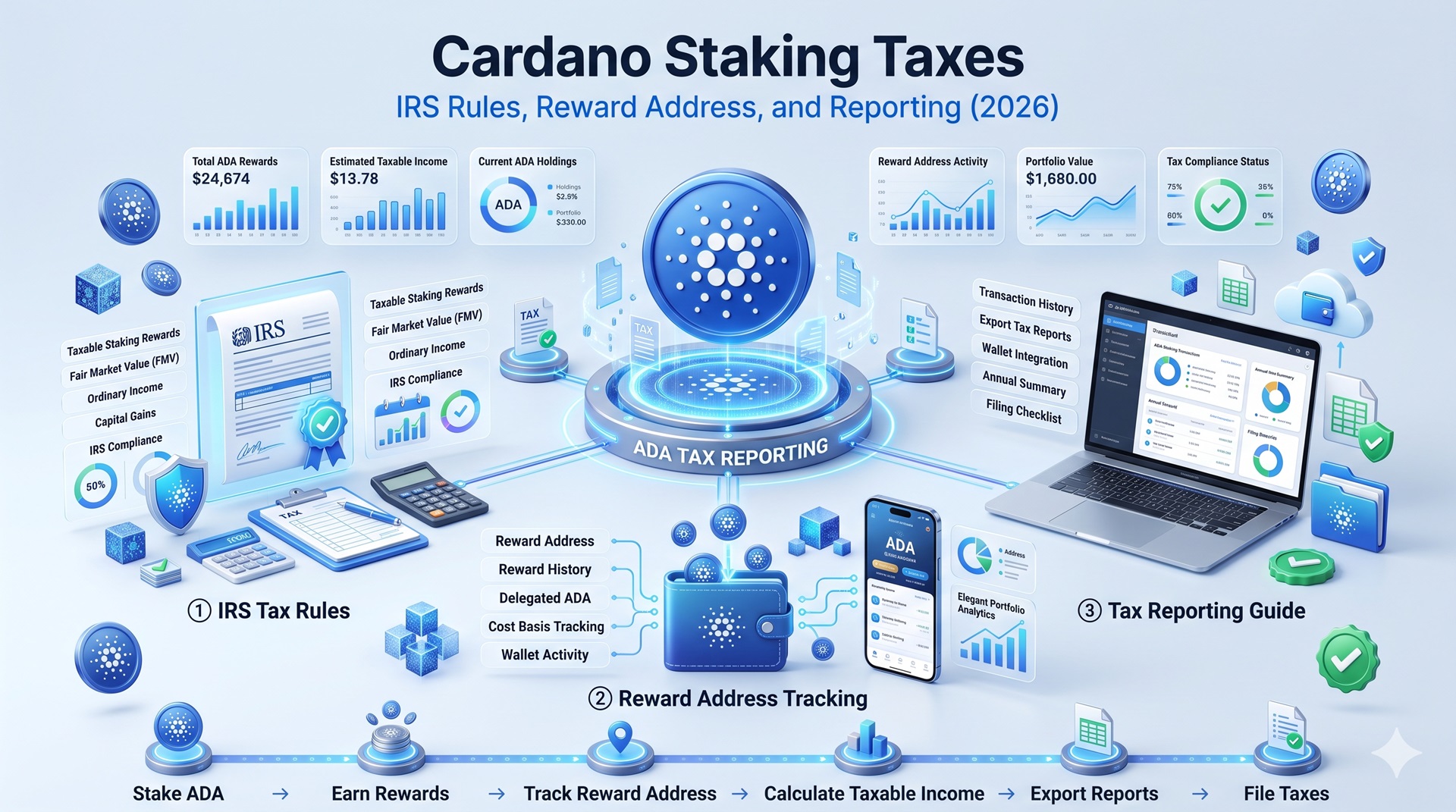
Cardano staking rewards are taxed as ordinary income at their fair market value when they hit your reward address each epoch, then taxed again as capital gains when you sell.
Because ADA rewards arrive roughly every five days, a single wallet generates around 73 taxable income events a year, and Cardano’s separate reward address adds a wrinkle most guides skip.
This guide explains when ADA staking is taxed, how the reward address shapes the timing, how to report it on the correct forms, and the Catalyst and governance rewards stakers often forget.
What “Cardano Staking Taxes” Actually Means
Cardano staking taxes consist of two separate layers. The first layer is income tax: when you receive staking rewards, their fair market value in your local currency counts as ordinary income. The second layer is capital gains tax: when you later sell, trade, or spend that reward ADA, the difference between the sale price and the value you already reported as income is a capital gain or loss.
For US tax purposes, all Cardano activity is subject to the same property rules as any other cryptocurrency under IRS Notice 2014-21. Most major tax authorities, including the IRS and the UK’s HMRC, treat staking rewards as income, so this structure is broadly international.
Income at Receipt vs Capital Gains on Disposal
Tax Event
When It Triggers
Tax Type
Value Used
Income recognition
When rewards hit your reward address
Ordinary income
FMV at receipt
Capital gain or loss
When you sell, trade, or spend ADA
Capital gains
Sale price minus cost basis
Cost basis set
At the moment of income recognition
N/A
Equals the FMV reported as income
For example, if you receive 10 ADA when it is trading at $0.50, you report $5 of ordinary income, and $5 becomes your cost basis. Sell that ADA later for $8 and you have a $3 capital gain; sell for $4 and you have a $1 capital loss.
When Are Cardano Staking Rewards Taxable?
Cardano staking rewards are taxable as ordinary income at the fair market value on the day they are received, under IRS Revenue Ruling 2023-14 and the principles from Jarrett v. United States. The IRS uses the concept of dominion and control to determine when you have received your rewards, meaning the moment you can freely sell and transfer your ADA, even if you never withdraw it.
No Minimum Threshold: You must report all Cardano staking rewards regardless of the amount, so even $10 of ADA rewards for the entire year is legally reportable income. Since 2020, Form 1040 has included a digital asset question you must answer “Yes” to.
Why Cardano’s Separate Reward Address Affects Your Taxes
Rewards do not land in your main spending balance but accumulate in a separate reward address tied to your stake key, a different on-chain location from the Shelley address that holds your spendable ADA. Income recognition is tied to the rewards arriving in that reward address, not to when you eventually move them.
This creates a subtle reconciliation challenge at year end. Because rewards sit in the stake key’s reward address, it is easy to forget they exist until you withdraw a large accumulated sum in a single transaction. That withdrawal is not itself a taxable event, since the income was already recognized epoch by epoch as the rewards accrued.
Why Tax Software Becomes Necessary
With around 73 income events per wallet annually, manual tracking quickly becomes impractical. Tools like Koinly and CoinTracker let you connect your Cardano wallet using either your Shelley address (addr1) or your staking address (stake1), then automatically import each reward distribution and price it at fair market value.
How to Report Cardano Staking on Your Taxes
Most individual stakers report reward income on Form 1040 Schedule 1 as Other Income, entering the total fair market value of all ADA rewards received during the year. Every disposal of reward ADA is then reported on Form 8949, with totals carried to Schedule D.
Form
Purpose
Who Files
Schedule 1, Other Income
Report reward FMV as ordinary income
Casual individual stakers
Schedule C
Report rewards as business income, deduct costs
Professional validators / business stakers
Schedule SE
Self-employment tax on business staking
Business stakers
Form 8949 + Schedule D
Itemize and summarize disposals
All who sell, trade, or spend ADA
US residents may also receive tax forms from exchanges. A centralized exchange like Coinbase or Kraken may issue a 1099-MISC for more than $600 in staking rewards, and starting in 2026 exchanges issue the new 1099-DA reporting transactions, though early forms may contain missing cost basis data.
The Cardano Income Most Stakers Forget
Project Catalyst voting rewards, earned for participating in Cardano’s governance funding rounds, are taxable as income at their fair market value when received, the same as staking rewards.
Cardano’s growing DeFi and NFT activity adds further reporting duties. Interactions on decentralized exchanges like SundaeSwap or Minswap, liquidity pool rewards, and NFT sales each can create income or capital gains events under the same property rules.
Swaps Are Taxable Too: Trading ADA for a native token on a Cardano DEX, or providing ADA to a liquidity pool, realizes a capital gain or loss on the ADA given up, measured against its cost basis.
How to Reduce Cardano Staking Taxes Legally
Legitimate Levers
Hold ADA longer than 12 months before selling to access lower long-term capital gains rates of 0% to 20%
Harvest losses in a down market to offset other crypto or stock gains
Use tax-advantaged accounts like a crypto IRA where available
Deduct staking node expenses if you qualify as a business staker
Reconcile internal transfers so moves between your own wallets are not counted as disposals
What Cardano Staking Tax Rules Cannot Guarantee
The income-at-receipt rule under Revenue Ruling 2023-14 is well established, but the high volume of epoch rewards, the separate reward address, and Cardano-specific income like Catalyst rewards create complexity that software does not always classify perfectly.
Reporting rules are also tightening: the new 1099-DA regime began phasing in for 2025 transactions, and early forms may carry incomplete cost basis information that you must reconcile yourself.
Educational Note: This article is educational and not personalized tax advice; consulting a qualified crypto tax professional before filing is strongly advisable.
Frequently Asked Questions
Yes. Cardano staking rewards are taxable as ordinary income at their fair market value when received, under IRS Revenue Ruling 2023-14. There is no minimum threshold, so all rewards must be reported, and a later sale of that ADA is a separate capital gains event.
They are taxed when you gain dominion and control, which for Cardano is at the end of each epoch, roughly every five days, when rewards are credited to your reward address. You can freely use them at that point, so their fair market value is income even before you withdraw them.
Report reward income on Form 1040 Schedule 1 as Other Income using the FMV at receipt, and report each disposal on Form 8949 and Schedule D. Business stakers use Schedule C and may owe self-employment tax via Schedule SE. Exchanges may issue 1099-MISC or 1099-DA forms.
Because rewards are paid every epoch, roughly every five days, a single wallet generates about 73 income events per year, each needing a fair market value recorded at receipt. Cardano’s rewards accrue to a separate reward address, which is where each taxable event occurs.
Cardano rewards accumulate in a separate reward address tied to your stake key, distinct from the Shelley address holding your spendable ADA. Income is recognized when rewards are credited to that reward address each epoch, not when you later withdraw them to your main balance.
No, the same value is not taxed twice. You pay income tax on the reward when received, then capital gains tax only on any appreciation above that value when you sell. The reported income becomes your cost basis, which prevents genuine double taxation.
Yes. Project Catalyst voting rewards and other governance participation rewards are taxable as income at their fair market value when received, the same as staking rewards. Many stakers overlook them, but they should be tracked and reported alongside epoch staking rewards.
Hold ADA longer than 12 months for lower long-term rates, harvest losses to offset gains, use tax-advantaged accounts where available, deduct node expenses if you stake as a business, and reconcile internal transfers. Avoiding reporting entirely is not a legal option.