How to Choose the Best Polygon Validator | CryptoLurk
How to Choose the Best Polygon Validator
CrisCoin 10 min readPolygon
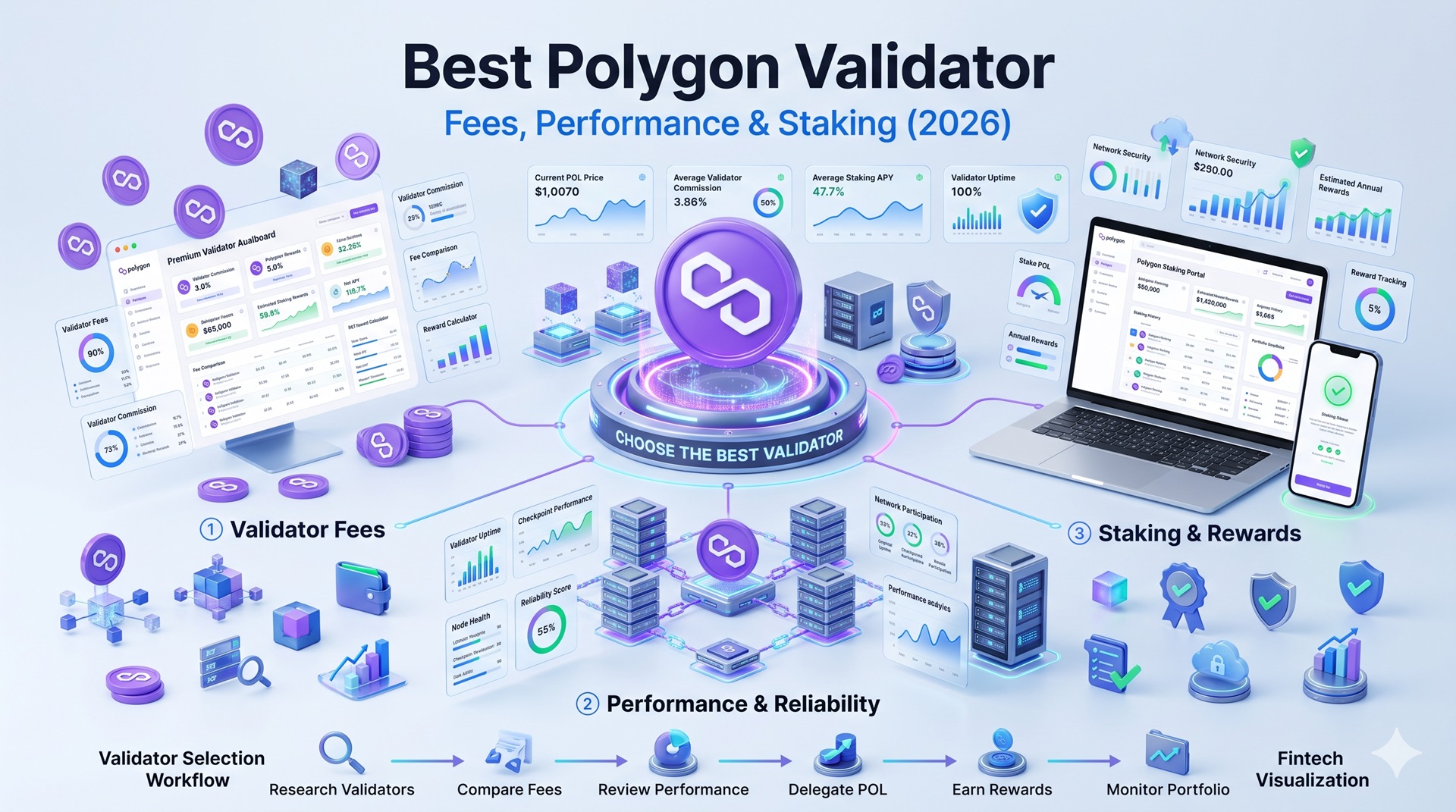
Choosing the best Polygon validator is not about finding the one with the highest name recognition or the lowest commission.
The Polygon PoS validator set is capped at 103–105 active operators, and the meaningful differences between them come down to four measurable factors: checkpoint signing rate, commission sustainability, stake concentration impact on the network, and a metric almost no guide covers — the validator’s ETH balance on their signer address, which directly determines whether they can submit checkpoints reliably to Ethereum mainnet.
Why Validator Selection Matters for Delegators
When you delegate POL to a validator on the Polygon Staking Portal, your rewards are directly tied to that validator’s performance. Polygon distributes staking rewards at every checkpoint — approximately every 34 minutes. If your validator misses a checkpoint, you earn nothing for that reward cycle. A validator operating at 95% checkpoint signing rate costs you roughly 5% of potential rewards compared to a validator at 100%.
The validator set is capped. New validators can only join when an existing one unbonds or is removed for sustained poor performance. This means the validators available to you are a fixed pool of established operators — and choosing correctly among them requires understanding what the live data actually tells you.
The Four Criteria That Determine the Best Polygon Validator
1. Checkpoint Signing Rate
Checkpoint signing rate is the single most important performance metric for delegators. It represents the percentage of the last 200 checkpoints that the validator has successfully signed and submitted to Ethereum mainnet.
Roughly every 34 minutes, validators push a cryptographic snapshot of the Polygon PoS chain state to Ethereum. Missing a checkpoint means no rewards are distributed for that cycle. Validators with lower signing rates quietly erode delegator yields with every missed submission.
What to Look For
Target validators at 99–100% checkpoint signing rate
98% is the minimum acceptable threshold — below this, reward reduction is material
Occasional dips to 96–97% from network-wide events are normal; sustained performance below 98% is a red flag
Live checkpoint signing data is published on Polygonscan and validator.info/polygon for every active validator.
2. Commission Rate — and the 0% Warning
Commission is the percentage of your staking rewards the validator retains as a service fee before distributing your share. Most Polygon validators charge between 0% and 10%, with the median near 7%.
The 0% Commission Red Flag: Several validators on Polygon advertise 0% commission. While a small number of established operators (such as Everstake, which has maintained 0% for 3+ years) make this sustainable through amortized infrastructure costs across 130+ networks, most anonymous operators offering 0% commission are using it as bait. Validators can change their commission rate at any time — a validator that raises commission from 0% to 100% in the blocks before a checkpoint, then lowers it back immediately after, effectively steals that checkpoint’s rewards from all delegators.
Practical Commission Guidance
A 0% commission from a verifiable, multi-year operator with public infrastructure is legitimate
A 0% commission from an anonymous validator with no website or contact information should be avoided
5–10% commission from a proven operator typically produces better net rewards than 0% from an unreliable one
3. Stake Concentration and Decentralization
The total stake delegated to each validator varies widely across Polygon’s active set. Choosing a highly concentrated validator — one holding a disproportionate share of the network’s total staked POL — weakens Polygon’s decentralization and concentrates governance influence.
More than 3.6 billion POL is staked across active validators as of mid-2026. When 20–30% of this stake is concentrated in 3–4 validators, those operators gain outsized influence over checkpoint timing and governance votes.
Why This Matters for Delegators: A mid-tier validator with 98.5% uptime and 5% commission produces nearly identical rewards to a top-tier validator at 99% uptime and 5% commission — while providing better network health. Spreading delegation across mid-sized operators with solid but not dominant stake positions is consistently better for the network and doesn’t meaningfully sacrifice your yield.
4. Multi-Chain Track Record
Established validator operators typically run infrastructure across multiple proof-of-stake networks simultaneously. Everstake, for example, operates across 130+ blockchain networks. This multi-chain presence is a proxy for infrastructure quality: operators who have invested in redundant servers, 24/7 monitoring, and professional operations teams across many networks are unlikely to let a single Polygon node degrade their overall reputation.
Conversely, a validator that only operates on Polygon and has a short history provides little external evidence of operational quality. Check whether the validator has a website, a clear team identity, verifiable social presence, and participation in Polygon’s Discord and governance forums.
Validator ETH Balance — The Hidden Selection Factor No Guide Covers
This is the factor that no competitor guide mentions: Polygon validators pay ETH gas fees every time they submit a checkpoint to Ethereum mainnet. The Polygon documentation for validators explicitly recommends maintaining 0.5–1 ETH in the signer address at all times.
Hidden Reliability Risk: A validator running low on ETH in their signer address will begin delaying or missing checkpoint submissions — because they literally cannot afford the Ethereum transaction fee to submit. This directly reduces rewards for all delegators assigned to that validator, with no warning surfaced on the staking dashboard.
How to check: Visit Polygonscan, look up the validator’s signer address (listed on the Polygon Staking Dashboard under each validator’s detail page), and check the ETH balance. A well-run validator maintains at minimum 0.2–0.5 ETH in their signer address as working capital.
This single check eliminates poorly-funded validators and is genuinely not covered by any other staking guide — yet it is a direct, verifiable predictor of checkpoint reliability.
Where to Check Validator Data
Data Sources
Polygonscan (polygonscan.com) — Shows the signer address ETH balance, historical transaction volume, and on-chain activity for each validator’s signer and owner addresses.
Validator.info/polygon — Provides the most complete delegator-facing validator overview: checkpoint signing rate, commission, total delegated stake, uptime history, and comparative ranking across the full 103-validator set. Use this as your primary validator selection tool before deciding where to delegate.
Polygon Staking Dashboard (staking.polygon.technology) — The official Polygon interface shows checkpoint signing rate, commission, and total stake for each validator. Less detailed than validator.info but sufficient for basic comparisons.
Specific Validators Worth Evaluating in 2026
Everstake — 0% commission, 3+ years of stable operation on Polygon, multi-chain operator across 130+ networks, 99%+ checkpoint signing rate maintained historically. Appropriate for delegators who want 0% commission from a verifiable, established operator.
Blocks United — Community-focused validator with transparent communication, reasonable commission under 10%, active presence in Polygon Discord and forums, high self-stake relative to many competitors. Appropriate for delegators who value operator accountability and community engagement.
Not a Permanent Recommendation: These are named for illustrative purposes. Always verify current checkpoint signing rates and ETH signer balance directly on Polygonscan and validator.info before delegating — validator performance can change, and no listed name is a permanent recommendation.
Frequently Asked Questions
Checkpoint signing rate is the most important factor. This metric, based on the last 200 checkpoints, directly determines your reward frequency. Aim for validators at 98% or above. Commission matters secondarily — a 5% commission from a 99.5% uptime validator produces better net rewards than 0% commission from a 94% uptime validator.
It depends entirely on the validator’s identity and track record. A 0% commission from an established, transparent, multi-year operator (like Everstake) is legitimate and sustainable. A 0% commission from an anonymous validator with no website or community presence is a warning sign — commission can be raised to 100% briefly before a checkpoint to capture all rewards, then lowered immediately. Check operator identity before delegating to any 0% commission validator.
Use validator.info/polygon to see checkpoint signing rates for all active validators. Polygonscan can be used to verify the signer address ETH balance and on-chain activity. The Polygon Staking Dashboard at staking.polygon.technology also shows the checkpoint signing percentage for each validator in the delegator interface.
Yes — from a network health perspective. The top validators by delegated stake hold disproportionate checkpoint and governance influence. Delegating to mid-tier validators with solid performance metrics produces nearly identical rewards while improving Polygon’s decentralization. This is the recommendation of validators like Blocks United who specifically advise against concentrating delegation in the largest operators.
Polygon’s active validator set is capped at 103–105 validators. New validators can only enter the set when an existing validator unbonds or is removed for sustained poor performance. Applications for validator slots are submitted at the Polygon Validators Hub, but approval is not guaranteed.
Final Tip: Before delegating, check the validator’s signer ETH balance on Polygonscan — it’s the single most overlooked predictor of consistent checkpoint reliability.