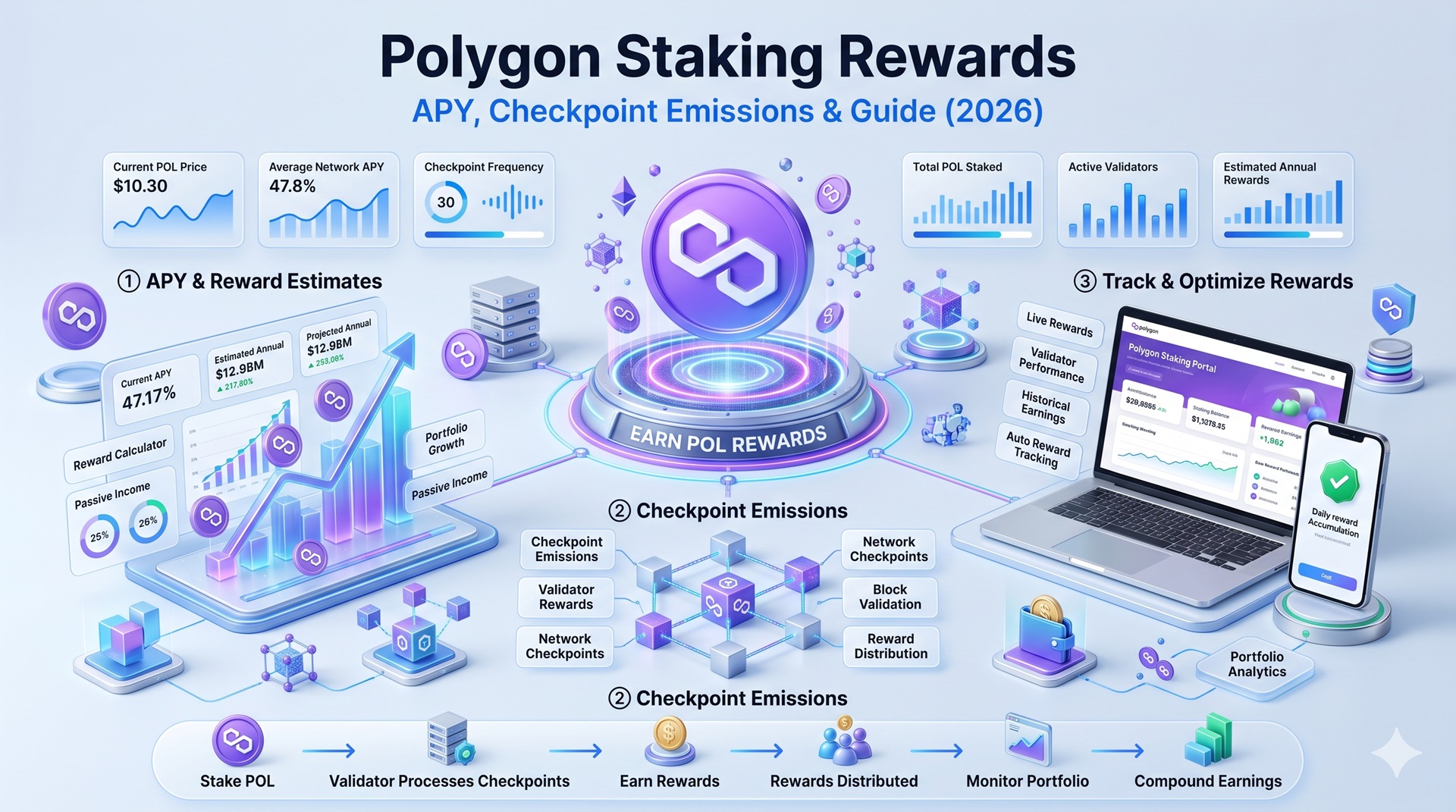
Polygon (POL) staking rewards are distributed every 34 minutes — one of the most frequent reward cycles among major proof-of-stake networks — but the headline APY you see on staking dashboards is almost never what you actually earn.
Understanding how Polygon’s checkpoint-based emission model works, what the 12% supply allocation means for long-term yield, and why gross APY and net yield diverge for most delegators is essential before committing any POL to a validator.
How Polygon Staking Rewards Are Generated
Polygon allocates 12% of its 10 billion total POL supply — 1.2 billion tokens — specifically to fund staking rewards during the network’s first five years. This allocation, combined with a 2% annual protocol emission, forms the base reward pool distributed to validators and delegators.
Of the 2% Annual Emission
1% goes to validators and delegators as direct staking rewards
1% is directed to the Community Treasury for ecosystem development
Rewards are distributed proportionally to each validator’s share of the total staked POL. A validator with 2% of total network stake receives 2% of the reward pool at each checkpoint.
An additional checkpoint proposer bonus is paid to whichever validator submits a given checkpoint to Ethereum. This bonus incentivizes validators to maintain reliable checkpoint submission and introduces a small additional reward for validators with high uptime.
Design Principle: The Polygon docs note that the staking reward system is intended to bootstrap network security in the early years, with the expectation that transaction fees gradually replace emission-based rewards as network activity grows. This means staking APY may decline over time as more POL is staked and the 5-year allocation depletes.
What APY to Expect in 2026
The official Polygon Staking Portal shows approximately 4.95% APY as the base reward rate in 2026. Real-world realized APY varies based on total staked supply, validator commission, and checkpoint signing rate.
Source
Estimated APY Range
Official Polygon Portal
~4.95%
Everstake (0% commission)
2.5–3% gross
Exchange staking (Coinbase, Kraken)
3–5% net after fees
Exchange staking (Binance 90-day locked)
Up to 19% (limited supply)
sPOL (with priority fee share)
Base + priority fee component
The range is wide because commission rates, compounding frequency, and platform fees interact differently in each case.
How Rewards Are Distributed — The Checkpoint Cycle
Polygon submits a checkpoint to Ethereum mainnet approximately every 34 minutes. At each checkpoint, the reward pool is distributed to all active validators proportionally, and each validator passes their delegators’ share on immediately (minus commission).
What This Means for You
Rewards accumulate continuously in the staking contract as each checkpoint passes
You do not receive rewards in your wallet automatically
To receive rewards, you must submit a manual claim transaction on the Polygon Staking Dashboard — which costs ETH gas
You can only claim when your accumulated rewards reach a minimum of 2 POL
This 2 POL minimum exists because the gas cost of submitting a claim transaction would otherwise exceed the reward value for very small balances. Plan to accumulate 10–20 POL in rewards before claiming to keep gas as a reasonable share of what you receive.
Gross Yield vs Net Yield — Why the Headline APY Is Not What You Actually Earn
This is the section most staking guides skip entirely, and it is the most practically useful for understanding your real return.
Gross yield is the headline APY based on total protocol emissions distributed before any costs. This is the number shown on most staking dashboards.
Net yield is what you actually receive after accounting for:
Costs That Erode Your Yield
Validator commission (typically 5–10%) — reduces gross by that percentage directly. At 7% commission, a 5% gross APY becomes 4.65% net.
Ethereum gas costs for claiming — each claim costs $5–$12 in ETH. A delegator with 500 POL ($150 value) earning 5% APY earns $7.50 per year. Two claim transactions cost $10–$24 in ETH — eliminating the entire yield or creating a net loss.
Ethereum gas costs for compounding — manually restaking rewards requires an additional delegation transaction at $8–$15 each. Compounding monthly costs $96–$180 per year in gas alone.
Missed checkpoint reward windows — while POL is unbonding, rewards stop entirely. Frequent unbonding and restaking amplifies this drag.
Practical Rule: For positions under ~1,000 POL, claim rewards no more than quarterly. For positions under ~300 POL, exchange staking absorbs these gas costs and almost certainly produces better net yield.
sPOL and Priority Fee Rewards
In April 2026, Polygon launched sPOL — the network’s native liquid staking token. Beyond standard staking emissions, validators participating in the sPOL program share a portion of priority fees (transaction tips paid by Polygon users for faster confirmations) directly with sPOL holders.
This is a meaningful structural advantage: base staking rewards come from protocol emissions, which dilute over time. Priority fee revenue grows with network activity, creating a second reward stream aligned with Polygon’s adoption trajectory. As of April 2026, sPOL starts at a 1:1 exchange rate with POL and appreciates in value as both staking rewards and priority fee shares accumulate.
Compounding Strategy — When It Makes Sense
Native Polygon staking does not auto-compound. Restaking rewards requires claiming rewards (ETH gas) and redelegating claimed rewards (ETH gas). Total compounding cost: $13–$27 in ETH per cycle.
Break-Even Analysis: If you hold 2,000 POL (~$700) at 5% APY, you earn ~$35 per year. Monthly compounding costs ~$190 in gas — turning positive yield negative. Quarterly compounding costs ~$52–$108 in gas — still a significant drag.
For native portal stakers, the most gas-efficient approach is annual restaking for positions under 5,000 POL, and quarterly restaking for positions above that threshold. sPOL solves this entirely — the exchange rate appreciation mechanism auto-compounds rewards without requiring any additional transactions.
Using the Polygon Staking Rewards Calculator
The official rewards calculator at validator.info/polygon/calculator allows you to input your stake size, validator commission, and compounding frequency to project your net annual return. Everstake also offers a calculator on its staking page. Always use these tools with current live data — the APY shown at portal login reflects current bonded ratio conditions which change weekly.
Frequently Asked Questions
The Polygon Staking Portal shows approximately 4.95% as the base gross APY in 2026. After deducting a typical validator commission (5–7%) and accounting for Ethereum gas costs on claims and compounding, realized net APY for most native portal stakers ranges from 3–4.5% annually. Exchange staking yields 3–5% with no gas cost, making it competitive or superior for smaller positions.
Rewards are distributed every time a checkpoint is successfully submitted to Ethereum mainnet, which occurs approximately every 34 minutes. However, rewards accumulate in the staking contract rather than auto-transferring to your wallet — you must claim manually, and only after accumulating a minimum of 2 POL.
No. Native Polygon staking rewards do not auto-compound. To compound, you must manually claim rewards and then submit a separate delegation transaction to redelegate them — both of which cost ETH gas. sPOL auto-compounds via exchange rate appreciation, making it the most gas-efficient compounding solution for POL stakers.
Validator commission is deducted from your gross rewards before distribution. A 7% commission on a 5% gross APY yields 4.65% net — a meaningful difference at scale. More importantly, a high-uptime validator charging 7% commission typically outperforms a low-uptime validator charging 0% commission, because missed checkpoints cost reward income that no commission discount can recover.
The minimum claimable reward amount on the Polygon Staking Portal is 2 POL. Rewards below this threshold accumulate in the staking contract and cannot be claimed until the 2 POL minimum is reached.
Final Tip: Before choosing a validator or claiming schedule, run your numbers through the rewards calculator — gas costs can quietly erode small positions to near-zero net yield.