Polygon (POL) Staking Risks in 2026: What Delegators Must Know | CryptoLurk
Polygon (POL) Staking Risks in 2026: What Delegators Must Know
CrisCoin 12 min readPolygon
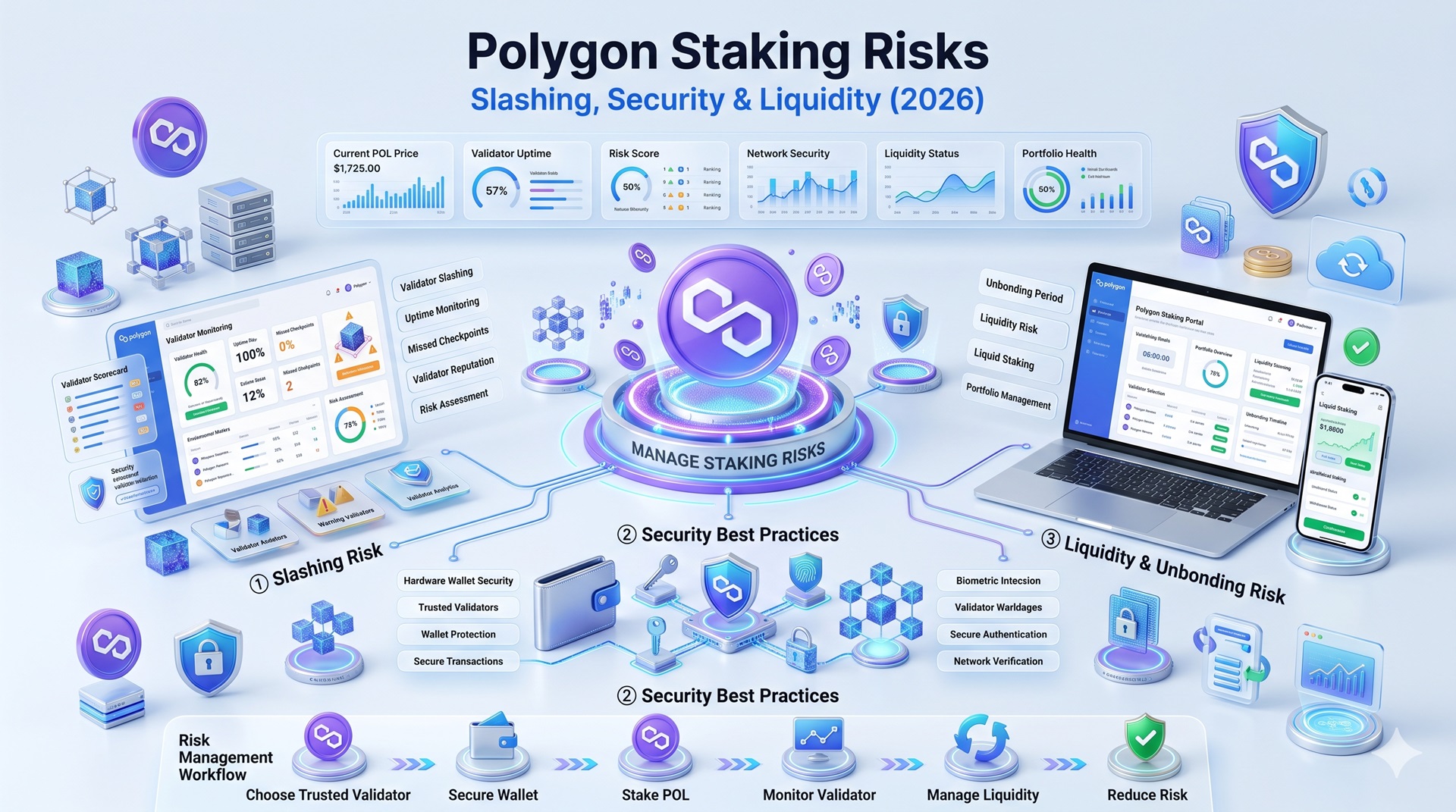
Polygon (POL) staking is one of the lower-risk staking environments among major proof-of-stake networks – primarily because automated stake-confiscation slashing remains inactive as of mid-2026.
However, that does not mean Polygon staking is risk-free. The meaningful risks for delegators in 2026 are concentrated in four areas that most guides underweight: phishing attacks targeting the mandatory spend approval transaction, smart contract exposure with liquid staking, commission spike manipulation, and the ETH gas cost exposure that can silently erode returns.
Slashing – What It Currently Means on Polygon PoS
Current Slashing Status in 2026
As of mid-2026, automated stake-confiscation slashing remains inactive on Polygon PoS. The protocol’s smart contracts include slashing functions, and Heimdall v2 references slashing incentives in its design — but the on-chain slash function is not currently used to seize or destroy delegator funds.
Confirmed by Everstake: Automated stake-confiscation slashing remains inactive on Polygon PoS. Although the protocol’s smart contracts include slashing functions and Heimdall v2 references slashing incentives in its design, the on-chain slash function is not currently used for delegator-fund confiscation.
The practical implication: your delegated POL cannot currently be permanently confiscated due to validator misbehavior.
How Validator Performance Affects Delegators Instead
While direct slashing is inactive, validators who miss checkpoints or experience downtime face a different consequence: they forfeit the reward share tied to those missed checkpoints. No rewards are distributed for a checkpoint a validator fails to sign.
Delegators share this reward loss proportionally. A validator operating at 94% checkpoint signing rate costs its delegators 6% of their potential reward income. Over a year, this compounds into material yield reduction with no on-chain alert to the delegator.
Under PIP-4, validators with sustained poor performance can be off-boarded from the capped active validator set. Delegators can also gradually redelegate away from underperforming validators — but the ~3–4 day unbonding period and the 21-day redelegation cooldown mean this “market mechanism” works slowly.
Future Slashing Risk
The Polygon roadmap includes progressive activation of slashing enforcement. Delegators staking today should factor the possibility of future slashing activation into their long-term risk assessment. Choosing validators with multi-year track records and high infrastructure standards reduces exposure if slashing enforcement is strengthened.
The Spend Approval Risk – How a Single Phishing Transaction Can Drain Your POL
This is the highest-probability, highest-impact risk for Polygon stakers — and it is consistently underweighted in every competitor guide.
When you first stake POL through the Polygon Staking Portal, you must approve a spend allowance: you authorize the staking smart contract to access your POL tokens. This is a standard ERC-20 approval transaction and is a legitimate requirement.
The Risk: Phishing sites that mimic the Polygon Staking Portal’s URL and interface display an identical “approve” prompt — but the smart contract address they request approval for is controlled by the attacker, not Polygon. Once you approve an unlimited spend allowance to a malicious contract, the attacker can drain your entire POL balance in a single subsequent transaction.
How to Protect Yourself
Bookmark staking.polygon.technology directly — never navigate to the staking portal from a Discord message, email, or social media post
Before confirming any “approve” transaction in MetaMask, verify the contract address matches the official Polygon StakeManager contract address (verifiable on Polygonscan)
Consider setting a specific spend limit (the exact amount you intend to stake) rather than approving unlimited access — most staking interfaces allow custom spend amounts
After staking, use a tool like revoke.cash to review and revoke any excess token approvals
This risk applies regardless of whether you use MetaMask, Coinbase Wallet, or any other self-custody wallet.
Smart Contract Risk with Liquid Staking
Native portal staking delegates directly to Polygon’s audited StakeManager contract. Liquid staking adds additional smart contract layers with their own risk profiles.
sPOL (Polygon’s native liquid staking token, launched April 2026): Audited by ChainSecurity and Certora, with Polygon Labs directly responsible for the protocol. Carries the lowest additional smart contract risk among Polygon liquid staking options.
Stader Labs (MaticX): Audited by Halborn and Immunebytes, with a $1M Immunefi bug bounty. Has operated since 2022 without a major exploit event.
Ankr (ankrPOL): Independent audits completed; ankrPOL is a reward-bearing token (quantity stays constant, exchange rate appreciates). Ankr notes explicitly that the only risk for stakers is missing out on rewards during any time a validator they staked with is slashed.
For All Liquid Staking Protocols
Smart contract bugs can cause loss of principal even if the underlying POL is “safe”
Protocol governance attacks can alter withdrawal mechanics
Third-party dependency on DEX liquidity for instant exits creates depeg risk under market stress conditions
Depeg risk: In volatile market conditions, liquid tokens like MaticX, sPOL, or ankrPOL may trade at a discount to POL on secondary markets. This affects anyone who exits via DEX sell rather than native redemption.
Commission Spike Risk
Validator commission is adjustable at any time. A validator operating at 0% or 2% commission today can raise their rate to 50% or higher without prior notice to delegators.
The most extreme version of this risk: a validator raises commission to 100% for a single checkpoint cycle — capturing all delegator rewards for that cycle — then immediately lowers it back. This “bait-and-switch” is technically possible with any validator that has not committed to a minimum notice period or governance-locked commission.
How to Mitigate
Choose validators with a history of stable commission and clear public communication
Monitor your validator’s commission on validator.info/polygon at least monthly
If commission changes, redelegate — accept the 3-4 day unbonding period as the cost of maintaining yield integrity
Ethereum Gas Cost Exposure
Every native Polygon staking transaction costs ETH — not POL. Delegation, reward claiming, compounding, and unstaking all require Ethereum gas fees.
This creates a risk that is almost unique to Polygon among major PoS chains: your staking yield can turn negative if Ethereum gas prices spike at the time you need to execute transactions.
During Ethereum network congestion events, gas prices can increase 5–10x from baseline. A delegation transaction that costs $8 at normal gas prices may cost $40–$80 during peak congestion. For smaller staking positions, high-gas environments can turn a profitable staking cycle into a net loss.
How to Mitigate
Use Ethereum’s gas tracker (etherscan.io/gastracker) to identify low-fee windows (typically weekends and nights UTC)
Batch transactions: combine reward claiming and redelegation into the same low-gas window
Hold 0.1–0.2 ETH buffer in your wallet at all times — running out of ETH mid-process can leave your POL stranded mid-transaction
Liquidity Risk – The 3–4 Day Unbonding Window
Once you initiate an unbonding request on the Polygon Staking Portal, your POL is locked for 80–82 checkpoints (~3–4 days). During this window:
You earn zero staking rewards
You cannot trade, transfer, or use your POL for any purpose
If POL’s price drops significantly during unbonding, you cannot sell
This 3–4 day lockup is substantially shorter than Cosmos (21 days) but longer than Solana (2–3 days) or Cardano (instant). For holders who need rapid liquidity, sPOL (sell on Polygon DEX instantly) or exchange staking with flexible withdrawal terms are the alternatives.
Exchange Custody Risk
Staking through centralized exchanges (Coinbase, Binance, Kraken, Bybit) eliminates gas cost exposure and the spend approval risk — but replaces them with platform custody risk.
When you stake POL through an exchange:
The exchange holds your private keys
Your POL is pooled with other users’ assets
In the event of an exchange insolvency or security breach, your staked POL is an unsecured creditor claim, not a segregated asset
The FTX collapse in 2022 demonstrated that even major, regulated-appearing exchanges can become insolvent rapidly. No centralized exchange staking product eliminates this risk.
Frequently Asked Questions
As of mid-2026, automated stake-confiscation slashing is inactive on Polygon PoS. Your delegated POL cannot currently be seized by the protocol due to validator misbehavior. However, validators who miss checkpoints forfeit reward income — and delegators share that reward loss. Future protocol upgrades may activate stake-confiscation slashing.
Phishing attacks targeting the mandatory spend approval transaction represent the highest-probability risk for active delegators. A single approval to a malicious contract can drain your entire POL balance. Bookmark the official portal URL and always verify the contract address before approving any transaction.
Yes, liquid staking adds smart contract risk, depeg risk, and protocol governance risk on top of the baseline risks of native delegation. Native staking through the official Polygon Staking Portal interacts only with Polygon’s audited StakeManager contract. Liquid staking through MaticX, sPOL, or ankrPOL adds protocol-specific vulnerabilities. The trade-off is flexibility and instant liquidity.
During the 80–82 checkpoint unbonding period, your POL earns no rewards and cannot be traded or transferred. If POL’s price drops significantly during this window, you cannot exit your position. For holders managing market exposure, sPOL (which can be sold on a DEX without waiting for unbonding) or exchange flexible staking provides faster exit options.
No legitimate exchange would intentionally steal user assets, but custodial risk is real. When you stake through a centralized exchange, the exchange controls your private keys and pools your assets with other users. In the event of insolvency, your staked POL becomes an unsecured creditor claim, not a guaranteed return. Self-custody native staking or liquid staking through audited protocols eliminates this specific risk.
Final Tip: Always verify the staking portal URL and contract address before approving any spend allowance — this single habit prevents the highest-probability risk to Polygon stakers.