How to Stake Crypto on Ledger Wallet: Complete 2026 Guide
How to Stake Crypto on Ledger Wallet: Complete 2026 Guide
CrisCoin 15 min readLedger
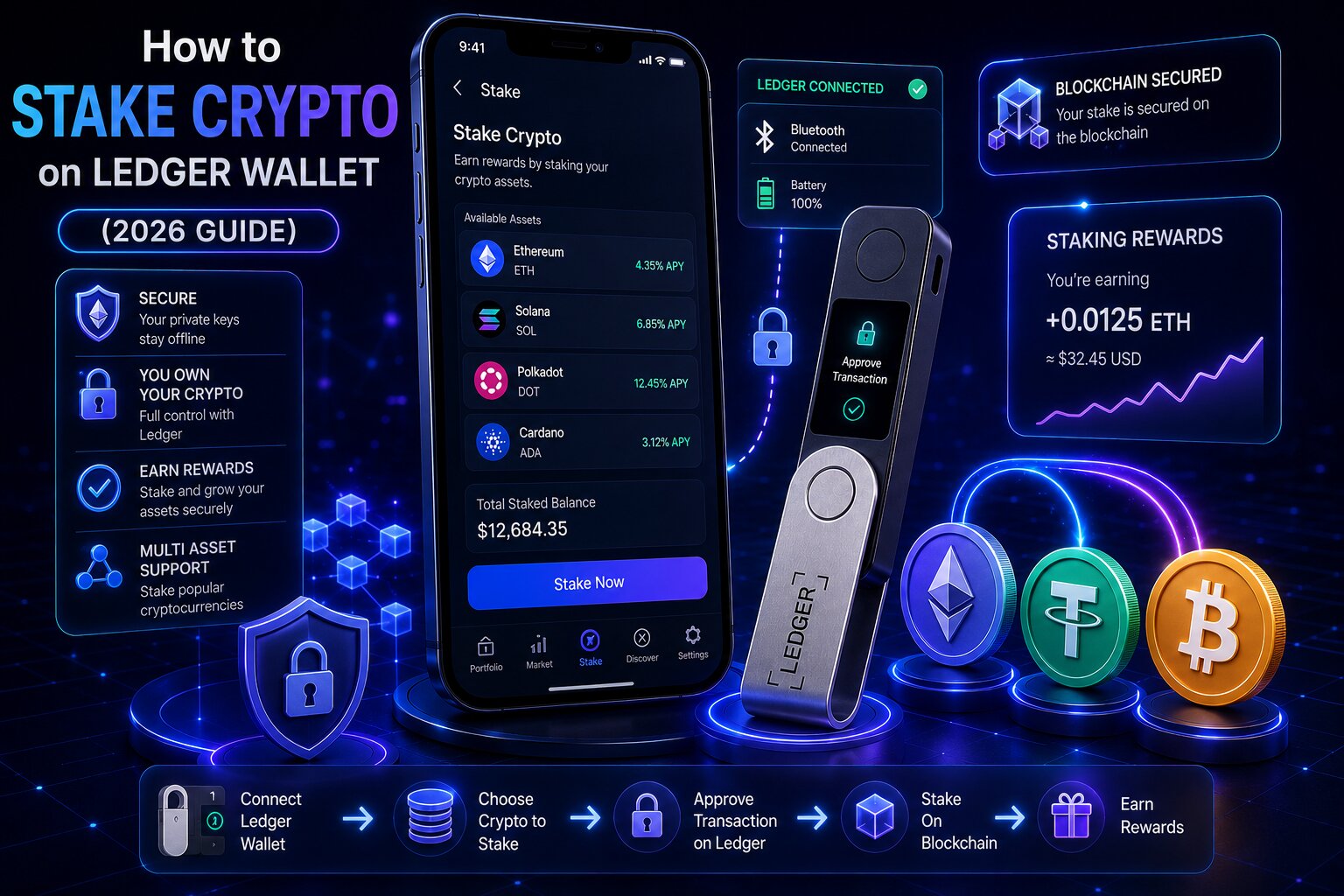
To stake on Ledger, open the Earn section in Ledger Wallet app, select an eligible asset, choose a Validator or provider, and confirm with Physical Confirmation.
Private keys stay offline in the Secure Element chip throughout — on-chain staking never requires transferring assets to an exchange or custodian.
Asset
Provider
Annualized Yield (2026)
Unbonding
ETH — Liquid Staking
Lido
~3%
None — swap stETH
ETH — Native Pooled
Kiln
~3.5%
~4 days
SOL — Native
Validator (user selects)
~5–7%
~2–3 days
ATOM — Delegated
Validator (user selects)
~15–21%
21 days
DOT — Nominated PoS
Validator (nominate)
~12–15%
28 days
ADA — Delegation
Stake pool
~2.7%
No lockup
Rewards Are Not GuaranteedAnnualized yields fluctuate based on network participation rates, Validator commission, and epoch reward schedules.
Key Staking Terms
Term
Definition
Validator
Network node that confirms transactions and distributes rewards
Delegator
Token holder who assigns stake to a Validator without transferring ownership
Unbonding Period
Mandatory wait between undelegating and accessing staked assets
Slashing
Penalty that burns staked tokens when a Validator misbehaves
Liquid Staking
Issues a tradeable receipt token (e.g. stETH) while the original asset earns rewards
Validator Commission
Percentage of rewards deducted before distribution to delegators
How Does the Earn Section Work?
Proof-of-Stake selects Validators based on the amount of crypto they hold or receive as delegations. Validators distribute a share of block rewards to delegators proportionally, after deducting commission. The Earn section in Ledger Wallet 4.0 automatically identifies idle assets eligible for rewards — no manual portfolio search required, and Liquid Staking providers like Lido and Kiln are accessible directly from the tab.
How to Stake — Step by Step
1
Connect and unlock
Connect the Ledger signer via USB-C and unlock with your PIN.
2
Open the Earn tab
See all eligible assets with current annualized yield and estimated rewards in token and fiat terms.
3
Choose asset and method
Select the asset, then native delegation to a Validator or Liquid Staking via Lido/Kiln.
4
Confirm with Physical Confirmation
Review the amount, yield, Unbonding Period, and commission, then press both buttons on the device.
Keep Gas ReservesAlways retain a small amount of the native token in the non-staked balance to cover gas fees for future staking and undelegation transactions.
Selecting a Validator for SOL, ATOM, or DOT
Selection Criteria
Target
Why
Uptime
99%+
Low uptime causes missed epoch rewards
Commission rate
5–10%
Higher commission reduces net yield
Total stake
Moderate
Very high stake reduces decentralization
Slashing history
Clean
Past incidents signal elevated future risk
Delegators can split positions across multiple Validators to reduce single-node Slashing exposure — particularly recommended for ATOM and DOT.
Staking ETH Without 32 ETH — Lido vs Kiln
Feature
Lido (Liquid Staking)
Kiln (Native Pooled)
Annualized yield
~3%
~3.5%
Output token
stETH
ETH (native)
Liquidity
Instant — swap via Paraswap
~4 day Unbonding Period
DeFi composability
stETH usable as collateral
No derivative token
Supply Chain RiskA 2025 supply chain attack on Kiln injected malicious logic into unstaking transactions, causing $41.5M in losses. The Ledger Secure Element chip was not compromised — the exploit targeted the smart contract layer.
Which Asset Offers the Best Staking Rewards?
Best for beginners
Asset
Yield
Slashing Risk
Unbonding
ADA
~2.7%
None
None
ETH (Lido)
~3%
Indirect
None
SOL
~5–7%
Yes
~2–3 days
ADA staking has no Slashing mechanism and no Unbonding Period — the ideal first staking experience. SOL auto-compounds rewards every epoch, increasing effective yield over time without any user action.
Best for passive income
ATOM delivers the highest nominal yield (~15–21%) via Cosmos Hub Delegated Proof-of-Stake, but assets are illiquid for 21 days after undelegation. DOT’s 28-day Unbonding Period is the longest among major Ledger staking assets — model liquidity needs carefully before committing.
Unstaking and Unbonding Periods
Asset
Unbonding Time
Rewards During Unbonding
ADA
None — instant
N/A
ETH (Lido)
None — swap stETH
N/A
SOL
~2–3 days
Stop at undelegation
ETH (Kiln)
~4 days
Stop at undelegation
ATOM
21 days
Stop at undelegation
DOT
28 days
Stop at undelegation
Unbonding Periods are enforced at the blockchain protocol level — they cannot be shortened by Ledger, the provider, or any third party.
Risks of Staking on Ledger
Five Risk Categories
Slashing — Validator misbehavior burns a portion of delegated assets
Smart contract exploit — a bug in Lido or Kiln code drains staked assets
Price depreciation — token falls during the Unbonding Period
Token inflation — new issuance may offset nominal staking yield (ATOM, DOT)
None of these risks expose the private key or compromise the hardware security chip — they only affect the fiat value of the delegated position.
Ledger vs Exchange Staking
Factor
Ledger
Coinbase
Binance
Key custody
Self-custody
Custodial
Custodial
ETH APY
~3–3.5%
~2.16%
~2.65%
SOL APY
~5–7%
~7.76%
~6.96%
Exchange hack risk
None
Present
Present
Ledger offers higher ETH and ADA yield than Coinbase and Binance while keeping assets in self-custody, where no exchange freeze or insolvency can block access. Coinbase leads on SOL yield — exchange staking occasionally outperforms hardware wallet staking on specific assets.
Frequently Asked Questions
Open Ledger Wallet app, connect the device, navigate to Earn, select an eligible asset, choose a Validator or staking provider, review the yield and Unbonding Period, then press both buttons to authorize with Physical Confirmation.
ETH (via Lido and Kiln), SOL, ATOM, DOT, ADA, and BTC yield, plus additional assets in the Earn section. SOL and ADA have no minimum. ETH staking does not require 32 ETH through pooled delegation.
Private keys stay offline in the hardware chip throughout — exchange hack and custodial risk don’t apply. Main risks are Validator Slashing, smart contract exploits in Lido/Kiln, price moves during unbonding, and token inflation.
Yes. Lido and Kiln both enable ETH staking with any amount through pooled delegation. Lido issues stETH with no Unbonding Period. Kiln offers ~3.5% native yield with about 4 days to withdraw after undelegation.
Open Earn → select the active position → Unstake → enter the amount → confirm with Physical Confirmation. ADA and Lido stETH have no lockup; SOL takes ~2–3 days; ATOM 21 days; DOT 28 days.