How to Bridge Tokens on Ledger Wallet: Complete 2026 Guide
How to Bridge Tokens on Ledger Wallet: Complete 2026 Guide
CrisCoin 12 min readLedger
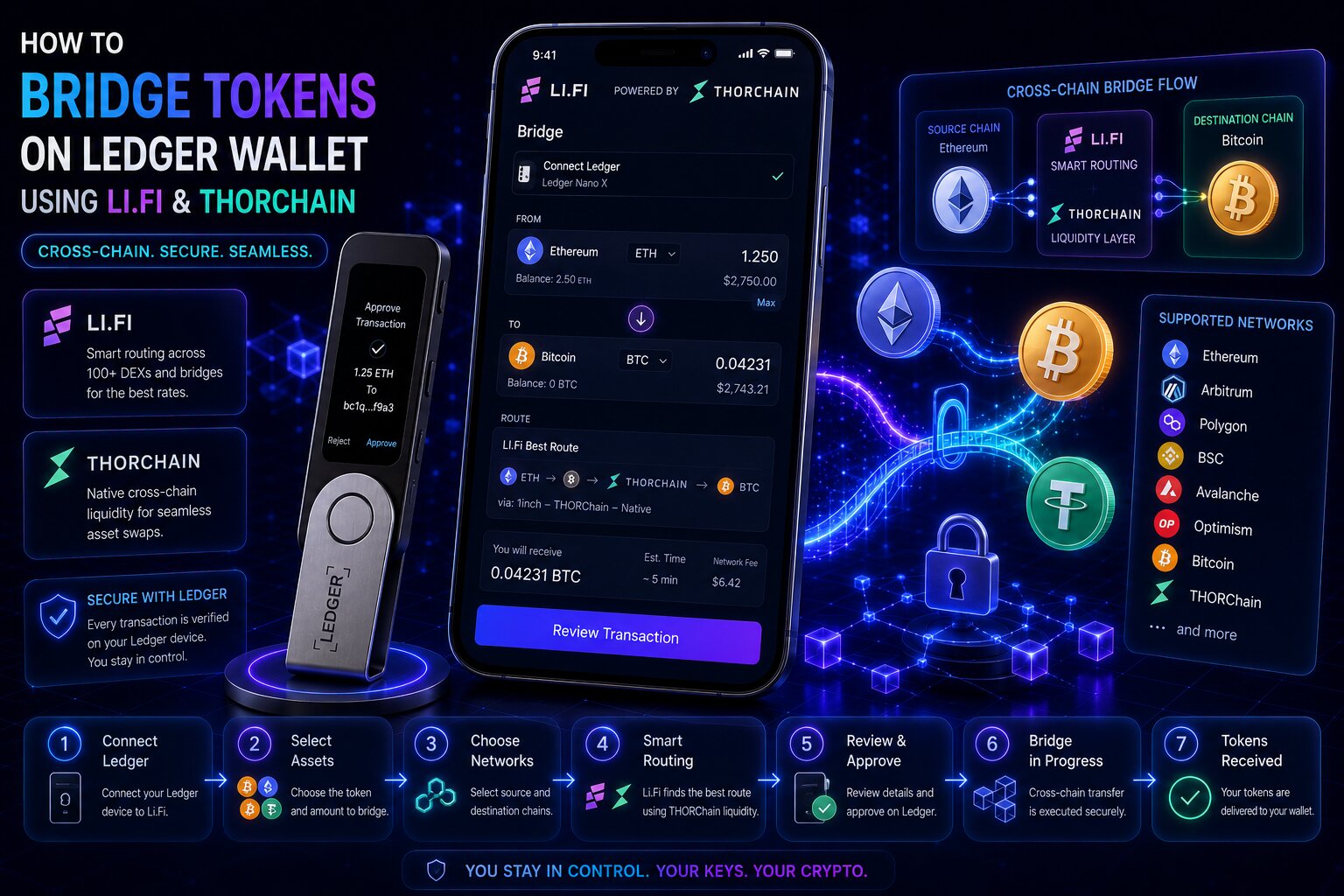
Token bridging moves crypto assets between blockchains using integrated cross-chain protocols inside Ledger Wallet 4.0.
Four providers are natively embedded — Li.Fi for EVM routing, THORChain for native Bitcoin settlement, NEAR Intents for intent-based execution, and OKX DEX for aggregated multi-chain liquidity. No external website is required, and the hardware signer validates every request locally.
Provider
Chains
Wrapped Asset
Best Intent
Li.Fi
ETH, Arbitrum, Base, BNB, Polygon, Optimism
Optional
Cheapest EVM-to-EVM route
THORChain
BTC, ETH, SOL, AVAX + others
Never
Native BTC → ETH/SOL without wrapping
NEAR Intents
NEAR, BTC, ETH, SOL + others
Optional
Fastest multi-chain execution
OKX DEX
20+ chains, 400+ DEXs
Optional
Best-price EVM cross-chain swap
What Is Token Bridging on Ledger Wallet?
Bridging moves assets between blockchains — isolated systems with incompatible transaction formats — through a cross-chain protocol. Ledger Wallet routes these natively through Li.Fi, THORChain, OKX DEX, or NEAR Intents without leaving the app, while the hardware signer isolates approval within its security module throughout. Ledger scans 15+ bridge providers and returns the optimal route ranked by cost, speed, and risk before you confirm.
Bridge vs Swap vs Cross-Chain Swap
Operation
Asset Changes
Chain Changes
Example
Swap
Yes
Same chain
ETH → USDC on Ethereum
Bridge
Same asset
Different chain
ETH on Ethereum → ETH on Arbitrum
Cross-chain swap
Yes
Yes
USDC on Ethereum → PEPE on Polygon
Which Bridge Mechanism Is Safest?
Mechanism
How It Works
Risk
Lock and Mint
Asset locked on chain A, wrapped token minted on chain B
Higher — lock contract exploitable
Burn and Mint
Native token burned on A, identical token minted on B
Lower — no lock contract
Lock and Unlock
Asset locked in pool A, native asset released from pool B
Medium — pool can be drained
Historical Bridge ExploitsMajor exploits including Ronin ($625M, 2022) and Wormhole ($320M, 2022) both targeted lock contracts. Burn-and-mint (Circle’s CCTP) and THORChain’s native pools avoid this risk entirely since no lock contract holds value.
Ledger’s Native Bridge Providers
Li.Fi — EVM Aggregator
Li.Fi is the primary EVM bridge aggregator, routing transfers across Ethereum, Arbitrum, Base, BNB Chain, Polygon, and Optimism. It aggregates routes from Across, Connext, Hop, Celer, and 10+ other providers, so solver competition produces the best available price and speed — you authorize once regardless of how many underlying contracts execute.
THORChain — Native Bitcoin Settlement
THORChain pools native BTC against native ETH, SOL, and AVAX liquidity — Bitcoin enters a Bitcoin-native vault operated by a validator quorum rather than being locked in an Ethereum contract. Node operators bond RUNE worth 1.5× the pooled value, aligning incentives toward honest operation. Settlement waits for 6 Bitcoin confirmations (~60 minutes) before releasing the destination asset.
NEAR Intents — Solver Competition
NEAR Intents lets users submit a signed intent specifying the desired outcome, and a network of solvers compete to fulfill it at the best price — producing faster settlement than single-route bridges. It spans NEAR, Bitcoin, Ethereum, and Solana in one unified intent layer.
OKX DEX — Aggregated Liquidity
OKX DEX routes trades through X-Routing technology across 400+ DEXs on 25+ chains, splitting large orders across multiple venues to minimize price impact. It operates non-custodially — Ledger’s hardware signer retains signing authority throughout.
How Do You Bridge Tokens — Step by Step?
Bridging ETH from Ethereum to Arbitrum
1
Connect and open Swap
Ensure the Ethereum app is installed and open on the device, then go to the Swap tab in Ledger Wallet.
2
Select source and destination
ETH on Ethereum as source, ETH on Arbitrum as destination.
3
Review the route
Check the Li.Fi route, output amount, slip tolerance, and settlement estimate.
4
Confirm on device
Verify the destination chain and amount on the hardware display, then press both buttons to authorize.
ETH arrives on Arbitrum within minutes via the rollup’s finality window.
Bridging USDC via Canonical CCTP
Circle’s CCTP burns USDC on the source chain and mints canonical native USDC at the destination — no wrapped intermediary. Select USDC on Ethereum as source and USDC on Base as destination in the Swap tab; Li.Fi automatically routes through CCTP when it’s the best path, and you confirm the Base destination on the device before it broadcasts.
Bridging Bitcoin to ETH or SOL via THORChain
1
Select BTC source and destination
Ensure the Bitcoin app is installed, then choose BTC on Bitcoin as source and ETH or SOL as destination.
2
Review the slip fee
Larger amounts relative to pool depth incur higher slip fees — review before confirming.
3
Confirm and wait
Verify the BTC amount and vault address on the device, authorize, and wait roughly 60 minutes for 6 Bitcoin confirmations before the destination asset arrives.
Paying Gas in Any Token
Ledger deducts gas costs directly from the swapped token — a user holding only USDC on Ethereum can bridge to Arbitrum without holding any native ETH. The displayed output already reflects gas deduction, though not every route supports this gas abstraction feature.
Li.Fi vs THORChain vs OKX DEX
Criterion
Li.Fi
THORChain
OKX DEX
Supports BTC
No
Yes — native
No
EVM coverage
Full
Limited
Full
Wrapped assets
Optional
Never
Optional
Best for BTC
❌
✅
❌
Best for USDC
CCTP canonical
❌
—
Use Li.Fi for canonical USDC transfers across EVM chains, THORChain for BTC ↔ ETH/SOL without wrapping, and OKX DEX for large EVM swaps needing deep liquidity. NEAR Intents offers the fastest settlement when solver competition is active.
Security Model for Bridging
Risk
Mitigation in Ledger Wallet
Bridge exploit (lock contract hacked)
Li.Fi routes via audited providers; THORChain/CCTP avoid lock contracts
Screen manipulation
Hardware display shows verified transaction data independently
Open the Swap tab, select source and destination chain and asset, review the auto-selected route from Li.Fi, THORChain, OKX DEX, or NEAR Intents, then click Exchange and verify the destination chain and amount on the hardware display before confirming. No external website is needed.
For canonical USDC, Li.Fi via CCTP avoids lock contract exposure. For BTC ↔ ETH/SOL without wrapping, THORChain’s native pools have no lock contract risk. For best-price EVM swaps, OKX DEX aggregates 400+ DEXs. Ledger automatically compares all providers and selects the optimal route.
Yes. THORChain pools native BTC against native ETH, SOL, and AVAX liquidity — no wrapped Bitcoin is created. Settlement requires roughly 60 minutes for 6 Bitcoin confirmations before the destination asset releases.
A swap exchanges one asset for another on the same blockchain. A bridge moves the same asset between two different blockchains. A cross-chain swap combines both. Li.Fi supports all three for EVM chains; THORChain specializes in cross-chain swaps using native liquidity pools.
It’s safer than external bridge websites, since the hardware signer prevents key exposure and screen manipulation. Smart contract risk remains inherent to all bridge protocols, though THORChain and CCTP-routed USDC carry the lowest risk since neither uses lock contracts or wrapped assets.