How to Bridge Tokens on Ledger Wallet Using Li.Fi and THORChain (2026 Guide)
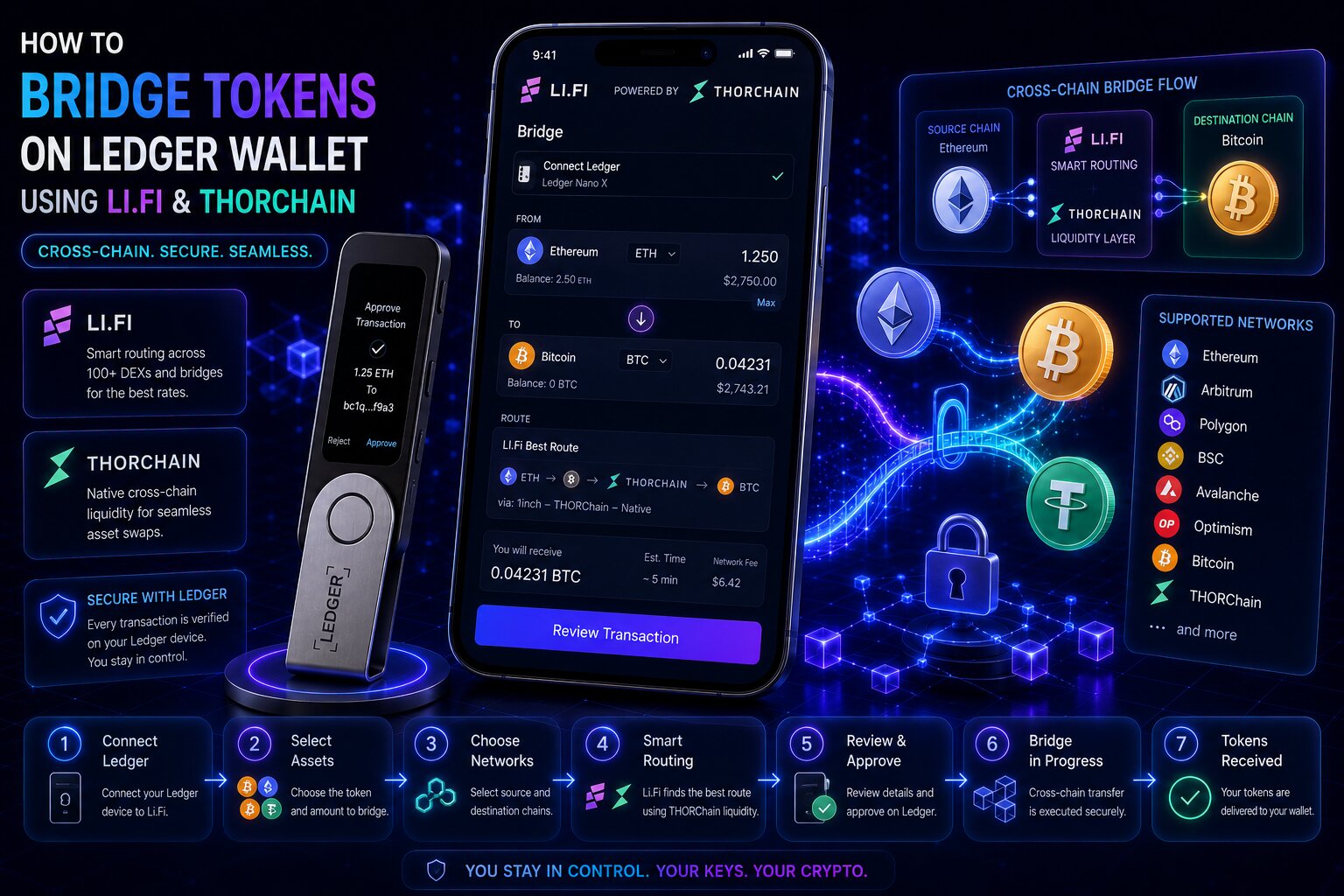
Token bridging moves crypto assets between blockchains using integrated cross-chain protocols inside Ledger Wallet 4.0. Four providers are natively embedded – Li.Fi for EVM routing, THORChain for native Bitcoin settlement, NEAR Intents for intent-based execution, and OKX DEX for aggregated multi-chain liquidity. No external website is required, and the hardware signer validates every bridge request locally before execution.
| Provider | Chains | Mechanism | Wrapped Asset | Best Intent |
| Li.Fi | ETH, Arbitrum, Base, BNB, Polygon, Optimism | Aggregated β Lock/Mint, Burn/Mint, Lock/Unlock | Optional | Cheapest EVM-to-EVM route |
| THORChain | BTC, ETH, SOL, AVAX + others | Native liquidity pools | Never | Native BTC β ETH/SOL without wrapping |
| NEAR Intents | NEAR, BTC, ETH, SOL + others | Intent-based solver competition | Optional | Fastest multi-chain execution |
| OKX DEX | 20+ chains, 400+ DEXs | X-Routing aggregation | Optional | Best-price EVM cross-chain swap |
What is token bridging on Ledger Wallet?
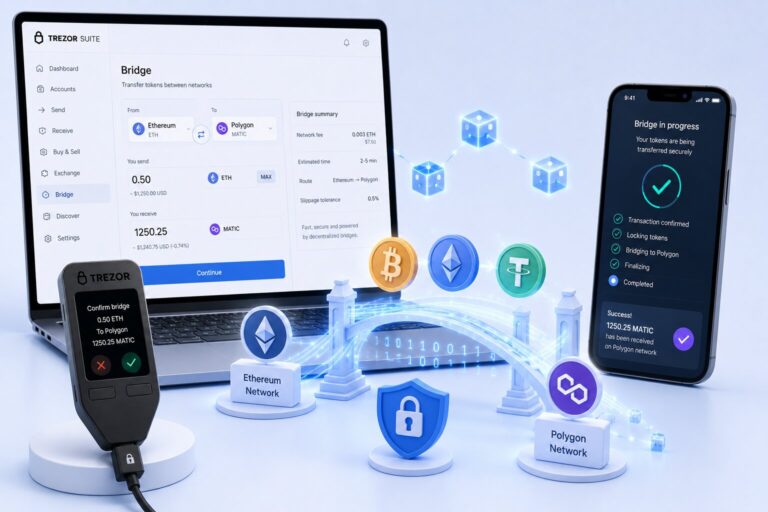
Token bridging moves assets between blockchains through a cross-chain protocol β Ledger Wallet 4.0 routes these operations natively through Li.Fi, THORChain, OKX DEX, or NEAR Intents without leaving the app. The hardware signer isolates transaction approval within its tamper-resistant security module throughout every operation.
- Blockchains are isolated systems with incompatible transaction formats and consensus rules β cross-chain bridges create interoperability channels between them.
- Ledger Wallet scans 15+ bridge providers simultaneously and returns the optimal route ranked by cost, speed, and risk before the user confirms.
- Introducing Ledger Wallet 4.0 eliminated the need to navigate external bridge sites β removing a major phishing attack vector that affected users of standalone bridge interfaces.
What is the difference between bridge, swap, and cross-chain swap on Ledger?
| Operation | Asset Changes | Chain Changes | Example |
| Swap | Yes | Same chain | ETH β USDC on Ethereum |
| Bridge | Same asset | Different chain | ETH on Ethereum β ETH on Arbitrum |
| Cross-chain swap | Yes | Yes | USDC on Ethereum β PEPE on Polygon |
- Li.Fi handles all three operation types for EVM chains β the interface routes the correct operation based on source and destination selection.
- THORChain handles cross-chain swaps only β it does not support same-chain exchanges.
- A cross-chain swap bundles bridge and exchange operations, typically using relayers and solver networks to minimize settlement time.
Which cross-chain bridge mechanism is safest for Ledger users?
Three bridge architectures operate within Ledger Wallet β each with different risk profiles depending on the trust assumptions built into the underlying protocol.
| Mechanism | How It Works | Destination Token | Trust Assumption | Risk |
| Lock and Mint | Asset locked in contract on chain A β wrapped token minted on chain B | Wrapped token (e.g. wBTC) | Bridge operator controls lock | Higher β lock contract exploitable |
| Burn and Mint | Native token burned on chain A β identical token minted on chain B | Canonical native token | Issuer consensus (e.g. Circle CCTP) | Lower β no lock contract |
| Lock and Unlock | Asset locked in pool A β native asset from pool B released | Native token | Liquidity pool depth | Medium β pool can be drained |
- Lock and Mint produces wrapped assets β synthetic representations whose value depends on the lock contract remaining intact. Major bridge exploits including the Ronin ($625M, 2022) and Wormhole ($320M, 2022) incidents targeted lock contracts.
- Burn and Mint β used by Circle’s CCTP for canonical USDC β destroys tokens on the source chain and creates native tokens at the destination. Circle launched CCTP specifically to eliminate fragmented wrapped USDC across Ethereum rollups.
- THORChain pools native BTC against native ETH, SOL, and AVAX liquidity β no lock contract holds Bitcoin, and no wrapped BTC is created at any stage.
Which bridge providers does Ledger Wallet support natively in 2026?
Does Ledger use Li.Fi for Ethereum and Arbitrum bridging?
Yes. Li.Fi is the primary EVM bridge aggregator integrated into Ledger Wallet β it routes cross-chain transfers across Ethereum mainnet, Arbitrum, Base, BNB Chain, Polygon, Optimism, and other EVM-compatible rollups. Li.Fi uses the ERC-2535 diamond proxy standard, enabling dynamic bridge integrations without full contract redeployment.
- Li.Fi aggregates routes from Across Protocol, Connext, Hop, Celer, and 10+ other bridge providers β the solver competition between these routes produces the best available price and settlement speed.
- When a bridge is initiated, the signed transaction calls Li.Fi’s smart contract, which routes to the selected bridge protocol’s relayer β the user authorizes once regardless of how many underlying contracts execute.
- Li.Fi’s aggregation model distributes risk across multiple bridge protocols β if one underlying provider is compromised, Li.Fi can route around it, though smart contract exposure at the aggregator layer itself remains.
Why does THORChain avoid wrapped BTC β and how does it work?
THORChain pools native BTC against native ETH, SOL, and AVAX liquidity on each respective chain. When Bitcoin enters the THORChain protocol, it does not get locked in an Ethereum contract β it enters a Bitcoin-native vault operated by a validator quorum of bonded node operators.
- THORChain’s validator quorum model requires node operators to bond RUNE worth 1.5Γ the value of pooled assets β misaligned validators face slashing, aligning incentives toward honest operation.
- Slippage tolerance on THORChain varies with pool depth β larger BTC swaps produce higher slip fees due to liquidity impact, which Ledger Wallet displays before confirmation.
- Finality assumptions differ from EVM bridging β THORChain waits for 6 Bitcoin confirmations (~60 minutes) before releasing the destination asset, creating longer settlement times than EVM-to-EVM bridges.
While THORChain prioritizes native asset settlement, Li.Fi focuses on aggregated EVM routing across multiple bridge providers. NEAR Intents takes a different approach entirely β abstracting the routing decision away from the user.
What is NEAR Intents and how does it enable fastest cross-chain execution?
NEAR Intents operates through solver competition β users submit a signed intent specifying what they want to receive, and a network of solvers compete to fulfill the intent at the best available price. The winning solver executes the cross-chain operation.
- Solver competition produces faster settlement than single-route bridges because multiple parties race to fill the order simultaneously.
- NEAR Intents supports NEAR, Bitcoin, Ethereum, and Solana β spanning EVM and non-EVM chains through a unified intent layer.
- Account abstraction elements in NEAR Intents allow the protocol to batch cross-chain steps β bridge, swap, and fee payment β into a single user-confirmed operation.
How does OKX DEX aggregate cross-chain liquidity for Ledger users?
OKX DEX routes trades through its proprietary X-Routing technology across 400+ DEXs on 25+ blockchains β finding optimal pricing by splitting orders across multiple venues simultaneously to minimize MEV exposure and price impact.
- OKX DEX functions as a decentralized search engine for on-chain liquidity β accessing Ethereum, Arbitrum, Optimism, Base, Polygon, and BNB Chain with a single interface.
- X-Routing splits large orders across multiple DEX pools to reduce slippage tolerance requirements β particularly valuable for larger cross-chain transfers where single-route execution would shift market prices.
- Despite being part of the broader OKX ecosystem, OKX DEX operates non-custodially β Ledger’s hardware signer retains signing authority and no funds transit OKX infrastructure during execution.
How do you bridge tokens on Ledger Wallet step by step?
How do you bridge ETH from Ethereum to Arbitrum on Ledger Wallet?
Steps β ETH Ethereum β Arbitrum via Li.Fi:
- Connect the Ledger signer and ensure the Ethereum app is installed and open on the device.
- Open Ledger Wallet app β navigate to the Swap tab.
- Select ETH on Ethereum as source and ETH on Arbitrum as destination.
- Enter the amount β Li.Fi displays the best available bridge route, estimated arrival time, and gas cost.
- Review the route details: provider, output amount, slip tolerance, and settlement estimate.
- Click Exchange β transaction details appear on the hardware device’s display screen.
- Verify destination chain (Arbitrum), destination address, and ETH amount on the device screen.
- Press both buttons to authorize β the bridge transaction broadcasts to Li.Fi’s smart contract.
- ETH arrives on Arbitrum within minutes via the Arbitrum rollup’s finality window.
Verify the destination chain and output amount on the hardware display before confirming β a cross-chain transaction sent to the wrong rollup is irreversible.
How do you bridge USDC across chains using canonical USDC (CCTP) in Ledger Wallet?
Circle’s CCTP produces canonical USDC at the destination β identical native USDC rather than a wrapped synthetic version. Li.Fi automatically routes USDC transfers through CCTP when it offers the best path.
Steps – USDC Ethereum β Base via CCTP:
- Ledger Wallet β Swap β select USDC on Ethereum as source, USDC on Base as destination.
- Enter the amount β Li.Fi identifies and displays the CCTP Burn and Mint route.
- Review: canonical USDC is received on Base, no wrapped token intermediary.
- Confirm on the hardware device β verify Base as destination chain.
- USDC burns on Ethereum; canonical native USDC mints on Base within minutes.
- CCTP canonical USDC avoids the wrapped token risk present in Lock and Mint bridges β the received USDC on Base has no dependency on a lock contract.
- LayerZero and Wormhole also facilitate USDC cross-chain transfers but use different trust models β CCTP’s issuer-consensus model (Circle-controlled) offers a different risk profile than third-party validator quorum bridges.
How do you bridge Bitcoin to ETH or SOL on Ledger Wallet using THORChain?
Steps β BTC β ETH via THORChain:
- Ensure the Bitcoin app is installed on the Ledger device.
- Open Ledger Wallet β Swap β select BTC on Bitcoin as source, ETH on Ethereum as destination.
- Enter BTC amount β THORChain displays the estimated ETH output, slip fee, and ~60-minute settlement estimate (6 Bitcoin confirmations).
- Review the slip fee β large BTC amounts relative to pool depth incur higher fees due to liquidity impact.
- Click Exchange β verify BTC amount and THORChain vault address on the hardware display.
- Authorize with Physical Confirmation β BTC broadcasts to the THORChain Bitcoin vault.
- Native ETH arrives in the Ledger Ethereum account after THORChain’s finality window completes.
Can Ledger bridge Bitcoin directly to Solana?
Yes. THORChain supports native BTC β SOL swaps through its multi-chain liquidity pool architecture β Bitcoin enters the BTC pool and native SOL exits the Solana pool. No wrapped Bitcoin appears at any stage.
- Settlement time for BTC β SOL follows Bitcoin’s confirmation requirements (~60 minutes for 6 blocks) β Solana finality on the destination side completes in seconds once BTC confirms.
- THORChain’s validator quorum secures the cross-chain settlement β each node bonds 1.5Γ the value of pooled assets as RUNE to guarantee honest execution.
How does Ledger Wallet let you pay gas fees in any token?
Ledger deducts gas costs directly from the swapped token during execution β users holding USDC on Ethereum can bridge to Arbitrum without holding any ETH for gas. The total output amount displayed on the hardware screen already reflects gas deduction.
- Gas abstraction bundles the network fee into the bridge operation β the protocol converts a portion of the source token to the required native gas token internally.
- This removes the barrier of acquiring native gas tokens on every supported chain before using DeFi β a common friction point for multi-chain users.
- Not all transaction types support gas abstraction β the Swap interface displays whether the feature is available for each specific route before the user confirms.
What is the safest way to bridge crypto with Ledger Wallet?
Security model summary: The hardware signer isolates transaction approval from internet-connected processes β private keys are generated and stored inside the tamper-resistant security module and never transmitted during any bridge operation. The hardware display shows verified transaction data before authorization, preventing screen manipulation attacks.
This section consolidates all security context β individual sections above do not repeat it.
| Risk | Mitigation in Ledger Wallet |
| Bridge exploit (lock contract hacked) | Li.Fi routes via audited providers; THORChain/CCTP have no lock contracts |
| Screen manipulation | Hardware display shows verified transaction data independent of connected computer |
| MEV exposure | OKX DEX X-Routing splits orders to reduce extractable value |
| Wrong chain confirmation | Hardware display verification + Physical Confirmation required |
| Relayer failure | Li.Fi aggregates 15+ providers β alternative routes available if one fails |
| Validator quorum compromise (THORChain) | 1.5Γ RUNE bond requirement per node aligns validator incentives |
| Liquidity fragmentation | Li.Fi scans 15+ bridge providers to find available liquidity automatically |
Are wrapped tokens riskier than native assets when bridging on Ledger?
Yes. Wrapped tokens carry an additional trust dependency β their value depends on the bridge’s lock contract remaining uncompromised. A bridge exploit that drains the lock contract renders the wrapped tokens on the destination chain worthless.
- The Ronin ($625M, 2022) and Wormhole ($320M, 2022) exploits both targeted lock contract vulnerabilities β wrapped asset holders on the destination chains lost value when the locks were drained.
- Canonical USDC via CCTP and native assets via THORChain avoid this risk entirely – no lock contract holds value, so no lock contract can be exploited.
- Ledger displays the bridge mechanism in the route details before confirmation – users can identify whether a wrapped intermediate asset is involved and choose alternative routes if preferred.
What happens if a bridge fails during a Ledger transaction?
A bridge failure after the source chain transaction confirms but before the destination chain receives the assets leaves funds in transit. Li.Fi’s aggregation layer monitors bridge status and provides recovery paths for stuck transactions.
- Most bridge failures resolve automatically within the protocol’s timeout window – Li.Fi displays transaction status in Ledger Wallet’s activity feed.
- If a bridge route fails completely, Li.Fi’s smart contract refunds assets to the source chain address – the Ledger account recovers the original tokens minus gas fees.
- THORChain has an outbound transaction queue β if the destination chain is congested, the swap completes after queue processing rather than failing outright.
Li.Fi vs THORChain vs OKX DEX β which should you use?
| Criterion | Li.Fi | THORChain | OKX DEX |
| Supports BTC | No | Yes – native | No |
| EVM coverage | Full | Limited | Full |
| Wrapped assets | Optional | Never | Optional |
| Smart contract risk | Multi-layer | Validator quorum | Aggregator layer |
| Settlement speed | Minutes (rollups) | ~60 min (BTC) | Minutes |
| Best for low fees | Aggregated routing | Slip fees on large swaps | X-Routing splits orders |
| Best for BTC | β | β | β |
| Best for USDC | CCTP canonical | β | β |
- Use Li.Fi for canonical USDC transfers across EVM chains β CCTP routing produces native USDC with no lock contract exposure.
- Use THORChain for BTC β ETH or BTC β SOL β the only option that avoids wrapped Bitcoin entirely.
- Use OKX DEX for large EVM token swaps requiring deep liquidity β X-Routing reduces price impact by splitting orders across 400+ venues.
- NEAR Intents offers the fastest settlement for multi-chain operations when solver competition is active β best for time-sensitive cross-chain swaps.
What are the most common mistakes when bridging tokens on Ledger?
| Mistake | Result | Prevention |
| Confirming wrong destination chain | Funds arrive on unintended chain β irreversible | Verify chain name on hardware display before confirming |
| Ignoring THORChain slip fee | Significantly less ETH/SOL received than expected | Review slip fee for BTC amounts above $10,000 |
| Using external bridge sites instead of Ledger Wallet | Phishing risk β fake interfaces steal approvals | Use only native providers inside Ledger Wallet app |
| Assuming same USDC across all chains | Receiving wrapped USDC instead of canonical | Check route for CCTP designation before confirming |
| Expecting instant BTC settlement | THORChain requires ~60 min for 6 Bitcoin confirmations | Plan for Bitcoin’s finality window before time-sensitive swaps |
FAQ
How do I bridge tokens on Ledger Wallet?
Open Ledger Wallet β Swap tab β select source chain and asset β select destination chain β review the auto-selected route from Li.Fi, THORChain, OKX DEX, or NEAR Intents β click Exchange β verify destination chain and amount on the hardware display β confirm. The hardware signer authorizes every bridge locally β no external website required.
What is the best bridge for Ledger?
For canonical USDC cross-chain transfers, Li.Fi via CCTP produces native USDC with no lock contract exposure. For BTC β ETH or BTC β SOL without wrapping, THORChain’s native pool model has no lock contract risk. For best-price EVM swaps, OKX DEX X-Routing aggregates 400+ DEXs across 20+ chains. Ledger Wallet automatically compares all providers and selects the optimal route.
How do I bridge ETH from Ethereum to Arbitrum on Ledger?
Open Ledger Wallet β Swap β select ETH on Ethereum as source and ETH on Arbitrum as destination β enter amount β review the Li.Fi route and gas cost β click Exchange β verify Arbitrum as destination on the hardware display β confirm with Physical Confirmation. ETH arrives on Arbitrum within minutes via the Arbitrum rollup’s finality settlement.
Does Ledger support cross-chain transfers?
Yes. Ledger Wallet 4.0 natively supports cross-chain transfers through Li.Fi (EVM rollups), THORChain (native BTC/ETH/SOL swaps), NEAR Intents (intent-based multi-chain), and OKX DEX (400+ DEXs, 20+ chains). Every cross-chain transfer is hardware-signed by the Ledger signer β no external bridge interface is needed.
How does Li.Fi work with Ledger?
Li.Fi aggregates 15+ bridge providers β Across, Connext, Hop, Celer, and others β and uses solver competition to find the optimal EVM cross-chain route. The signed transaction calls Li.Fi’s ERC-2535 diamond proxy contract, which routes to the selected bridge’s relayer. Li.Fi’s aggregation model distributes risk across multiple providers and enables CCTP routing for canonical USDC transfers.
Can I bridge Bitcoin on Ledger without wrapping?
Yes. THORChain, integrated in Ledger Wallet 4.0, pools native BTC against native ETH, SOL, and AVAX liquidity β no wrapped Bitcoin is created at any stage. THORChain’s validator quorum model bonds 1.5Γ pooled value in RUNE per node. Settlement requires ~60 minutes for 6 Bitcoin confirmations before the destination asset releases.
What is the difference between bridge and swap on Ledger?
A swap exchanges one asset for another on the same blockchain. A bridge moves the same asset between two different blockchains. A cross-chain swap combines both β changing chains and assets simultaneously. Li.Fi supports all three operation types for EVM chains. THORChain specializes in cross-chain swaps between non-EVM and EVM chains using native liquidity pools without wrapped intermediaries.
Is bridging on Ledger safe?
Bridging on Ledger is safer than external bridge websites – the tamper-resistant security module prevents key exposure and the hardware display stops screen manipulation attacks. Smart contract risk remains inherent to all bridge protocols. THORChain and CCTP-routed USDC carry the lowest risk – neither uses lock contracts or wrapped assets. Major historical bridge exploits (Ronin $625M, Wormhole $320M) targeted lock contracts that THORChain and CCTP architecturally avoid.