How Bitcoin Staking Rewards Work on Babylon (BABY Tokens Explained) | CryptoLurk
How Bitcoin Staking Rewards Work on Babylon (BABY Tokens Explained)
CrisCoin 10 min readBabylon
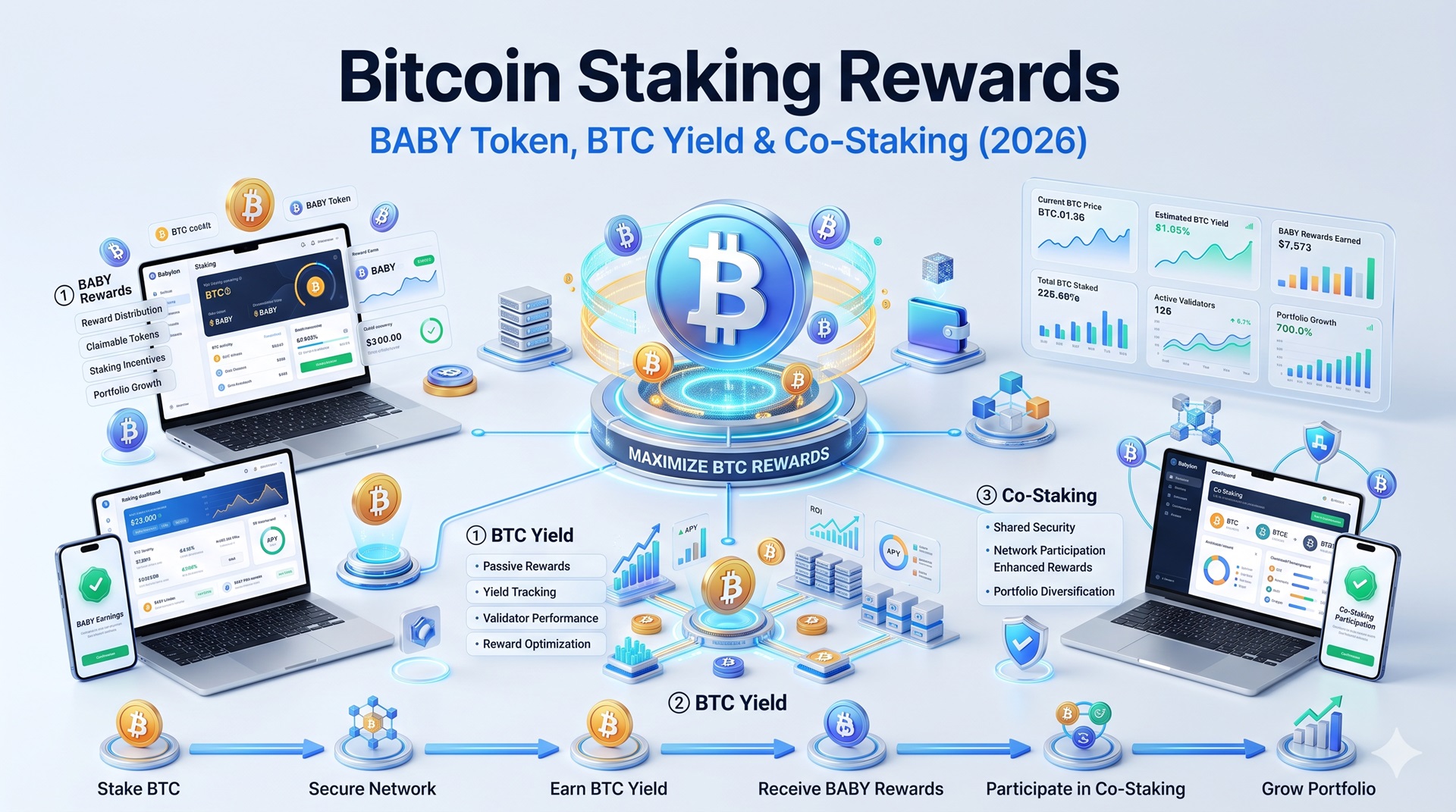
Bitcoin staking rewards through Babylon are paid in BABY tokens — not in Bitcoin — and this single fact transforms how staking yield should be evaluated.
A listed “2% BABY APY” has a completely different risk profile from “2% ETH APY” on Ethereum staking: your actual purchasing power and BTC-denominated return depends on BABY’s market price, which dropped over 80% from its January 2026 launch price before recovering.
How Babylon Generates Bitcoin Staking Rewards
Babylon does not generate yield from the Bitcoin network itself — Bitcoin’s proof-of-work design produces no native staking rewards. Instead, Babylon’s reward system runs on the Babylon Genesis chain, a Cosmos SDK-based Layer 1 that launched in April 2025.
The Babylon Genesis chain has a fixed 8% annual token inflation on BABY’s total supply. This inflation is split equally between two staker groups:
BTC stakers’ 4% share is distributed proportionally based on each staker’s BTC delegation size relative to the total BTC staked across all Finality Providers. A delegator representing 0.1% of total staked BTC earns 0.1% of the 4% BTC staker allocation.
Current Range: Gross APY range is 1–3% in BABY tokens, with the precise rate depending on total BTC staked across the network. As more BTC is added, individual yield per BTC decreases.
BABY Price Volatility – Why Your BTC-Denominated Yield Is Unpredictable
This is the central risk that almost every Bitcoin staking guide underweights. Your staking “APY” is denominated in BABY tokens. BABY is a new token that launched in January 2026.
Date
BABY Price
Change
Launch (Jan 2026)
~$0.06
—
March 2026 low
~$0.0107
-82% from launch
May 2026 recovery
~$0.02
+87% from low
At a 2% BABY APY on 1 BTC (~$100,000):
Price Point
Reward Value / Year
Launch price ($0.06)
~$2,000
March low ($0.0107)
~$357
May price ($0.02)
~$667
The same 2% APY produces $357 to $2,000 in annual dollar value depending entirely on BABY’s market price — a 5.6x range. There is no mechanism to convert your BABY rewards to BTC automatically within the Babylon protocol. If you sell BABY for BTC at market price, you accept whatever exchange rate exists at that moment.
This is categorically different from Ethereum staking (rewards paid in ETH, same asset you staked) or Cosmos staking (rewards paid in ATOM, same asset). Bitcoin staking on Babylon is closer to staking ETH to earn an airdrop token than to traditional PoS staking.
The Co-Staking Bonus – Earning More by Staking BABY Alongside BTC
Babylon introduced a co-staking mechanic that rewards delegators who hold and stake BABY tokens alongside their BTC. This is the only mechanism that can meaningfully increase your BTC staking reward rate beyond the base 4% BTC staker share.
The co-staking weight formula uses the ratio of your BABY delegation to your BTC delegation. The optimal ratio is 20,000 BABY tokens per 1 BTC staked.
Below 20,000 BABY per BTC: partial bonus, proportional to how close you are to the optimal ratio
Above 20,000 BABY per BTC: no additional BTC-staking weight (excess BABY earns on the BABY-side only)
Example at 2% Base APY + 2.35% Co-Staking Bonus
1 BTC staked alone: 2% in BABY annually
1 BTC + 20,000 BABY co-staked: ~4.35% in BABY annually
The co-staking bonus is significant enough to change the economics for holders who already hold or plan to acquire BABY, but the bonus is still denominated in BABY — making BABY price the variable that determines real dollar yield.
How and When Rewards Are Paid
On Babylon native staking: Rewards accrue continuously on the Babylon Genesis chain as BABY emissions. They are not automatically sent to your wallet. You claim BABY rewards through the Babylon Genesis chain using a Cosmos-compatible wallet address linked to your Bitcoin staking public key. Rewards are not auto-compounded.
On Kraken: BABY rewards accrue daily and are paid to your Kraken spot balance weekly.
On Binance On Chain Yields: BABY rewards accrue daily (snapshots) and are paid at term end for locked products.
Minimum Claim Threshold: The Babylon staking portal does not have a published minimum claim amount, but small balances may not be economical to claim if Cosmos network transaction fees consume a meaningful share.
Platform Reward Comparison
Platform
APY (BABY terms)
Reward Frequency
Compound Option
Babylon native (no co-stake)
1–2%
Claimable anytime
Manual
Babylon native (w/ co-stake, optimal)
~3–4.35%
Claimable anytime
Manual
Kraken flexible
~0.5–1%
Weekly
Manual
Kraken bonded
~1%
Weekly
Manual
Binance 15-day
1.5%
At term end
Manual
Binance 30-day
1.8%
At term end
Manual
Binance 90-day
2.5%
At term end
Manual
LBTC (Lombard)
1–3% BABY + DeFi yield
Variable
Via DeFi strategies
All BABY-denominated APYs are subject to BABY price volatility for BTC-denominated real yield calculation.
The Original Draw – BABY Token Airdrops
The biggest economic event for early Babylon BTC stakers was not the recurring 1–3% BABY APY, but the BABY token airdrop that accompanied the Babylon Genesis chain launch in January 2026. Stakers who participated during Cap-1 through Cap-3 of Phase 1 received BABY airdrop allocations based on their staked BTC × blocks staked formula.
Cap-1 stakers received the highest per-BTC allocations. By Cap-3 (December 2024), the per-BTC allocation had decreased significantly as total staked BTC grew. For context: stakers who received Cap-1 allocations and sold BABY near its January 2026 peak ($0.06) received meaningful dollar value. Those who held through the March 2026 low held assets worth ~18% of the peak value.
Future Bitcoin Supercharged Networks onboarding to Babylon may introduce additional airdrop and reward token opportunities for active BTC stakers.
Frequently Asked Questions
On Babylon native staking, the base APY is 1–3% in BABY tokens. With optimal co-staking (20,000 BABY per 1 BTC), this can reach ~3–4.35% in BABY. Exchange platforms offer similar ranges: Kraken up to ~1%, Binance up to ~2.5% on 90-day locked products. All yields are in BABY tokens — your BTC-denominated real return depends on BABY’s market price.
No. Babylon staking rewards are paid in BABY tokens, Babylon’s native token. There is no major protocol that pays BTC holders staking yields denominated in BTC. CeFi lending platforms (Nexo, YouHodler) advertise BTC-denominated yields but operate through lending mechanisms, not staking.
Co-staking means delegating both BTC (to a Finality Provider) and BABY tokens (to a Babylon Genesis validator) simultaneously. The optimal ratio is 20,000 BABY per 1 BTC staked. At this ratio, your combined position achieves full co-staking weight efficiency, adding approximately 2.35% annually on top of your base BTC staking APY.
On Babylon native staking, rewards accrue continuously and are claimable at any time through the Babylon Genesis chain interface. Kraken pays BABY rewards weekly to your spot balance. Binance fixed-term products pay at term end.
No. P2P.org confirms explicitly that staking rewards are not compounded by default on Babylon. Manual claiming and restaking is required to compound. For liquid staking protocols like LBTC, DeFi strategies can be used to deploy rewards into yield-generating positions, but this involves additional smart contract risk.
Final Tip: Always evaluate a listed BABY APY alongside BABY’s current market price to estimate your real BTC-denominated return before staking.