How to Stake Polygon (POL) in 2026: Complete Guide
How to Stake Polygon (POL) in 2026: Complete Guide
CrisCoin 12 min readPolygon
Polygon (POL) staking rewards delegators for securing one of Ethereum’s most widely used scaling networks.
With the MATIC to POL migration completed in 2024 and Polygon 2.0’s AggLayer architecture reshaping the validator role, choosing where to stake POL in 2026 involves more than finding the highest APY — it means understanding a detail most guides skip.
Polygon’s staking system runs on Ethereum mainnet, not the Polygon chain — and that single fact should heavily influence which platform you choose based on your position size.
How Polygon (POL) Staking Works
Polygon uses a Delegated Proof-of-Stake (DPoS) mechanism to secure its network. At the core of this system are two participant roles: validators and delegators.
Validators and Delegators on Polygon PoS
Validators run full nodes, stake their own POL tokens directly on Ethereum, and are responsible for producing blocks and signing checkpoints. The Polygon validator set is capped at 105 active validators at any time.
Delegators do not run nodes. Instead, they assign their POL tokens to an existing validator and earn a proportional share of that validator’s staking rewards, minus commission. When you delegate POL, you retain ownership of your tokens — they are never transferred to the validator.
Why Polygon Staking Runs on Ethereum Mainnet — Not the Polygon Chain
This is the most practically important and least-explained aspect of Polygon staking: the Polygon PoS staking smart contracts are deployed on Ethereum mainnet, not on the Polygon sidechain.
When you stake or unstake POL through the official Polygon Staking Portal, you are submitting transactions on Ethereum — which means you pay ETH gas fees, not POL. Every delegation transaction, every reward claim, and every unbonding transaction costs ETH.
Direct Impact on Platform Choice: A delegator staking 50 POL (~$20-$30 in 2026) will lose a significant portion of their rewards to Ethereum gas fees on the native portal. A full staking cycle can cost $10-$30 in ETH. For holders staking fewer than ~500 POL, exchange staking is often the better net return despite lower headline APY.
MATIC to POL — What the Migration Means for Stakers
In September 2023, Polygon launched the POL token as the replacement for MATIC under the Polygon 2.0 upgrade plan. The full migration completed across major platforms through 2024.
Key Facts for Stakers in 2026
MATIC staked before the migration was automatically upgraded to POL at a 1:1 ratio on most major platforms
MATIC held in an older self-custody wallet may need manual migration at migrate.polygon.technology
POL introduces a re-staking mechanism — validators can opt into securing multiple chains under AggLayer for supplemental rewards
For delegators, the migration’s most important implication is validator re-evaluation: if your original validator has opted into AggLayer consumer chains, their reward profile may have changed. Check your validator’s current commission and performance before continuing to delegate.
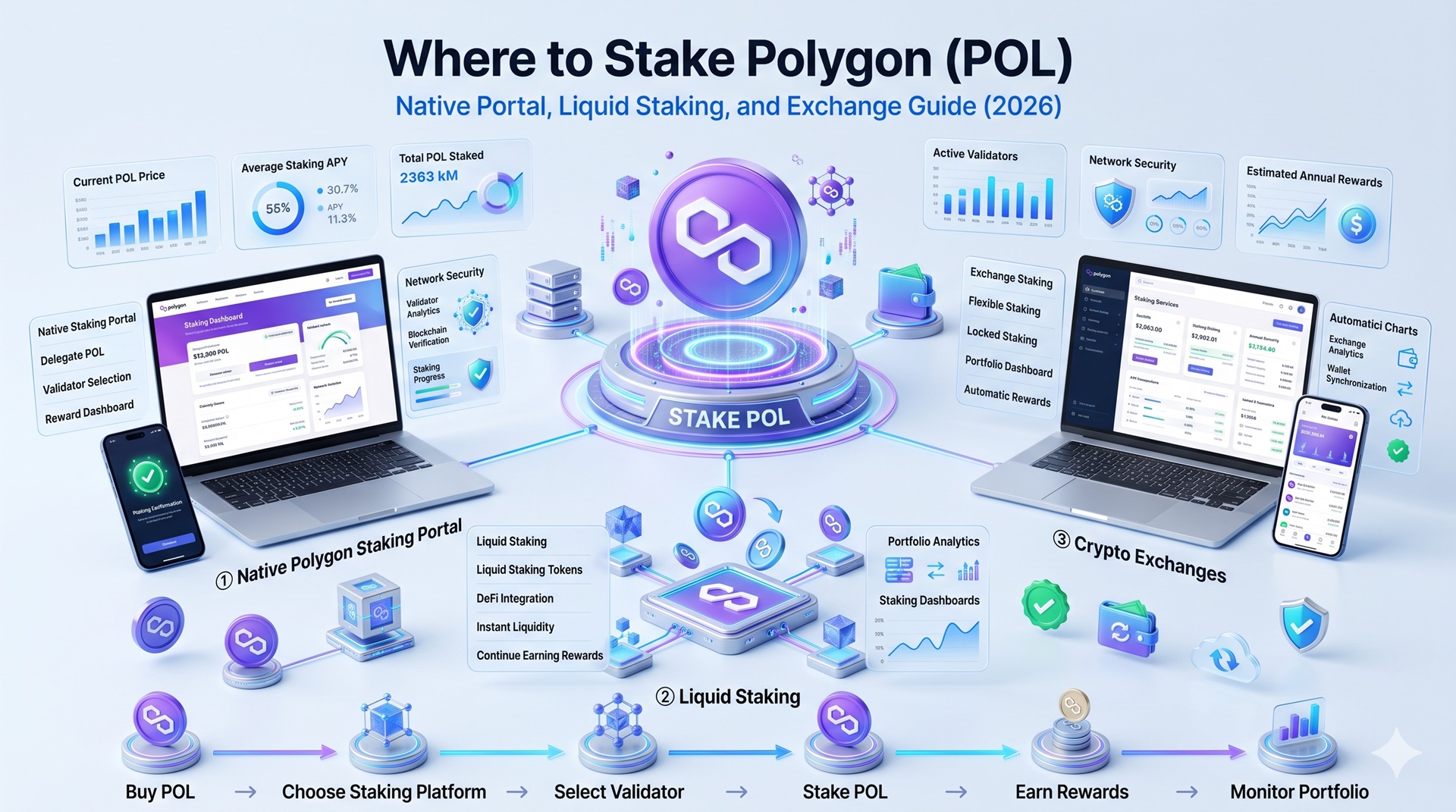
Where to Stake Polygon — Four Paths Compared
Method
Custody
Est. APY (2026)
ETH Gas Required
Unbonding
Native Portal
Self-custody
4-7%
Yes ($5-$30)
~3 days
Stader Labs / MaticX
Self-custody
4-6%
Yes (Ethereum)
Instant (sell)
Coinbase
Custodial
~3-5%
No (pooled)
Platform-managed
Kraken (bonded)
Custodial
~3-6%
No (pooled)
3-28 days
Binance
Custodial
5-19% (locked)
No (pooled)
30/60/90 days
Everstake
Self-custody
4-7%
Yes (Ethereum)
~3 days
Polygon Staking Portal — Best for Self-Custody Delegators
The official Polygon Staking Portal at staking.polygon.technology is the native on-chain staking interface. It connects directly to the Polygon PoS staking contracts on Ethereum mainnet and gives delegators full visibility into the validator set.
How to Connect and Delegate on the Native Portal
1
Switch to Ethereum Mainnet
Open MetaMask (or Coinbase Wallet) and switch to the Ethereum mainnet network — not Polygon PoS.
2
Prepare Funds
Ensure you have POL in ERC-20 form in your wallet, plus at least 0.05-0.1 ETH to cover gas fees.
3
Connect Wallet
Navigate to staking.polygon.technology and click “Connect Wallet.”
4
Browse Validators
Select “Become a Delegator” to browse the active validator list.
5
Evaluate Validators
Evaluate by checkpoint signing rate (aim for near 100%), commission percentage, and total stake concentration.
6
Delegate
Click “Delegate” on your chosen validator, enter the amount, and confirm the Ethereum transaction.
Your delegation is active once the Ethereum transaction is confirmed. Rewards begin accruing immediately and can be claimed at any time — though each claim costs ETH gas.
ETH Gas Cost Reality Check for Small Holders
Action
Est. ETH Gas Cost
Delegation (first time)
~$8-$15
Reward claim
~$5-$12
Undelegation initiation
~$8-$15
Final withdrawal after unbonding
~$5-$10
Total Lifecycle Cost: Approximately $26-$52 in ETH per cycle. At 5% APY on 500 POL (~$200), annual rewards equal roughly $10 — gas costs alone can exceed this yield for positions under ~1,000 POL. The native portal is the right choice for holders with 1,000+ POL.
Stader Labs and MaticX — Best for Liquid Staking
Stader Labs offers liquid staking for POL through its MaticX derivative token. When you deposit POL into Stader, you receive MaticX in return — a liquid, tradeable token that represents your staked position and accrues rewards through an exchange rate mechanism.
Key Features
No minimum deposit requirement
No native unbonding wait to exit — sell MaticX on Uniswap or QuickSwap instead
Native redemption follows the ~3-day Polygon unbonding period
Staking supported on either Ethereum mainnet or Polygon PoS chain
Stader distributes your POL across a curated set of validators, spreading slashing risk. The protocol has been audited by Halborn and Immunebytes, and maintains a $1M bug bounty on Immunefi. Staking through the Polygon PoS interface costs POL gas instead of ETH, which is significantly cheaper.
Exchange Staking — Best for Beginners
Centralized exchange staking handles ETH gas costs on your behalf by pooling thousands of delegators and submitting batched transactions. This makes exchange staking the economically correct choice for smaller POL positions.
Coinbase POL Staking
Coinbase supports POL staking with a straightforward interface and no minimum deposit beyond platform trading minimums. Rewards are credited to your Coinbase account balance at an estimated APY of 3-5%, reflecting Coinbase’s commission.
Kraken Flexible and Bonded Staking
Kraken offers flexible staking with no lockup and lower APY, and bonded staking requiring 3-28 days for withdrawal with higher APY, historically 3-6% on MATIC/POL. Availability and rates vary by region.
Binance and Bybit POL Staking Products
Binance Earn offers structured fixed-term POL staking with 30, 60, and 90 day lockups at escalating APY — historically the highest exchange APY among major platforms. Bybit offers flexible-term staking at lower APY (~0.5-2%) suited to active traders.
Everstake — Best for Institutional Delegators
Everstake is a professional validator operator running staking infrastructure across 130+ blockchain networks, including a long-standing Polygon validator node. For institutional delegators or large POL holders (over $1 million equivalent), Everstake offers customized staking arrangements and dedicated support.
Frequently Asked Questions
It depends on position size. For self-custody holders with 1,000+ POL, the native Polygon Staking Portal gives maximum control and full protocol APY. For smaller amounts, exchange staking through Coinbase or Kraken avoids gas fees that could exceed your yield. For DeFi-active users, Stader Labs and MaticX is the best option.
MATIC was replaced by POL as the staking token in 2024. Most platforms automatically converted MATIC to POL 1:1. If you hold MATIC in an old self-custody wallet, visit migrate.polygon.technology to upgrade before staking. Only POL is accepted on the official portal.
Yes, if you use the native Polygon Staking Portal or Stader Labs on Ethereum mainnet, since staking contracts are deployed on Ethereum. Plan for 0.05-0.1 ETH per cycle. Exchange staking on Coinbase, Kraken, or Binance requires no ETH from the user.
There is no protocol-enforced minimum. Given Ethereum gas costs, a practical minimum for native portal staking is approximately 500-1,000 POL. Exchange platforms have their own minimums, and Stader Labs has no minimum deposit requirement.
Native staking gives full self-custody, full protocol APY, and validator control — better for large positions. Exchange staking absorbs gas costs but takes a commission and requires surrendering custody. For positions under ~500 POL, exchange staking typically produces better net returns after gas.
Final Tip: Match your platform to your position size — small holders should let an exchange absorb gas costs, while holders above ~1,000 POL get the most value from native, self-custodied staking.