Cosmos (ATOM) Staking Taxes: Complete US Guide 2026
Cosmos (ATOM) Staking Taxes: Complete US Guide 2026
CrisCoin 13 min readCosmos · Taxes
Cosmos (ATOM) staking rewards are taxable in the United States, and the IRS has issued direct guidance on how they must be reported.
Under Revenue Ruling 2023-14, every batch of ATOM rewards credited to your wallet triggers an ordinary income event — regardless of whether you sell, swap, or hold those tokens.
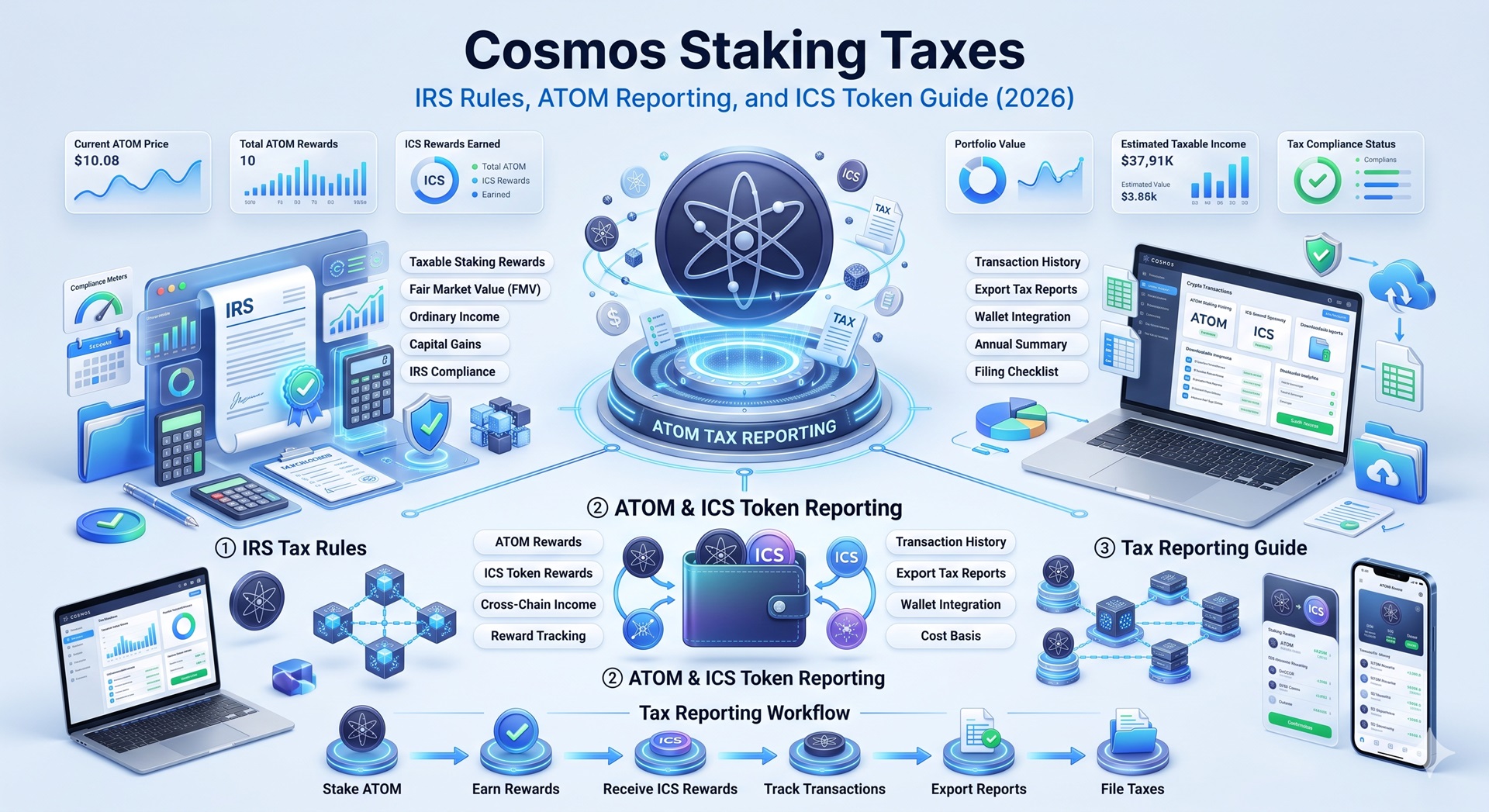
This guide walks through exactly how Cosmos staking taxes work in 2026: the two-event tax structure, how to calculate your cost basis, how to handle Interchain Security token rewards, and which software tools make Cosmos tax reporting practical.
Disclaimer: This article is for educational purposes only and does not constitute tax advice. Consult a licensed CPA or tax professional for guidance specific to your situation.
Are Cosmos Staking Rewards Taxable in the US?
Cosmos staking rewards are taxable in the United States. The IRS treats ATOM staking rewards as ordinary income, measured at fair market value at the moment the rewards become accessible in your wallet.
Rev. Rul. 2023-14 — The IRS Position on ATOM Rewards
Revenue Ruling 2023-14, published in July 2023 (IRB 2023-33), is the IRS’s definitive statement on proof-of-stake staking taxation. It holds that a taxpayer who stakes cryptocurrency and receives additional units as validation rewards must include the fair market value of those rewards in gross income in the taxable year they are received.
This ruling applies directly to Cosmos ATOM delegators — whether staked through Keplr, Cosmostation, Exodus, or a centralized exchange like Coinbase. The ruling does not differentiate between self-custody staking and exchange staking.
Dominion and Control — When Does the Tax Event Occur?
Rev. Rul. 2023-14 uses a key legal standard: “dominion and control.” A taxable event occurs when you gain the freedom to sell, trade, or otherwise dispose of your staking rewards — not when they begin accruing.
For native staking through Keplr or Cosmostation, each claim transaction constitutes the moment of dominion and control, triggering income recognition at that ATOM’s fair market value. For exchange-based staking, the moment the exchange credits ATOM to your account is typically the dominion and control point.
Two Taxable Events from Cosmos Staking
Every ATOM staking reward creates two separate taxable events over its life — one when received and one when disposed of.
Event 1 — Ordinary Income at the Time of Receipt
When you claim ATOM staking rewards, you recognize ordinary income equal to the fair market value of those tokens in USD at the exact time of the claim transaction. This income is reported on Schedule 1 of Form 1040, Line 8z, as “Other Income.”
Example: You claim 12 ATOM on March 15, 2026, when ATOM is trading at $8.40. You recognize $100.80 in ordinary income on that date, regardless of what ATOM’s price does afterward. This income is taxed at your marginal federal rate (10%-37%).
Event 2 — Capital Gains When You Sell Your ATOM Rewards
When you later sell, trade, or spend the ATOM rewards you previously received, a second taxable event occurs: sale proceeds minus cost basis equals capital gain or loss. Your cost basis equals the amount you already reported as ordinary income when you received them.
Example: if you claimed 12 ATOM at $8.40 and later sell those same 12 ATOM at $14.00, your capital gain is ($14.00 − $8.40) × 12 = $67.20.
Holding Period
Tax Treatment
Short-term (held ≤ 1 year)
Taxed at ordinary income rates
Long-term (held > 1 year)
Preferential rates of 0%, 15%, or 20%
This two-event structure means Cosmos staking creates ongoing tax complexity: every claim transaction generates a new income lot with its own cost basis and holding period clock.
How to Calculate Your ATOM Staking Income
Precise calculation requires knowing the fair market value of ATOM at the exact time of each reward claim — not the day’s average, but the spot price at the time your claim transaction was confirmed on-chain.
Finding FMV per Reward
Mintscan or Cosmos.directory block explorers for transaction timestamps
CoinGecko or CoinMarketCap historical price APIs
StakeTax (stake.tax) — enter your “cosmos1” address to auto-export a CSV with FMV estimates
Cost Basis — What It Is and Why It Matters
Your cost basis in each batch of ATOM staking rewards equals the USD amount you reported as ordinary income when received. Per Rev. Proc. 2024-28, cost basis must be tracked per-wallet — staking rewards from Keplr and rewards credited through Coinbase are separate basis pools that cannot be combined.
Short-Term vs Long-Term Capital Gains on ATOM Rewards
Because every reward claim creates a new acquisition date, your ATOM staking rewards can generate both short-term and long-term capital gains in the same tax year.
Planning Note: Holding ATOM rewards for more than one year before selling can reduce your effective tax rate on the gain. Tax loss harvesting is also available, and unlike stocks, crypto is not subject to the wash sale rule under current IRS guidance.
ICS Consumer Chain Tokens — The Cosmos Tax Issue No Other Guide Covers
Interchain Security (ICS) allows consumer chains to rent security from the Cosmos Hub validator set. As of 2026, ATOM delegators staking through ICS-participating validators earn additional rewards paid in consumer chain native tokens — not just ATOM.
What Are ICS Rewards and Why Are They Taxable?
Under Rev. Rul. 2023-14 and basic IRS income principles, consumer chain token rewards are taxable ordinary income at fair market value when received — exactly like ATOM staking rewards. The token being a different asset does not change the income recognition rules.
Practical Complication: Consumer chain tokens may have low liquidity or lack clean historical price data. If fair market value is genuinely not determinable, you may need to assign a best-estimate FMV and document your methodology clearly.
How to Track and Report ICS Token Income
Most crypto tax software that supports Cosmos addresses (Koinly, CoinLedger, Coinpanda) will import IBC-transferred tokens automatically. Some consumer chain tokens may require manual tagging. Best practice: after each ICS reward distribution, record the token quantity, wallet address, block height, and best-available USD price.
Auto-Compounding Cosmos Rewards and Constructive Receipt
Restake.app is a popular auto-compounding tool that automatically claims your ATOM staking rewards on a set schedule and immediately redelegates them — increasing your staked position without manual intervention.
Does Restake.app Trigger Income at Each Compound?
Under the “dominion and control” standard, the answer depends on whether you have genuine control over the rewards at the point of compounding. The conservative, IRS-compliant position is to treat each auto-compound cycle as a separate income recognition event, at the FMV of the newly redelegated ATOM.
Method
Tax Implication
Manual claim
You control timing of income events; fewer, larger lots to track
Auto-compound (Restake.app)
Potentially daily/weekly income events; more lots but faster compounding
How to Report Cosmos Staking Taxes — Step by Step
Form 1099-MISC from Centralized Exchanges
If you staked ATOM through Coinbase, Kraken, or another exchange and received more than $600 in staking rewards, the exchange may issue a Form 1099-MISC. Even without one — for example under $600, or self-custody staking — you are still legally required to report your staking income.
Schedule 1, Line 8z — Reporting Ordinary Income
Cosmos staking rewards are reported as ordinary income on Schedule 1 of Form 1040, Line 8z (“Other Income”). Enter the total USD fair market value of all ATOM rewards claimed during the tax year. If staking as a trade or business, use Schedule C instead.
Form 8949 and Schedule D — Reporting Capital Gains
When you sell, trade, or spend your ATOM staking rewards, each disposal is reported on Form 8949, requiring the asset description, date acquired, date sold, sale proceeds, cost basis, and short/long-term classification. Totals flow to Schedule D.
Best Tax Software for Cosmos (ATOM) Staking
Tools That Support Cosmos Natively
Koinly — direct import of “cosmos1” addresses, per-wallet basis tracking, Schedule 1 and Form 8949 reports
CoinLedger — automatic staking transaction tagging, integrates directly with TurboTax
StakeTax and Coinpanda — free CSV export option, compatible with other platforms
Jarrett v. United States — What It Means for 2026 Filers
Jarrett v. United States (3:24-cv-01209, M.D. Tenn.) is the most significant pending challenge to the IRS’s staking tax position. The Jarretts staked Tezos and argued staking rewards are newly created property that should not be taxable until sold. As of April 2026, cross-motions for summary judgment were pending, with a bench trial scheduled for September 29, 2026 if not resolved earlier.
What This Means for ATOM Stakers Filing in 2026: Continue reporting staking rewards as ordinary income per Rev. Rul. 2023-14 — it remains the law. Do not take a “no income at receipt” position based on the pending litigation. Stakers with material income (above $10,000/year) may wish to consult a CPA about protective refund claims.
Frequently Asked Questions
Yes. Under Rev. Rul. 2023-14, ATOM staking rewards are taxable as ordinary income at the moment you claim them — regardless of whether you sell. If you claim 50 ATOM and hold all of them, you still owe ordinary income tax on their fair market value at claim time.
Your cost basis is the USD fair market value of the ATOM at the time you claimed them — the same amount reported as ordinary income. Each claim creates a separate tax lot with its own cost basis and acquisition date.
Report it as ordinary income on Schedule 1 of Form 1040, Line 8z. Total all USD fair market values of ATOM rewards claimed during the year. Subsequent sales are reported on Form 8949 and Schedule D.
The IRS hasn’t issued direct guidance. The conservative position most tax professionals recommend treats each auto-compound cycle as a separate income event at the FMV of the newly restaked ATOM. Deferral arguments carry audit risk.
Koinly, CoinLedger, Coinpanda, and Divly all support Cosmos native staking through wallet address import. StakeTax provides free CSV exports. For exchange-based staking, download your transaction history and import it into your preferred software.
Final Tip: Keep a running log of every claim’s date, amount, and fair market value — it’s the single habit that makes Cosmos tax season painless.