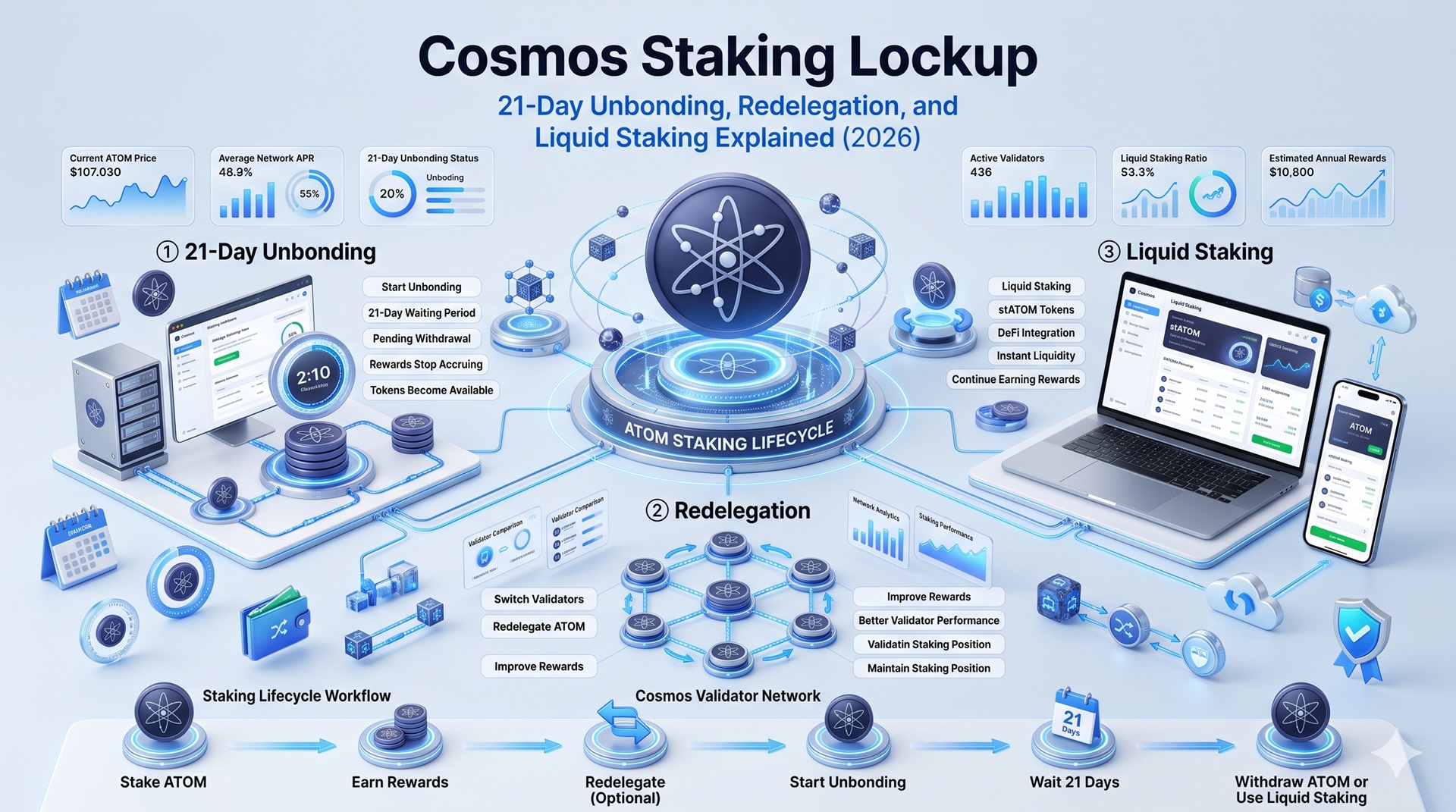
Cosmos (ATOM) staking comes with a fixed 21-day lockup every time you decide to unstake.
During those three weeks, your ATOM earns nothing, moves nowhere, and cannot react to market conditions. Understanding exactly how the lockup works — including the redelegation escape hatch and the Liquid Staking Module that bypasses it entirely — is essential before you commit any ATOM to a validator.
What Is the Cosmos Staking Lockup Period?
The Cosmos staking lockup period is a protocol-enforced 21-day unbonding window that activates the moment you choose to unstake (undelegate) your ATOM from a validator. It is not a platform-imposed rule — it is hardcoded into the Cosmos Hub’s Delegated Proof-of-Stake consensus mechanism and applies equally whether you stake through Keplr, Cosmostation, Exodus, or any self-custodial wallet.
The lockup exists to keep validators and delegators financially committed to the network long enough to detect and punish misbehavior — giving the Cosmos Hub time to identify slashing events and enforce penalties before capital can exit.
How the 21-Day Unbonding Period Works
When you submit an undelegate transaction, the protocol starts a 21-day countdown. Your ATOM does not disappear — it enters an “unbonding” state, still associated with the original validator but no longer actively participating in consensus. After the full 21 days expire, the ATOM is automatically released to your wallet without any additional transaction required.
Important Detail: The unbonding period cannot be shortened, paused, or reversed once initiated — unless the Gaia upgrade that introduced the Liquid Staking Module (LSM) is used, which allows canceling unbonding under specific conditions on some wallets.
What Happens to Your ATOM During the Lockup
During the 21-day unbonding period, your ATOM is subject to three restrictions simultaneously:
Three Restrictions During Unbonding
No staking rewards — unbonding ATOM stops earning inflation rewards the moment the transaction confirms
No transfers or trades — unbonding ATOM cannot be sent, swapped, sold, or moved to any address
No redelegation — unlike bonded ATOM, it cannot be redirected to a different validator to escape a slashing situation
Why Does Cosmos Use a 21-Day Unbonding Period?
The 21-day duration is not arbitrary. It is a security parameter specifically designed around Tendermint consensus’s vulnerability to long-range attacks.
Tendermint Consensus and Long-Range Attack Prevention
Cosmos Hub runs on Tendermint BFT consensus, where validators sign blocks using private keys tied to their staked ATOM. A long-range attack occurs when a malicious actor obtains old private keys from validators who have already exited, and uses them to rewrite blockchain history. Because old validators have already withdrawn their stake, they have nothing to lose from signing a fraudulent fork.
The 21-day unbonding period solves this by ensuring any validator attempting to sign invalid history still has their ATOM locked on-chain and subject to slashing during the entire exit window.
How the Lockup Protects the Validator Set
The lockup also protects the network against sudden mass withdrawals. If validators and delegators could exit instantly, a coordinated sell-off could collapse the bonded ratio below the 66% threshold needed to maintain Byzantine fault tolerance.
What You Lose During the Cosmos Unbonding Period
The 21-day lockup is a real cost — not just an inconvenience.
No Staking Rewards During Unbonding
In 2026, native Cosmos staking yields approximately 14-20% APY depending on the bonded ratio and validator choice. The moment your unbonding transaction is submitted, that yield stream stops. At a 17% APY, 21 days of missed yield on 1,000 ATOM equals roughly 9.8 ATOM — permanently forfeited.
No Trading, Transferring, or Redelegating Locked ATOM
Unbonding ATOM is illiquid by protocol design. You cannot sell it on a decentralized exchange, transfer it to Coinbase or Kraken, use it as DeFi collateral, or redelegate it to a different validator to avoid a slashing event. This illiquidity is the primary reason liquid staking protocols like Stride and pStake attracted significant ATOM TVL.
Slashing Risk Doesn’t Stop at Day 1
A Point Most Guides Miss: Your ATOM remains slashable during the unbonding period if the validator you originally delegated to commits a slashing offense. If your validator double-signs a block on day 3 of your 21-day window, a 5% slash penalty can still be applied to your exiting ATOM.
Redelegation vs Unstaking — The Key Difference Most Stakers Miss
The most actionable and underexplained fact about the Cosmos lockup is this: redelegation does not trigger the 21-day unbonding period.
Redelegation Is Instant — No Lockup Triggered
When you redelegate ATOM from Validator A to Validator B, your tokens move directly from one bonded state to another. The transaction completes in a single block. Your ATOM stays bonded throughout the switch, continues earning rewards immediately from Validator B, and is never placed in an unbonding queue.
The only restriction is a 21-day “redelegation cooldown” that prevents you from redelegating from Validator B again until 21 days have passed, preventing rapid redelegation from being used to escape slashing detection.
When to Redelegate Instead of Unstake
Your current validator’s commission increases beyond your tolerance
Your validator’s uptime drops and you want to reduce slashing exposure
You want to shift voting weight to a more aligned governance participant
You want to move stake to a validator participating in Interchain Security for extra yield
How the Liquid Staking Module (LSM) Changes the Lockup Equation
In September 2023, the Cosmos Hub launched the Gaia 12 upgrade, introducing the Liquid Staking Module (LSM), which fundamentally changed how staked ATOM interacts with the 21-day restriction.
Stride and stATOM — Stake and Stay Liquid
Stride is a Cosmos appchain that accepts bonded ATOM and issues stATOM in return. You receive stATOM immediately — a liquid, tradeable token representing your staked position that accrues yield through an exchange rate mechanism. You can sell stATOM on Osmosis at any time, no 21-day wait, typically at a small discount reflecting the expected unbonding cost.
With LSM, you can even convert already-staked ATOM directly to stATOM without first waiting for an unbonding window — the major unlock of the Gaia 12 upgrade.
pStake, pATOM, and Other Liquid Staking Options
pStake Finance issues pATOM as its liquid staking derivative, using a similar mechanism to Stride. pATOM can be used in DeFi within the Cosmos IBC ecosystem. Multiple liquid staking providers now exist, with Stride being the most widely adopted in 2026 by total ATOM TVL.
LSM Trade-offs: Smart Contract Risk and Lower Yield
Liquid staking does not eliminate the lockup — it converts it into a market discount.
Trade-off
Detail
Smart contract risk
Stride and similar protocols carry protocol-specific vulnerabilities
Lower effective yield
Protocol fees (typically 5-10% of rewards) reduce your net APY
stATOM/ATOM depeg risk
Can trade at a 2-5% discount in high-volatility periods
25% LSM cap
Governance caps liquid-staked ATOM at 25% of total bonded ATOM
Cosmos Lockup Compared — ATOM vs ETH, SOL, ADA
Network
Lockup Period
Rewards During Lockup
Redelegation
Liquid Staking
Cosmos (ATOM)
21 days
None
Instant
stATOM, pATOM
Ethereum (ETH)
Exit queue (~1-4 days)
Stops on exit
No direct redelegate
stETH (Lido), rETH
Solana (SOL)
~2-3 days (epoch-based)
None during cooldown
Via stake accounts
mSOL (Marinade), bSOL
Cardano (ADA)
0 days
Earns until unstake
Instant pool switch
Limited
Cosmos has the longest native lockup of the major PoS chains listed. Cardano stands out with zero lockup — ADA delegators can switch pools or unstake with no waiting period and continue earning until the epoch boundary.
Platform Differences — Does the Lockup Change?
The 21-day unbonding period is a protocol parameter — it applies at the Cosmos Hub level regardless of wallet. However, some platforms abstract it away.
Keplr and Cosmostation (Native 21-Day)
Both are native Cosmos wallets that delegate your ATOM directly to on-chain validators. You retain full custody, earn full protocol rewards, and are subject to the full 21-day window when you exit.
Kraken Flexible Staking (No Lockup, Lower APY)
Kraken offers flexible ATOM staking with no user-facing lockup, achieved by maintaining a buffer of unstaked ATOM to cover withdrawal requests — effectively socializing the unbonding wait. In exchange, effective yield is lower and you do not control your private keys. As of 2026, Kraken’s bonded staking offers up to ~18% APY (with lockup), lower for flexible staking.
Coinbase and Exchange Staking Lockup Rules
Coinbase states it does not impose additional lockup periods beyond the protocol requirement. The current estimated reward rate on Coinbase is approximately 13.88% — significantly below self-custody Keplr staking — due to Coinbase’s 20% commission on rewards.
Frequently Asked Questions
Exactly 21 days. This unbonding window starts the moment you submit an undelegate transaction and cannot be shortened. During the 21 days, your ATOM earns no rewards and cannot be transferred or traded.
Not natively. But if you hold stATOM from Stride, you can sell it on Osmosis at the prevailing market rate without waiting. Exchanges like Kraken also offer flexible staking that processes withdrawals instantly using an internal liquidity buffer.
No. ATOM stops earning staking rewards the moment unbonding is initiated, and the yield loss is permanent — three weeks of missed rewards cannot be recovered.
Redelegation moves your ATOM instantly from one validator to another without triggering the 21-day unbonding period. Your ATOM stays bonded and keeps earning immediately from the new validator, with only a 21-day cooldown before you can redelegate that ATOM again.
The 21-day protocol lockup applies to all self-custodial native staking. Platforms like Kraken abstract it away using internal liquidity management, offering instant withdrawals at the cost of lower APY and custodial risk.
Final Tip: If you’re switching validators, always redelegate — never unstake and re-stake. Reserve the 21-day unbonding for when you actually need liquid ATOM.