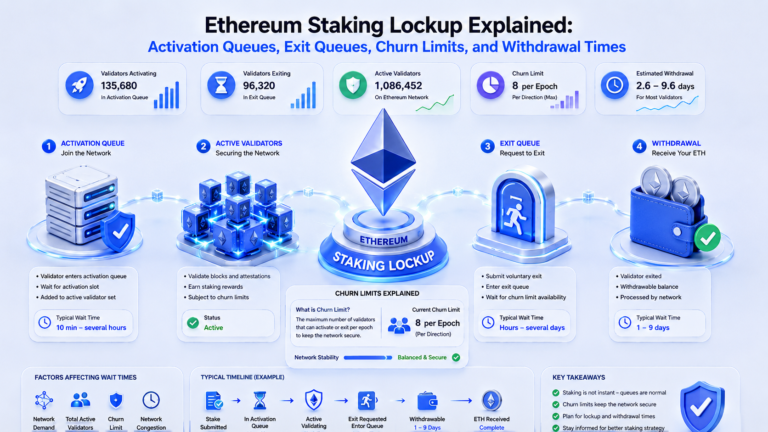
Unstaking Ethereum is the process of withdrawing staked ETH from the Beacon Chain validator set or a liquid staking protocol.
The process differs significantly between solo validators, liquid staking protocols, and centralized exchanges. This guide explains queue lengths, how long unstaking takes, and what factors affect validator withdrawals in 2026.
What Is the Ethereum Unstaking Process?
Unstaking Ethereum is the process of withdrawing staked ETH from the Beacon Chain validator set or a liquid staking protocol — returning principal and accumulated rewards to the depositor’s wallet. The process differs significantly between solo validators, liquid staking protocols, and centralized exchanges.
Method
Unstaking Path
Minimum Time
Maximum Time
Solo validator
Voluntary exit → queue → 27hr delay → sweep
~1 day
53+ days
Lido (stETH)
Withdrawal request → queue
Minutes
Hours to days
Lido secondary
Sell stETH on Curve/Uniswap
Seconds
Minutes
Rocket Pool (rETH)
Burn rETH for ETH
Minutes
Hours
Coinbase
Unstake in app
Hours to days
1-2 weeks
Kraken
Unstake in Earn section
Hours
Days
Post-Pectra upgrade (May 2024), daily exit capacity increased to 57,600 ETH — replacing the previous validator-count-based churn limit with an ETH-amount-based limit. Selling liquid staking tokens on secondary markets provides immediate effective liquidity, bypassing the withdrawal queue entirely at the cost of potential slippage.
Key Terms for Ethereum Unstaking
Term
Definition
Voluntary exit
A signed message initiating exit from the active validator set
Exit queue
The protocol-level queue validators wait in, ordered by submission time
Churn limit
Maximum ETH that can exit per epoch — 256 ETH post-Pectra
Epoch
32 slots of 12 seconds each — roughly 6.4 minutes
256-epoch delay
Mandatory 27.3-hour cooldown after exit before ETH is withdrawable
Sweep delay
Time for the round-robin sweep to reach a validator — ~7-10 days
How Does the Unstaking Process Work Technically?
Ethereum unstaking separates into three stages for solo validators — exit queue, post-exit delay, and withdrawal sweep — each with distinct timing characteristics.
Stage 1 — Voluntary Exit and Queue Wait
The validator operator signs a voluntary exit message using the validator private key and broadcasts it to the consensus layer, placing the validator in the exit queue if others are simultaneously exiting. The validator must be active, not slashed, and must have been active for at least 256 epochs before exit is permitted. The queue processes validators strictly first-in-first-out, with no priority mechanism regardless of stake size.
After the exit queue clears, a mandatory 256-epoch (~27.3-hour) delay applies before the ETH becomes withdrawable. During this delay, the validator earns zero rewards — creating additional opportunity cost beyond the queue wait. The validator’s status transitions Active → Exiting → Exited → Withdrawable.
Stage 3 — Withdrawal Sweep
After reaching Withdrawable status, the validator’s ETH waits for the withdrawal sweep, a round-robin process cycling through all validators with pending withdrawals. The sweep processes a maximum of 16 withdrawals per block, and sweep delay is approximately 7-10 days for full withdrawals under current conditions.
Ethereum Validator Queue Times — May 2026
Queue State
ETH Waiting
Wait Time
Entry queue (activation)
3,066,633 ETH
~53 days
Exit queue
0 ETH
~0 minutes
Sweep delay
N/A
~7.7 days
Vitalik Buterin has defended exit delays as a design feature, comparing it to a soldier deciding to quit the army — friction in quitting is part of the deal. Historical peak: during late 2025, the exit queue held approximately 1 million ETH with a 43-day wait.
How Do You Unstake ETH From Lido (stETH)?
Lido provides two unstaking paths: protocol withdrawal and secondary market sale.
1
Protocol withdrawal
Go to lido.fi/withdrawal, connect wallet, enter the stETH amount to redeem, and click Request withdrawal to confirm the transaction (gas fee applies). It typically processes within minutes to hours.
2
Secondary market sale
Go to Curve.fi or Uniswap, connect wallet, select the stETH → ETH pair, review slippage (typically 0.01-0.1% under normal conditions), and confirm. ETH arrives immediately.
Slippage Risk: During the June 2022 depeg event, stETH/ETH slippage on Curve reached approximately 6%, demonstrating the cost of using secondary market liquidity during stress.
How Do You Unstake ETH From Rocket Pool (rETH)?
Rocket Pool provides direct redemption at the current rETH/ETH exchange rate through the app’s Unstake tab, or a secondary market sale on Uniswap and Curve. Direct redemption requires liquidity in the Rocket Pool contract — if insufficient, the request joins a queue until new deposits or exiting mini-pools provide ETH. rETH secondary market liquidity is smaller than stETH’s.
How Do You Unstake From Coinbase and Kraken?
Exchange
Unstaking Speed
Notes
Coinbase
Hours to days
Flexible — no fixed lockup
Kraken
1-7 days
Manages internal Beacon Chain exit
Binance
Hours to days
WBETH redemption or market sale
How Do You Unstake a Solo Ethereum Validator?
1
Confirm withdrawal credentials
Withdrawal credentials must be 0x01 or 0x02 type before initiating exit.
2
Broadcast a voluntary exit
Using your consensus client CLI (Lighthouse, Prysm, or Teku), generate and broadcast a signed voluntary exit message.
3
Monitor status
Track the exit on beaconcha.in as the validator transitions from Active → Exiting.
4
Wait for the queue and delay
After exiting the active set, wait 256 epochs (~27 hours) for Withdrawable status, then wait for the sweep cycle, approximately 7-10 more days.
ETH principal plus accumulated rewards transfers automatically to the configured withdrawal address — no additional transaction required. Rewards stop accruing immediately when the validator enters “Exited” status.
What Is the Post-Pectra Change to Unstaking?
Parameter
Pre-Pectra
Post-Pectra
Churn calculation
Based on validator count
Based on ETH amount
Daily exit capacity
~1,800 validators/day
57,600 ETH/day
EIP-7251 allows validators with 0x02 credentials to set a maximum effective balance up to 2,048 ETH, eliminating the need to run multiple 32 ETH validators for large stakers.
Common Mistakes When Unstaking Ethereum
Mistake
Result
Prevention
Not setting withdrawal credentials before exit
ETH cannot be withdrawn — funds locked
Upgrade to 0x01/0x02 credentials before exit
Selling stETH during depeg panic
Realized loss at below-parity price
Use the Lido withdrawal queue instead
Timing exit during high queue demand
Extended wait, rewards stop
Monitor validatorqueue.com before exiting
Not accounting for sweep delay
Actual wait longer than expected
Plan for queue + 27hr + sweep total
CEX unstaking with urgent need
Platform processing times delay access
Do not stake ETH needed within 1-2 weeks
Frequently Asked Questions
Four methods: solo validator voluntary exit (exit queue → 27hr delay → sweep, 1-53 days total); Lido protocol withdrawal (minutes to hours); Lido secondary market sale (instant via Curve); or CEX unstaking (hours to days). Liquid staking token sales provide the fastest access.
Solo validator unstaking takes a minimum of approximately 1-2 days under zero-queue conditions, up to 53+ days during high exit demand. Lido protocol withdrawals typically complete in minutes to hours. CEX platforms process in 1-7 business days.
The exit queue is a first-in-first-out mechanism limiting how much ETH exits the active validator set per epoch — 256 ETH per epoch post-Pectra. Current exit queue is near-empty while the entry queue holds over 3 million ETH with a 53-day wait as of May 2026.
The 256-epoch delay is a mandatory protocol cooling period between a validator exiting and its ETH becoming eligible for withdrawal. During this period the validator earns zero rewards, and the delay deliberately prevents rapid large-scale exits that could destabilize network security.
Liquid staking tokens can be sold on secondary markets for immediate ETH liquidity, subject to market pricing and slippage. Direct solo validator unstaking cannot be instant due to the mandatory exit queue and 256-epoch delay.
The Shanghai upgrade (April 2023) enabled ETH staking withdrawals for the first time since the Beacon Chain launched in December 2020. Before Shanghai, staked ETH was locked indefinitely with no withdrawal mechanism.
Check validatorqueue.com for real-time entry and exit queue data. The full solo validator exit timeline is exit queue wait plus 256 epochs (27.3 hours) plus sweep delay (~7.7 days).
Partial withdrawals automatically sweep validator balance above 32 ETH periodically without affecting active status. Full withdrawals remove all ETH and require a voluntary exit message, taking the validator permanently offline.