Ethereum Staking Lockup Explained: Queues, Timing, and Liquidity (2026)
Ethereum Staking Lockup Explained: Queues, Timing, and Liquidity (2026)
CrisCoin 9 min readEthereum
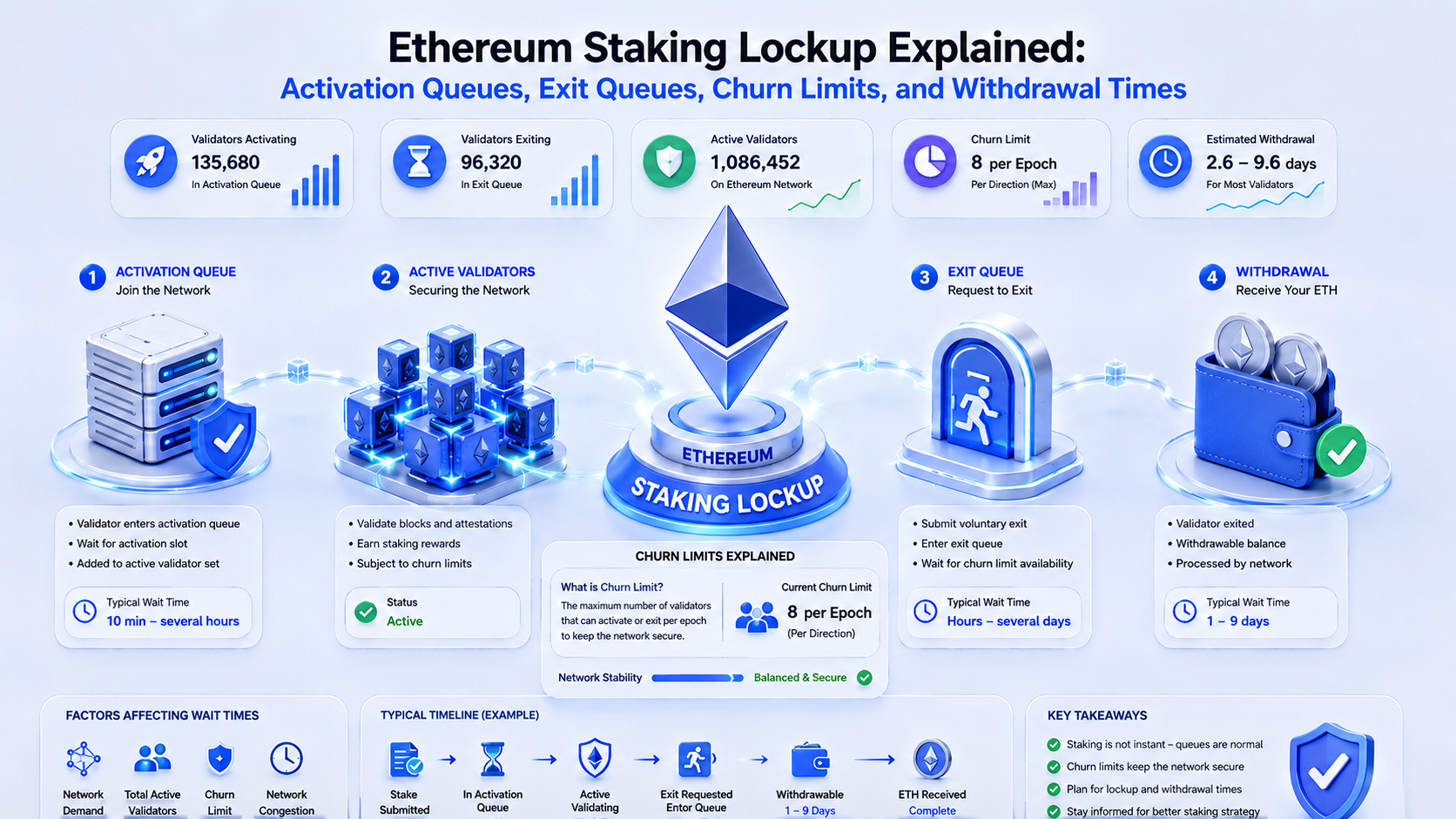
Ethereum staking lockup is a queue-based liquidity system rather than a fixed lock period.
Activation queues, churn limits, exit queues, withdrawal sweeps, and validator demand collectively determine how long ETH remains inaccessible. This guide explains how queue lengths change, how long unstaking takes, and how liquid staking compares to native staking.
What Is Ethereum Staking Lockup?
Ethereum staking lockup is the time ETH remains unavailable while moving through the validator lifecycle. The lockup includes activation queues, active validation, exit queues, and withdrawal processing. Ethereum does not impose a contractual lock period — instead, network capacity determines how quickly validators enter and leave the validator set.
How Does Ethereum Control Staking Lockups?
Ethereum uses the Beacon Chain consensus layer to manage validator participation. The protocol limits validator entries, limits validator exits, preserves network security, maintains chain finality, and protects against validator concentration risks. The primary mechanism is the Ethereum churn limit, which regulates how much ETH can enter or leave the active validator set during each epoch.
What Is the Ethereum Validator Lifecycle?
Every validator passes through a defined lifecycle.
Stage
Purpose
Deposit
ETH enters the deposit contract
Deposit Follow Distance
Network verifies deposit safety
Activation Queue
Validator waits for available capacity
Active Validator
Validator earns staking rewards
Voluntary Exit
Validator requests withdrawal
Exit Queue
Validator waits for exit processing
Withdrawable State
Validator becomes eligible for withdrawal
Withdrawal Sweep
ETH transfers to withdrawal credentials
What Are the Four Ethereum Staking Lockup Phases?
Phase
Description
Deposit Follow Distance
Deposit verification period
Activation Queue
Waiting to become active
Active Validation
Validator earns rewards
Exit Queue and Withdrawal
Validator exits and receives ETH
Each phase affects liquidity differently. The Beacon Chain waits approximately 6.8 hours before activating a deposit record, which reduces reorganization risk and ensures consensus stability.
What Is the Ethereum Activation Queue?
The activation queue is the waiting period before a validator becomes active. Validators enter it whenever staking demand exceeds available churn capacity. During this period, ETH remains locked, rewards do not accrue, validators cannot participate in consensus, and capital remains illiquid.
Why Queues Grow: Institutional staking adoption, ETF-related demand, bull market participation, liquid staking growth, and validator expansion by large operators all lengthen the activation queue. In May 2026, activation waits exceeded 62 days due to an entry backlog above 3.5 million ETH.
What Is the Ethereum Exit Queue?
The Ethereum exit queue is a protocol-controlled waiting period for validators leaving the network. Validators cannot instantly withdraw ETH after requesting an exit — Ethereum processes exits according to the churn limit. The queue preserves economic security, enables slashing enforcement, protects chain finality, and prevents validator flight during stress events.
Without an exit queue, validators could potentially attack the network and immediately withdraw funds before penalties apply, which is why validators remain slashable even after submitting an exit request.
What Is the Ethereum Churn Limit?
The Ethereum churn limit caps how much ETH can enter or exit the validator set during each epoch. Following EIP-7251, Ethereum measures churn using ETH amounts rather than validator counts.
Metric
Value
Churn Limit
256 ETH per epoch
Epoch Length
~6.4 minutes
Epochs per Day
~225
Daily Capacity
57,600 ETH
Why Does Queue Length Change?
Queue length changes because validator demand changes. Major drivers include staking demand (more deposits create longer activation queues), institutional participation (large providers can add thousands of validators at once), market cycles, Pectra-enabled validator consolidation, and large validator exits. A notable example occurred in September 2025 when exit queues exceeded 2.67 million ETH, pushing withdrawal waits past 46 days.
How Long Does It Take to Unstake Ethereum?
Network Condition
Typical Withdrawal Time
Empty Exit Queue
~5-6 days
Moderate Queue
1-3 weeks
Heavy Congestion
Several weeks
Extreme Exit Events
More than 40 days
The exit queue operates on a first-in, first-out basis. No validator receives priority treatment regardless of stake size or institutional status.
Can Validators Be Slashed During Exit?
Yes. Validators remain subject to slashing rules until the exit process fully completes.
Validator State
Slashing Risk
Active
Yes
Exiting
Yes
Exited
Limited
Withdrawable
No
Partial vs Full Withdrawals
Feature
Partial Withdrawal
Full Withdrawal
Exit Queue Required
No
Yes
Validator Continues Operating
Yes
No
Rewards Continue
Yes
No
Returns Entire Stake
No
Yes
Partial withdrawals automatically transfer rewards above 32 ETH while keeping the validator active.
How Pectra and EIP-7251 Changed Ethereum Staking
The Pectra upgrade introduced EIP-7251, which increased the maximum effective validator balance from 32 ETH to 2,048 ETH. This change reduces validator key management, improves validator efficiency, supports network scalability, and simplifies institutional staking. The upgrade also altered how churn calculations work by measuring ETH rather than validator count.
How Do Ethereum Lockups Compare to Other Blockchains?
Network
Unbonding Period
Ethereum
Variable
Solana
2-3 Days
Cosmos
21 Days
Polkadot
28 Days
Avalanche
User Selected
Ethereum’s model prioritizes adaptive security rather than fixed withdrawal periods.
Does Liquid Staking Avoid the Lockup?
Liquid staking largely avoids exit queue delays. When users stake through Lido (stETH), Rocket Pool (rETH), Frax (sfrxETH), or StakeWise (osETH), they receive liquid tokens that can be traded immediately instead of waiting for validator exits.
Advantages vs Risks
Advantages: Immediate liquidity, continued yield exposure, no exit queue dependency
Yes. Long activation queues can reduce effective annual yield because capital remains idle before rewards begin. Factors affecting staking returns include queue duration, validator participation, total staked ETH, MEV rewards, network issuance, and opportunity cost. The longer ETH waits in activation queues, the lower realized yield becomes.
Frequently Asked Questions
No. Ethereum staking is not permanent. Validators can request a voluntary exit at any time and withdraw after the exit queue and withdrawal process complete.
Developers can propose protocol changes, but Ethereum requires an exit queue to preserve validator accountability and network security.
ETH earns no rewards during activation queue waiting periods.
The withdrawal sweep continuously processes eligible validators according to Beacon Chain rules and validator ordering.
No. After a validator submits a voluntary exit and the request becomes effective, the process cannot be reversed.
Liquid staking tokens typically provide the fastest access because users can sell the token immediately without waiting for validator exits.
The exit queue governs validator departures. The withdrawal sweep governs when exited validators actually receive ETH.