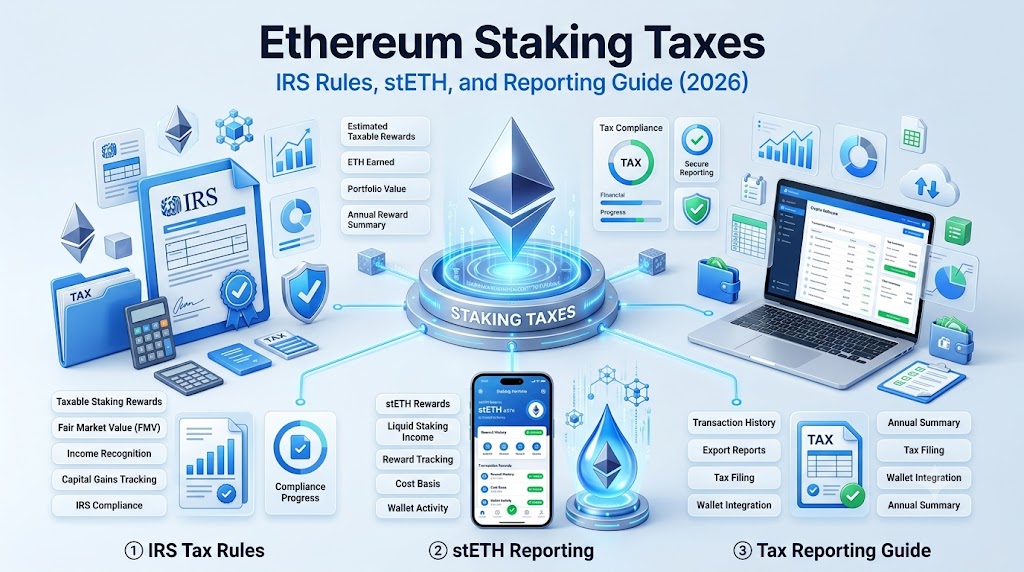
Ethereum staking rewards are taxable as ordinary income the moment you gain dominion and control over them, then taxed again as capital gains when you later sell, swap, or spend them.
This two-layer treatment catches most stakers off guard, especially those using liquid staking tokens like stETH where rewards arrive invisibly through daily rebasing. This guide breaks down exactly when Ethereum staking is taxed and how to report it correctly.
What “Ethereum Staking Taxes” Actually Means
Ethereum staking generates two distinct taxable events, and confusing them is the single most common reporting error. The first event is income recognition: when staking rewards become available to you, their fair market value in your local currency counts as ordinary income. The second event is a capital gain or loss: when you later dispose of those reward tokens.
In the United States, the IRS treats cryptocurrency as property, not currency, per Notice 2014-21. That classification is why staking rewards flow through the income-then-capital-gains pipeline rather than being taxed once.
Income at Receipt vs Capital Gains on Disposal
Tax Event
When It Triggers
Tax Type
Value Used
Income recognition
When you gain dominion and control of rewards
Ordinary income
FMV at receipt
Capital gain or loss
When you sell, swap, or spend reward ETH
Capital gains
Sale price minus cost basis
Cost basis established
At the moment of income recognition
N/A
Equals the FMV reported as income
The value you report as income becomes your cost basis for the second event. If you receive 0.1 ETH worth $300 as a staking reward, you report $300 of ordinary income, and $300 becomes the cost basis. Sell that ETH later for $400, and you have a $100 capital gain.
When Ethereum Staking Rewards Become Taxable Income
The trigger for income recognition is the “dominion and control” standard, set out in IRS Revenue Ruling 2023-14. A cash-method taxpayer who stakes cryptocurrency and receives validation rewards must include the fair market value of those rewards in gross income in the tax year they gain dominion and control over them.
Revenue Ruling 2023-14 describes a taxpayer who staked 200 units, received two units as a reward that were nontransferable during a short lock-up period, and could sell those units the day after the lock-up ended. The ruling concludes income is recognized after the lock-up expires, and applies identically to direct staking and staking through a centralized exchange like Coinbase.
The Dominion and Control Standard Explained
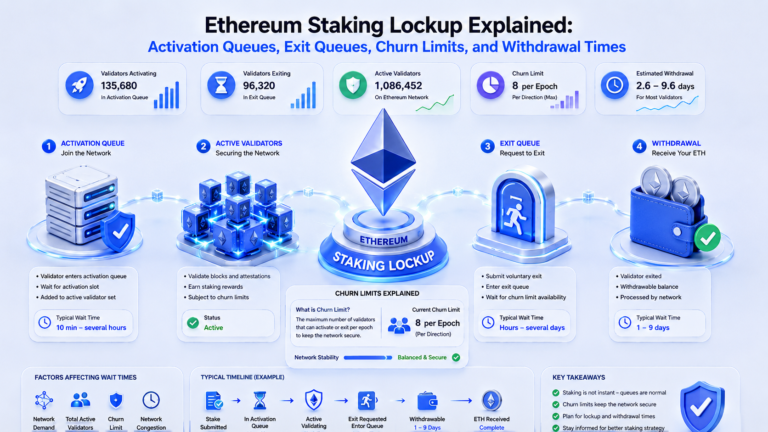
Dominion and control means you have unrestricted ability to use the tokens without permission from any third party. If reward ETH is credited to your account but locked by a real withdrawal restriction, income recognition is generally delayed until the restriction lifts. The key term is “available,” not “sold.”
Are Locked Rewards Taxable? Locked staking rewards are generally not taxable until the lock-up ends and you gain the ability to freely withdraw them. Note that the Jarrett v. United States litigation has tested whether locked rewards should instead be taxed only at final disposition, so the conservative position remains income at the point control attaches.
How to Report Ethereum Staking on Your Taxes
Reporting Ethereum staking correctly means filing the income layer and the capital gains layer on separate forms.
Form 1040 Schedule 1 for Reward Income
Most individual stakers report reward income on Form 1040, Schedule 1, Line 8z, labeled “Other Income.” You enter the total fair market value of all ETH rewards received during the tax year, valued at the moment each reward became available. There is no minimum threshold — even a few dollars of rewards must be reported.
Schedule C for Solo Validators and Business Stakers
If you operate a staking validator as a business, you report reward income on Schedule C instead, where rewards are taxed at ordinary income rates as business revenue. The advantage is deductibility: business stakers may deduct related expenses such as validator hardware, hosting, and electricity.
Form 8949 and Schedule D for Disposals
Every time you sell, swap, or spend reward ETH, you report the disposal on Form 8949, with totals carried to Schedule D. The holding period determines the rate: dispose within 12 months of receipt and short-term capital gains rates apply; hold longer and the lower long-term rates apply.
Form
Purpose
Who Files
Schedule 1, Line 8z
Report reward FMV as Other Income
Casual individual stakers
Schedule C
Report rewards as business income, deduct costs
Solo validators, business stakers
Form 8949
Itemize each disposal of reward ETH
All stakers who sell or swap
Schedule D
Summarize total capital gains and losses
All stakers who sell or swap
How stETH Rebasing Creates Hidden Daily Taxable Income
Liquid staking tokens are where most stakers silently underreport, and stETH is the clearest example. When you stake ETH through Lido, you receive stETH, a token whose balance rebases upward roughly every day as staking rewards accrue. Unlike a discrete new ETH credit, stETH rewards are baked into a quietly growing token balance, and many stakers miss this income entirely.
Tracking Problem: Rebasing produces hundreds of micro-income events per year, each requiring a fair market value in fiat at the time it accrued. Wallet-integrated tax software is effectively mandatory here, since manual tracking of daily rebases across a full year is impractical.
Is Wrapping or Converting stETH a Taxable Event?
Whether wrapping or converting a liquid staking token is taxable depends on which interpretation you follow, and the IRS has not issued token-wrapping-specific guidance. Under the “swap” interpretation, converting ETH to stETH is a taxable disposal. Under the “receipt” interpretation, stETH is merely a receipt for ETH that Lido stakes on your behalf, so no taxable event occurs. Because the IRS has not ruled, the conservative approach is to treat the wrap as a taxable disposal.
Do You Pay Tax Twice on Ethereum Staking Rewards?
You do not pay tax twice on the same value, but staking rewards do trigger two separate taxable events that feel like double taxation. The mechanism that prevents true double taxation is cost basis — the capital gains calculation only taxes the appreciation above the amount already reported as income.
How to Reduce Ethereum Staking Taxes Legally
Legitimate Levers
Hold longer than 12 months before disposing of reward ETH to access long-term capital gains rates
Harvest losses to offset gains, with up to $3,000 of net losses deductible against ordinary income per year in the US
Avoid unnecessary swaps between wallets you own, which are not taxable disposals, versus crypto-to-crypto trades, which are
Deduct validator expenses if you qualify as a business staker filing Schedule C
Track per-wallet cost basis under Revenue Procedure 2024-28
How Ethereum Staking Is Taxed Outside the US
Tax treatment of Ethereum staking varies by country. HMRC in the UK treats staking rewards as miscellaneous income, valued at their GBP price on the day you receive them, and later disposal is subject to Capital Gains Tax. The UK personal allowance means smaller stakers may owe no income tax on rewards below the threshold. As of January 1, 2026, the UK activated the Crypto-Asset Reporting Framework, meaning exchanges now report user activity to HMRC directly.
Common Ethereum Staking Tax Mistakes
Mistake
Result
Prevention
Missing stETH rebasing income
Underreported ordinary income
Use wallet-integrated tax software
Double counting wallet plus exchange imports
Inflated income, overpayment
Reconcile and deduplicate sources
Confusing income tax with capital gains
Wrong amounts on wrong forms
Track receipt FMV separately from disposal
Over-reporting wallet-to-wallet transfers
Phantom taxable events
Treat self-transfers as non-taxable
Ignoring small rewards because no 1099
Noncompliance, penalty exposure
Report all rewards regardless of threshold
What Ethereum Staking Tax Rules Cannot Guarantee
Educational Note: Revenue Ruling 2023-14 establishes income at dominion and control, but liquid staking treatment remains genuinely uncertain, and the Jarrett litigation may yet reshape when staking income is recognized. This guide is educational rather than personalized tax advice. Consult a qualified crypto tax professional before filing.
Frequently Asked Questions
Yes. Ethereum staking rewards are taxable as ordinary income at their fair market value when you gain dominion and control over them, under IRS Revenue Ruling 2023-14. A later sale or swap of those rewards is a separate capital gains event.
ETH staking rewards are taxed at the moment you can freely sell, exchange, or transfer them, not necessarily when they are created. If rewards are subject to a real lock-up, income recognition is delayed until the restriction lifts.
Report reward income on Form 1040 Schedule 1, Line 8z as Other Income, using the FMV at receipt. Report each later disposal on Form 8949 and Schedule D. Solo validators and business stakers use Schedule C instead.
Receiving staking rewards is a taxable income event. Locking ETH into a validator is generally not taxable by itself, but converting ETH to a liquid staking token like stETH may be treated as a taxable disposal under the conservative interpretation.
stETH rewards accrue through daily rebasing, and each increase in your balance is ordinary income as it becomes available. Converting ETH to stETH may be a taxable crypto-to-crypto swap, since the IRS has not issued specific guidance.
No, the same value is not taxed twice. You pay income tax on the reward when received, then capital gains tax only on any appreciation above that value when you sell.
Hold reward ETH for more than 12 months to qualify for lower long-term capital gains rates, harvest capital losses to offset gains, avoid unnecessary crypto-to-crypto swaps, and deduct validator expenses if you file as a business staker.
Locked staking rewards are generally not taxable until the lock-up ends and you can freely withdraw them, because dominion and control has not yet attached.