Ethereum Staking Risks Explained: A Complete 2026 Breakdown
Ethereum Staking Risks Explained: A Complete 2026 Breakdown
CrisCoin 10 min readEthereum
Ethereum staking carries distinct risk categories depending on which method is used — solo validator staking, liquid staking, centralized exchange staking, or EigenLayer restaking.
Understanding these risks before committing ETH is essential for making informed staking decisions. This guide breaks down slashing, smart contract, depeg, queue, centralization, restaking, and regulatory risk in detail.
Risk Categories at a Glance
Ethereum staking carries distinct risk categories depending on which method is used — solo validator staking, liquid staking, centralized exchange staking, or EigenLayer restaking. Understanding these risks before committing ETH is essential for making informed decisions.
Risk Category
Solo Staking
Liquid Staking
CEX Staking
Restaking
Slashing
Direct — self-managed
Via protocol operators
Via exchange operators
Compound — ETH + AVS
Smart contract risk
None
Present
Limited
High
Custodial risk
None
None
High
None
LST depeg risk
None
Present
None
Via LST
Centralization risk
None
Lido dominance
High
EigenLayer concentration
Scale of the Sector: Non-custodial ETH staking now exceeds $130 billion in TVL as of 2026 — the scale of capital in Lido, Rocket Pool, and EigenLayer means a material exploit at any major protocol would produce systemic consequences beyond individual losses.
What Is Slashing Risk — and How Does It Work?
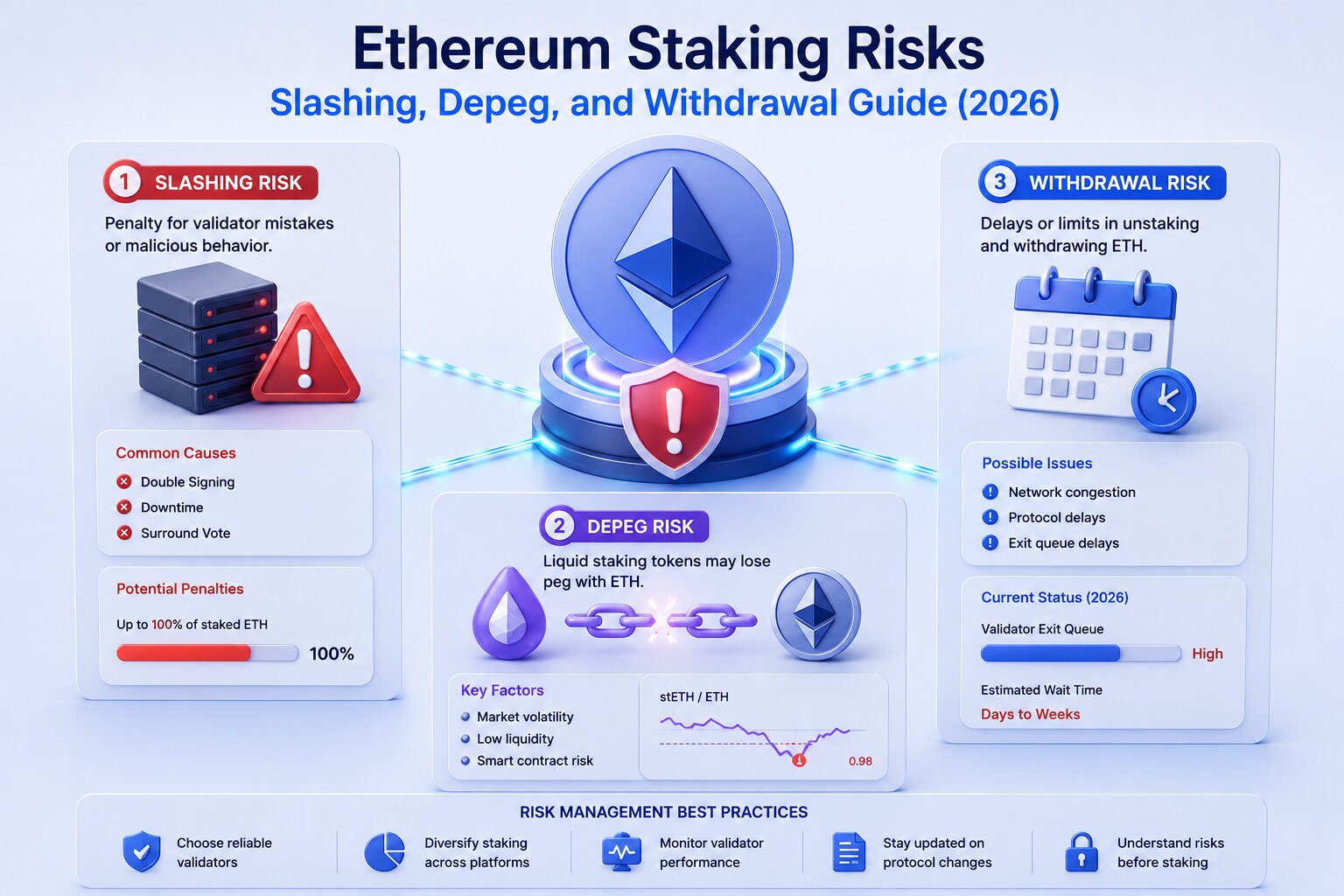
Slashing is a protocol-enforced penalty that permanently destroys a portion of a validator’s staked ETH for specific misbehavior, designed to economically deter attacks on Ethereum’s consensus. It occurs for equivocation — signing two conflicting messages at the same slot, whether double-voting or surround voting.
Slashing Event
Initial Penalty
Total Maximum
Standard individual slash
1/32 of balance (~1 ETH)
Up to 32 ETH if 33%+ slash simultaneously
Correlated slash (33%+ of validators)
1/32 of balance
Full stake loss
A slashed validator is automatically marked for exit and its ETH enters the withdrawal queue with reduced balance. Slashing is very rare for honest, well-configured validators — the primary cause is operator misconfiguration, such as running the same validator key on two machines simultaneously.
What Is Smart Contract Risk in Liquid Staking?
Liquid staking protocols like Lido, Rocket Pool, and ether.fi rely on audited smart contracts to accept ETH deposits, operate validators, distribute rewards, and handle withdrawals. A contract exploit could result in partial or total loss of deposited ETH.
Smart contract audits reduce exploit probability but do not eliminate it — re-entrancy vulnerabilities, oracle manipulation, and governance attacks have occurred in previously audited protocols. Lido has been audited by Sigma Prime and Certora; Rocket Pool by Sigma Prime, Consensys Diligence, and Trail of Bits.
Mitigation
Diversifying across multiple liquid staking protocols reduces exposure to any single contract failure
Holding stETH, rETH, and eETH across protocols provides smart contract risk distribution
What Is LST Depeg Risk — and How Serious Is It?
Liquid Staking Tokens trade on secondary markets at prices determined by supply and demand. During market stress, LSTs can trade below their underlying ETH-equivalent value, a temporary disconnect known as a depeg.
Depeg Event
Date
Peak Discount
Cause
stETH depeg
June 2022
~6% below ETH
Three Arrows Capital collapse — forced selling
Minor stETH dips
Various 2023-2024
0.1-0.5%
Normal market liquidity variation
Users holding LSTs as collateral in DeFi protocols can face liquidation during depeg events even though the underlying protocol remains solvent. rETH has historically maintained a tighter peg than stETH during stress events due to its smaller market size and direct redemption mechanism.
What Is the Withdrawal Queue Risk?
Ethereum’s validator exit mechanism uses a queue-based system — validators cannot exit instantly. Daily exit capacity is capped at 57,600 ETH post-Pectra, creating bottlenecks when withdrawal demand surges.
Stage
Duration
Exit queue wait
Minutes to weeks
Post-exit delay
~27 hours (256 epochs)
Sweep delay
~7-10 days
Total typical wait
1-14+ days
During the peak exit queue in late 2025, approximately 1 million ETH faced over 43-day withdrawal delays, demonstrating that withdrawal queues are not theoretical. Liquid staking token secondary market sales bypass the queue entirely, providing immediate liquidity at the cost of potential market impact.
What Is Ethereum Staking Centralization Risk?
Centralization risk refers to the concentration of validator stake under a small number of operators, creating potential influence over block production, transaction censorship, and consensus governance.
Protocol
Market Share
Centralization Risk
Lido
24.2%
High — single entity with large share
Binance
9.1%
High — custodial exchange
ether.fi
6.0%
Medium — distributed operators
Rocket Pool
~3%
Low — permissionless operators
Lido’s 24.2% share approaches the critical 33% threshold where a single entity could theoretically influence Ethereum finality. The Ethereum Foundation has publicly flagged liquid staking protocol dominance as a systemic risk to consensus health.
What Is EigenLayer Restaking Risk?
EigenLayer restaking layers additional risk on top of base Ethereum staking by deploying staked ETH or LSTs as security for Actively Validated Services, each with independent slashing conditions. Restakers face compound slashing exposure — ETH can be slashed by both the Ethereum base protocol and by any AVS whose conditions the validator violates simultaneously.
Restaking Contagion: If a popular liquid restaking token depegs during market stress, operators may become forced sellers, deepening the discount and impairing collateral for other protocols accepting the token. EigenLayer’s April 2026 security incident demonstrated that DeFi exploit shocks can rapidly flood exit queues.
What Is Regulatory Risk for Ethereum Staking?
Regulatory treatment of Ethereum staking rewards varies significantly across jurisdictions and continues to evolve, creating potential for retrospective tax obligations or staking service restrictions. The US SEC has taken enforcement action against exchange staking services — Kraken settled for $30 million in February 2023 over its staking-as-a-service program. Yield-bearing ETH ETF approval in 2026 was a bullish surprise, but policy tone can reverse quickly.
How to Manage Ethereum Staking Risks
Risk
Mitigation Strategy
Slashing (solo)
Never run the same validator key on two machines — use DVT for fault tolerance
Smart contract (LSP)
Diversify across Lido, Rocket Pool, and ether.fi
LST depeg
Maintain a secondary liquidity buffer — avoid leveraged collateral use
Withdrawal queue
Plan exit timing — do not stake ETH needed for near-term liquidity
Centralization
Choose Rocket Pool over Lido; choose minority clients over Prysm
Restaking
Understand each AVS’s slashing conditions before opting in
Frequently Asked Questions
The primary risks are slashing, smart contract exploits for liquid staking protocols, LST depeg, withdrawal queue delays, centralization risk from Lido’s large share, custodial risk for CEX staking, and compound slashing for EigenLayer restakers.
Yes, in specific scenarios. Slashing destroys a portion of staked ETH permanently, smart contract exploits can reduce depositor balances, LST depeg creates mark-to-market losses, and normal solo staking with correct configuration carries extremely low probability of actual loss.
Slashing is a permanent protocol penalty for validator equivocation — signing two conflicting blocks or attestations at the same slot. The initial penalty is 1/32 of staked ETH, scaling to full forfeiture in correlated mass-slashing events.
LST depeg occurs when a liquid staking token trades below its ETH-equivalent value on secondary markets. During the June 2022 Three Arrows Capital collapse, stETH traded at approximately 6% below ETH.
Post-Pectra, daily exit capacity is 57,600 ETH. Under normal conditions, solo validator withdrawal completes within 1-14 days. During peak demand, queues have extended to 43+ days.
Neither is strictly safer — they carry different risk profiles. Solo staking eliminates smart contract and custodial risk but retains slashing and queue risk. Liquid staking eliminates hardware management but introduces smart contract and depeg risk.
A smart contract exploit could partially or fully drain deposited ETH. Users holding the LST would face mark-to-market losses proportional to the exploit magnitude. All major protocols have undergone multiple independent audits, but audits do not guarantee zero exploit risk.
EigenLayer restaking adds compound slashing exposure from both Ethereum consensus rules and each AVS’s independent conditions. AVS reward distributions are variable, and the complexity of layered security assumptions creates risk profiles that differ materially from base staking.