How to Stake Crypto with Coinbase Wallet (2026 Guide)
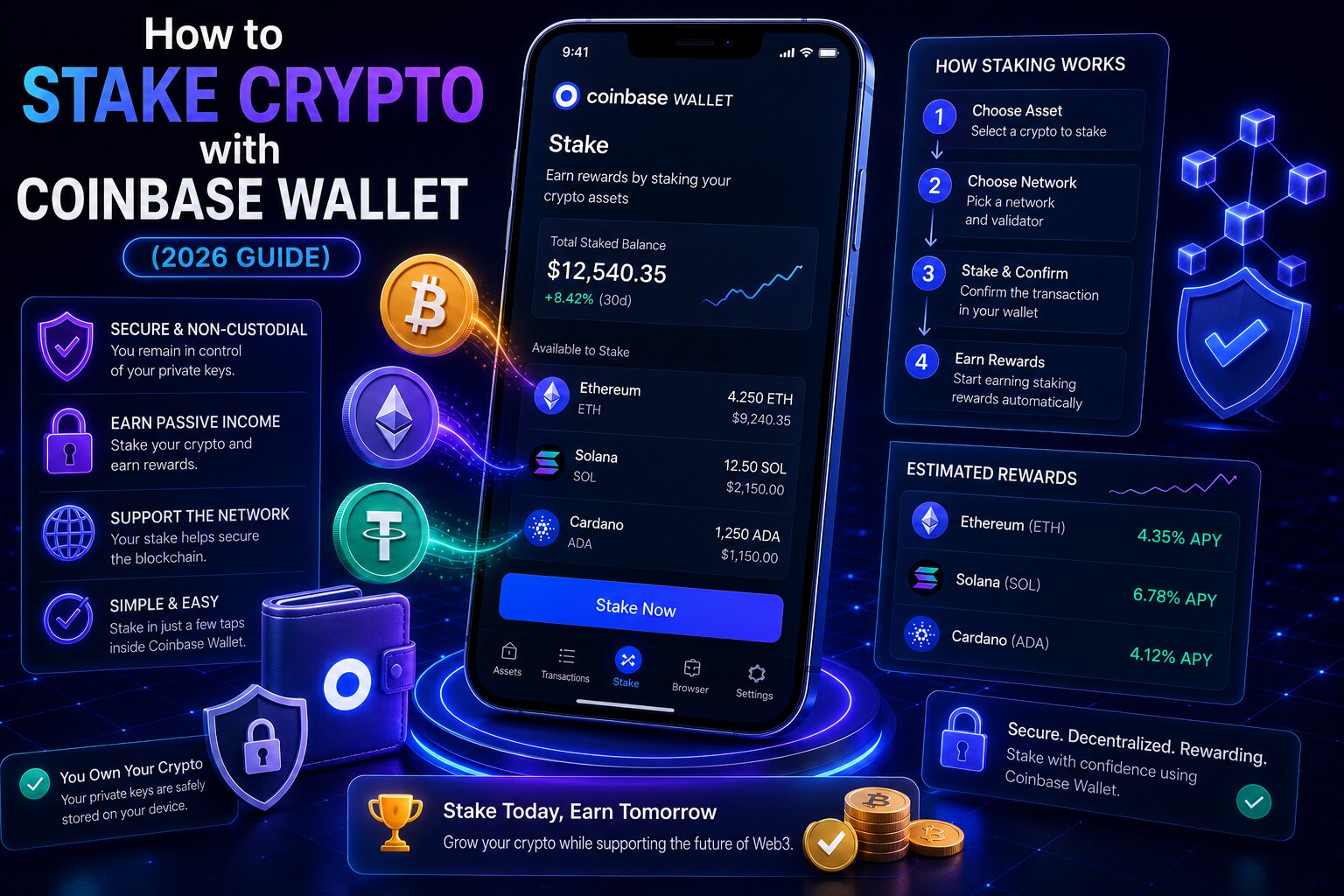
Coinbase Wallet stakes crypto through the built-in dApp Browser β connecting to DeFi protocols like Lido, Rocket Pool, and Jito while private keys stay on the user’s device. This is fundamentally different from Coinbase exchange staking, where Coinbase holds the assets and manages Validators on the user’s behalf.
| Staking Method | Custody | APY (Net, May 2026) | Commission | KYC |
| Lido ETH (via Coinbase Wallet) | Self-custodial | ~2.16% | 10% | No |
| Rocket Pool ETH (via Coinbase Wallet) | Self-custodial | ~2.98% | 14% | No |
| Jito SOL (via Coinbase Wallet) | Self-custodial | ~5.34% | ~8% | No |
| Coinbase Exchange ETH | Custodial | ~1.88% | 25β35% | Yes |
| Coinbase Exchange SOL | Custodial | ~4.88β5.63% | 25β35% | Yes |
- Lido currently manages approximately $14 billion in Total Value Locked (TVL) across Ethereum, Solana, and Polygon staking β the largest Liquid Staking protocol by TVL.
- Coinbase manages 1,840,952 ETH across its Validator infrastructure β 5.1% of all active Ethereum Beacon Chain validators as of early 2026.
- The Ethereum staking APR fluctuates based on Beacon Chain validator participation rates, network transaction fees, and MEV rewards β rates shown reflect May 2026 conditions.
Key Staking Terms for Coinbase Wallet Users
| Term | Definition |
| Proof-of-Stake (PoS) | Blockchain consensus where Validators confirm transactions using staked tokens |
| Beacon Chain | Ethereum’s Consensus Layer β coordinates Validators and distributes staking rewards |
| Validator | Network node that confirms blocks on the Beacon Chain and distributes Staking Rewards |
| Node Operator | Entity that runs Validator hardware on behalf of a staking protocol |
| Epoch | Fixed time interval (Ethereum: ~6.4 min / Solana: ~2-3 days) after which rewards are calculated |
| Liquid Staking | Staking method that issues a receipt token representing staked assets plus accrued rewards |
| TVL | Total Value Locked β total assets committed to a staking protocol |
| Restaking | Using already-staked assets to secure additional protocols β available via EigenLayer |
| LSDfi | Liquid Staking Derivatives Finance β DeFi protocols that accept stETH, rETH, or JitoSOL |
| Smart Contract Audit | Independent security review of protocol code β Lido audited by Certora and others |
| Delegated Staking | Assigning stake to a Validator without transferring asset ownership |
| Stake Account | On-chain Solana account that tracks a delegated staking position |
What is the difference between Coinbase Wallet staking and Coinbase exchange staking?
Coinbase Wallet staking is self-custodial – users connect to DeFi protocols while keeping private keys on their own device. Coinbase exchange staking is custodial β Coinbase holds the assets and manages all Node Operators on the user’s behalf.
| Feature | Coinbase Wallet Staking | Coinbase Exchange Staking |
| Custody | Self-custodial | Coinbase holds keys |
| KYC | No | Yes |
| Commission | Protocol-level (10β14%) | 25β35% of all rewards |
| Slashing coverage | User bears risk | Coinbase covers losses |
| Liquid token issued | stETH, rETH, JitoSOL | cbETH (ETH only) |
| DeFi composability | Full LSDfi access | Limited – cbETH on select protocols |
| U.S. state restrictions | None | Some states restricted (NY, HI) |
| Validator selection | Protocol-managed | Coinbase-managed |
Why does Coinbase Wallet staking require a dApp Browser instead of a Stake button?
Coinbase Wallet is a self-custodial wallet β it does not operate staking infrastructure or manage Node Operators. DeFi staking protocols like Lido and Jito operate as independent smart contracts on Ethereum and Solana. Connecting through the dApp Browser keeps private keys on the user’s device while enabling on-chain Delegated Staking through audited protocol smart contracts.
- The dApp Browser connects the wallet to smart contracts β the wallet signs transactions locally, and the protocol manages Validator delegation on-chain.
- Coinbase Wallet never transfers key ownership to any staking protocol β it only authorizes specific on-chain actions via signed transactions.
- A dedicated Stake button exists in the Coinbase exchange app because the exchange operates a custodial managed service β Coinbase Wallet’s self-custodial architecture requires direct protocol interaction.
Which staking method is better for beginners β Coinbase exchange staking or Coinbase Wallet?
Beginners benefit from Coinbase exchange staking because it requires no DeFi knowledge, covers Slashing losses, and handles all Validator management automatically. Coinbase Wallet DeFi staking is better for users who understand smart contracts, want self-custody, and prioritize higher net yield.
| Factor | Beginners | Advanced Users |
| Recommended method | Coinbase Exchange staking | Coinbase Wallet + Lido/Jito |
| Setup complexity | Simple – one tap | Moderate – dApp Browser navigation |
| Slashing protection | Coinbase covers | User bears risk |
| Net ETH yield | ~1.88% | ~2.16β2.98% |
| Key control | Coinbase holds | User holds |
What is the difference between native staking and Liquid Staking on Coinbase Wallet?
Native staking locks tokens directly with a Validator and generates no receipt token β assets are illiquid during the Unbonding Period. Liquid Staking issues a receipt token (stETH, rETH, JitoSOL) that can be traded, used as collateral, or deployed in LSDfi protocols while the underlying asset continues earning Staking Rewards.
| Feature | Native Staking | Liquid Staking |
| Receipt token | None | stETH, rETH, JitoSOL, cbETH |
| Liquidity | Locked until Unbonding ends | Tradeable anytime |
| DeFi usability | Limited | Full LSDfi access |
| Unbonding Period | Required β varies by chain | Usually avoidable via DEX swap |
| Smart contract risk | Lower | Higher β relies on protocol code |
| Validator Uptime risk | Direct impact | Distributed across many Validators |
| Best for | Long-term holders | Active DeFi users |
- Native staking on Ethereum requires running a Validator with 32 ETH β not accessible to most retail users without a pooled staking protocol.
- Liquid Staking through Lido, Rocket Pool, and Jito provides pooled access to Validator rewards for any amount β the receipt token represents ownership of the staked position.
- LSDfi protocols like Aave and Curve accept stETH and rETH as collateral β enabling borrowing, yield farming, and liquidity provision on top of the base staking yield.
How does Coinbase Wallet interact with staking smart contracts?
Coinbase Wallet interacts with staking smart contracts by signing transactions locally β the wallet constructs and authorizes the staking instruction, while the smart contract executes the Delegated Staking on-chain. Private keys never leave the device at any point in this process.
| Step | Who Acts | What Happens |
| 1. User opens dApp Browser | User | Navigates to staking protocol URL |
| 2. Wallet connects to protocol | Coinbase Wallet | Shares Public Address β read-only access |
| 3. User initiates stake | User | Enters amount β reviews transaction details |
| 4. Wallet signs transaction | Coinbase Wallet (local) | Private key signs β stays on device |
| 5. Smart contract executes | Protocol smart contract | Processes Delegated Staking β on-chain |
| 6. Validator delegation | Node Operator | Runs Validator on Beacon Chain |
| 7. Receipt token issued | Protocol | stETH or JitoSOL credited to wallet |
| 8. Rewards accrue | Beacon Chain / Solana | Distributed per Epoch |
- The staking smart contract processes Delegated Staking entirely on-chain β Coinbase Wallet never sends assets to a server or a third-party account.
- Lido’s smart contracts have been audited by Certora, Mixbytes, and other security firms β independent Smart Contract Audits reduce but do not eliminate exploit risk.
- Jito’s validator architecture on Solana uses a decentralized set of Stake Accounts and MEV-enabled Node Operators β the protocol is open-source and audited.
Does Coinbase Wallet expose private keys during staking?
No. Private keys are generated and stored on the user’s device β they are never transmitted to any staking protocol, DeFi smart contract, or external server during any staking interaction. The dApp Browser connects to smart contracts through the wallet’s signing interface β keys authorize transactions locally without leaving the device.
Can staking protocols drain a wallet β and what permissions do they request?
Staking protocols request only the specific permissions needed to execute the staking transaction β they do not receive blanket access to the wallet. The Coinbase Wallet approval screen shows exactly what each transaction authorizes before the user confirms.
| Permission Type | What It Allows | Risk Level |
| Transfer ETH to staking contract | Sends specific amount to protocol | Expected for staking |
| Token approval (unlimited) | Grants protocol unlimited spending on a token | High – set specific amount |
| Token approval (specific amount) | Grants protocol limited spending on a token | Lower risk |
| Wallet connection (read-only) | Shares Public Address | No fund access |
- Always review the permission scope in the Coinbase Wallet approval screen before confirming any staking transaction β reject unlimited token approvals and set specific amounts instead.
- Staking approvals granted to smart contracts persist on-chain after disconnecting from the dApp β use revoke.cash to cancel any outstanding approvals after each staking session if desired.
How do you stake ETH using Coinbase Wallet and Lido β step by step?
To stake ETH through Coinbase Wallet, open the dApp Browser, navigate to lido.fi, connect the wallet, enter the ETH amount, and confirm. Lido issues stETH β a Liquid Staking token that accrues Beacon Chain rewards via daily rebase.
Steps:
- Open Coinbase Wallet and tap the dApp Browser (Discover) tab.
- Type lido.fi in the browser bar and press Go.
- Tap Connect Wallet β select Coinbase Wallet from the options.
- Select Stake Now β Ethereum 2.0 from the Lido menu.
- Enter the ETH amount to stake β any amount is accepted, no minimum required.
- Review the estimated APR (~2.4% gross, ~2.16% net after 10% commission) and gas fee.
- Tap Submit β Coinbase Wallet displays a transaction approval screen.
- Confirm the transaction β ETH is staked and stETH appears in the wallet balance.
Retain a small ETH balance after staking β gas fees for future transactions including stETH swaps must be paid in ETH.
How does Rocket Pool compare to Lido for ETH staking via Coinbase Wallet?
| Feature | Lido | Rocket Pool |
| Net APY (May 2026) | ~2.16% | ~2.98% |
| Liquid token | stETH (rebase) | rETH (value-accruing) |
| Commission | 10% | 14% |
| TVL | ~$14B+ | ~$2B+ |
| Decentralization | Lower | Higher β permissionless Node Operators |
| Audit status | Certora, Mixbytes | Independent audits β open source |
| DeFi integrations | Very broad | Moderate |
- Rocket Pool delivers higher net yield (2.98% vs 2.16%) because its gross yield is higher β despite charging a higher 14% commission than Lido’s 10%.
- rETH uses a value-accruing model where 1 rETH becomes worth more than 1 ETH over time β unlike stETH’s daily balance rebase mechanism.
- Rocket Pool’s open-source Node Operator design requires only 16 ETH to run a validator β more decentralized than Lido’s permissioned Node Operator set.
How do you stake SOL using Coinbase Wallet and Jito – step by step?
To stake SOL through Coinbase Wallet, open the dApp Browser, navigate to jito.network, connect the wallet, enter the SOL amount, and confirm. Jito issues JitoSOL β a Liquid Staking token that captures both standard Epoch rewards and MEV priority fees.
Steps:
- Open Coinbase Wallet β tap dApp Browser.
- Type jito.network β press Go.
- Tap Connect Wallet β select Coinbase Wallet.
- Enter the SOL amount β any amount accepted, no minimum.
- Review the estimated APY (~5.8% gross, ~5.34% net) and gas fee (~$0.001).
- Tap Stake β confirm the transaction in Coinbase Wallet.
- JitoSOL appears in the wallet β it appreciates in value relative to SOL as Epoch rewards and MEV fees accumulate.
What are MEV rewards and why does Jito offer higher SOL APY than standard validators?
MEV (Maximal Extractable Value) rewards come from Jito’s block engine β it optimizes transaction ordering within each Solana block, capturing additional priority fees that are distributed to JitoSOL holders alongside standard Epoch inflation rewards.
| SOL Staking Method | Gross APY | Commission | Includes MEV | Net APY |
| Jito (JitoSOL) | ~5.8% | ~8% | Yes | ~5.34% |
| Marinade Finance (mSOL) | ~11.8% | Variable | Yes | Variable |
| Standard native | ~5β7% | 5β10% | No | ~4.5β6.3% |
- Solana Epoch rewards come from inflation β the Solana network issues new tokens each Epoch (~2-3 days) distributed to all staked validators proportionally.
- MEV rewards on Jito come from transaction ordering optimization β additional income on top of base Epoch inflation rewards.
- Delegated Staking on Solana uses a Stake Account β an on-chain record that tracks the delegation without transferring asset ownership to the Validator.
What is cbETH and how does it compare to stETH and rETH?
cbETH is Coinbase’s Liquid Staking token for Ethereum β issued when users stake ETH on the Coinbase exchange. It is not staked through Coinbase Wallet’s dApp Browser β it is acquired via the exchange or purchased on Uniswap and then held or used in DeFi via Coinbase Wallet.
How does cbETH differ from stETH and rETH?
| Feature | cbETH (Coinbase) | stETH (Lido) | rETH (Rocket Pool) |
| Token model | Value-accruing | Rebase (balance grows) | Value-accruing |
| Commission | 25β35% | 10% | 14% |
| Custody at minting | Custodial | Non-custodial | Non-custodial |
| Slashing coverage | Coinbase covers | User bears | User bears |
| DeFi protocols | Uniswap, Aave | Aave, Uniswap, Curve (broad) | Moderate |
| Tradeable without unstaking | β Yes | β Yes | β Yes |
| Smart Contract Audit | Coinbase internal | Certora, Mixbytes | Independent audits |
- cbETH’s value-accruing model means 1 cbETH gradually becomes worth more than 1 ETH β the yield appears as price appreciation rather than balance growth.
- stETH’s daily rebase increases the token balance in the wallet each day β both models deliver equivalent economic value but display differently.
- LSDfi protocols like Aave accept all three tokens as collateral β stETH has the deepest liquidity and most protocol integrations in the LSDfi ecosystem.
What APY can you earn staking through Coinbase Wallet β and why does it change?
Net yield is the only meaningful comparison metric β gross APY before commission overstates actual returns. Net yield formula: Gross APY Γ (1 β commission rate).
| Protocol | Gross APY | Commission | Net APY (May 2026) |
| Lido (stETH) | 2.4% | 10% | ~2.16% |
| Rocket Pool (rETH) | 3.46% | 14% | ~2.98% |
| Jito (JitoSOL) | 5.8% | ~8% | ~5.34% |
| Coinbase Exchange ETH | ~3.5% gross | 25β35% | ~1.88β2.63% |
| Coinbase One ETH | ~3.5% gross | 26.3% | ~2.58% |
Why does staking APY change over time on Coinbase Wallet?
Staking APY is not fixed β it fluctuates based on multiple network and market factors that change independently.
| Factor | Impact on APY | Direction |
| Validator participation rate | More validators = reward dilution per validator | β as participation increases |
| Network transaction fees | Higher activity = more fees per block | β during high network demand |
| MEV rewards (Solana/Ethereum) | Block ordering demand drives MEV income | Variable β market-dependent |
| Solana inflation rate | Programmatic decay per Epoch | β gradually over time |
| Ethereum Beacon Chain issuance | Fixed per validator β diluted by total validators | β as ETH total staked grows |
| Protocol commission changes | Governance votes can adjust fees | Governance-dependent |
- Ethereum staking APR has declined from ~4-5% in 2023 to approximately 2.4-3.5% in 2026 because the total ETH staked on the Beacon Chain has grown significantly β more validators competing for the same reward pool reduces individual yields.
- Solana APY includes both inflation rewards and MEV capture β MEV rewards vary with daily transaction activity, creating natural yield fluctuations between Epochs.
- Lido’s commission rate is set by Lido DAO governance β any future vote to change the 10% fee would affect net yield for all stETH holders.
What are the risks of staking via Coinbase Wallet?
Staking through Coinbase Wallet carries four risk categories β none expose the private keys stored in the wallet, but all can reduce the value of staked positions.
| Risk | Description | Protocols Affected | Mitigation |
| Slashing | Validator misbehavior burns staked tokens proportionally | Lido, Jito, Rocket Pool | Use audited, established protocols |
| Smart contract exploit | Code vulnerability drains staked assets | All DeFi protocols | Smart Contract Audit status β size conservatively |
| Liquid Staking token depeg | stETH or JitoSOL temporarily loses 1:1 peg | Lido (stETH), Jito (JitoSOL) | Position-size to tolerate temporary depeg |
| Price depreciation | Token falls while staking | All assets | Match staking duration to holding conviction |
- Lido’s stETH depegged approximately 6% below spot ETH during the 2022 Terra collapse β Liquid Staking tokens are not immune to market-driven valuation shocks under extreme stress.
- EigenLayer restaking allows staked ETH to secure additional protocols simultaneously β this emerging sector builds additional yield on top of base Liquid Staking but adds compounding smart contract risk layers.
- Coinbase exchange staking covers Slashing losses β a protection that no current Coinbase Wallet DeFi staking protocol provides.
What mistakes should you avoid when staking with Coinbase Wallet?
Six common mistakes account for most staking losses and errors when using Coinbase Wallet for DeFi staking.
| Mistake | Consequence | Prevention |
| Approving unlimited token permissions | Smart contract gains unlimited spending rights | Set specific amount β not unlimited β in every approval |
| Forgetting gas fee reserves | Subsequent transactions fail β cannot unstake | Keep ETH balance for gas after every staking transaction |
| Confusing gross APY with net yield | Overstating expected returns | Always apply: Gross Γ (1 β commission) = Net APY |
| Ignoring Slashing risk | Portion of staked assets burned by protocol | Research Validator Uptime and audit status before staking |
| Sending to wrong network | Assets on incompatible chain β permanent loss | Confirm Blockchain Network before every DeFi transaction |
| Swapping depegged stETH during market stress | Crystallizing temporary loss as permanent | Hold through temporary depeg β swap only when peg recovers |
- Unlimited token approvals granted to staking smart contracts persist on-chain after disconnecting β revoke unnecessary approvals via revoke.cash after each session.
- Gas fee reserves are critical on Ethereum β a wallet with 0 ETH balance cannot execute any transaction, including unstaking or swapping stETH back to ETH.
- Comparing gross APY across platforms without applying commission arithmetic is one of the most common staking calculation errors β Coinbase exchange’s 25β35% commission significantly reduces headline gross rates.
Is staking via Coinbase Wallet taxable?
In most jurisdictions, Staking Rewards received through DeFi protocols are treated as ordinary income at the time of receipt β taxed at fair market value when credited.
| Action | Common Tax Treatment |
| stETH daily rebase increment | Ordinary income β taxable when credited each day |
| JitoSOL value appreciation | Capital gains when sold or swapped |
| Swapping stETH to ETH on Uniswap | Taxable disposal β capital gains on price difference |
| Swapping JitoSOL to SOL | Taxable disposal β capital gains |
| cbETH appreciation | Capital gains when cbETH is sold |
| Coinbase exchange staking rewards | Ordinary income β Coinbase may issue 1099-MISC |
- Coinbase Wallet does not issue tax forms for DeFi staking activity β use transaction history exports or crypto tax software to calculate staking income and capital gains.
- stETH’s daily rebase creates a tax event each day rewards are credited in most jurisdictions β detailed record-keeping is essential for accurate reporting.
- Tax treatment varies significantly by country and is subject to regulatory change β consult a qualified tax professional before staking material amounts.
FAQ
How do I stake crypto on Coinbase Wallet?
Open the Coinbase Wallet dApp Browser, navigate to lido.fi for ETH or jito.network for SOL, connect the wallet, enter the stake amount, and confirm the transaction. Coinbase Wallet issues no direct Stake button β all self-custodial staking occurs through DeFi protocols in the dApp Browser. Keep ETH or SOL for gas fees after every stake.
What is cbETH on Coinbase?
cbETH is Coinbase’s Liquid Staking token for Ethereum β issued when users stake ETH on the Coinbase exchange. It uses a value-accruing model where cbETH price rises relative to ETH as Beacon Chain rewards accumulate. cbETH is tradeable on Uniswap and usable as collateral on Aave. Coinbase covers Slashing losses for cbETH holders β a protection Lido and Rocket Pool do not provide.
Can I stake ETH without 32 ETH on Coinbase Wallet?
Yes. Lido and Rocket Pool both accept any ETH amount through pooled Delegated Staking β no minimum is required. Open the dApp Browser, navigate to lido.fi or rocketpool.net, and stake any amount. Lido issues stETH and Rocket Pool issues rETH β both can be swapped back to ETH without an Unbonding Period via Uniswap or Curve.
What is the APY for staking on Coinbase Wallet?
Net APY through Coinbase Wallet DeFi protocols in May 2026: Lido ETH ~2.16%, Rocket Pool ETH ~2.98%, Jito SOL ~5.34%. These are net figures after protocol commissions. Gross APY Γ (1 β commission rate) = net yield. APY fluctuates based on Beacon Chain validator participation, MEV rewards, network fees, and Epoch inflation schedules.
Is staking on Coinbase Wallet safe?
Coinbase Wallet staking keeps private keys on the user’s device β private keys are never exposed to staking smart contracts. Main risks are Slashing from Validator misbehavior, smart contract exploits, and Liquid Staking token depegs. Use only audited protocols β Lido is audited by Certora and Jito is open-source and audited. Review token approval permissions carefully before confirming every staking transaction.
How do I unstake crypto on Coinbase?
For Coinbase Wallet DeFi staking: swap stETH, rETH, or JitoSOL back to ETH or SOL via Uniswap, Curve, or Jupiter accessible through the dApp Browser β no Unbonding Period required. For Coinbase exchange staking: tap the staked asset, select Unstake, and follow prompts β ETH has a variable Beacon Chain withdrawal queue and SOL takes approximately 2β3 days per Epoch.
Does Coinbase Wallet charge fees for staking?
Coinbase Wallet charges $0. DeFi protocol commissions apply separately β Lido charges 10% of Staking Rewards, Rocket Pool charges 14%, and Jito charges approximately 8%. A one-time gas fee goes to the blockchain network when initiating staking. Compare only net yield after commissions β Coinbase exchange staking charges 25β35% of all rewards, substantially reducing headline gross rates.

Is it better to stake on Coinbase or use Lido via Coinbase Wallet?
Lido via Coinbase Wallet offers higher net ETH yield (~2.16% vs ~1.88%), self-custodial key control, no KYC, full LSDfi composability, and no U.S. state restrictions. Coinbase exchange staking provides Slashing coverage, automated management, and beginner-friendly access. Choose Coinbase Wallet + Lido for self-custody and yield. Choose Coinbase exchange for managed simplicity and Slashing protection.