How to Stake Crypto on Ledger Wallet (2026 Guide)Β
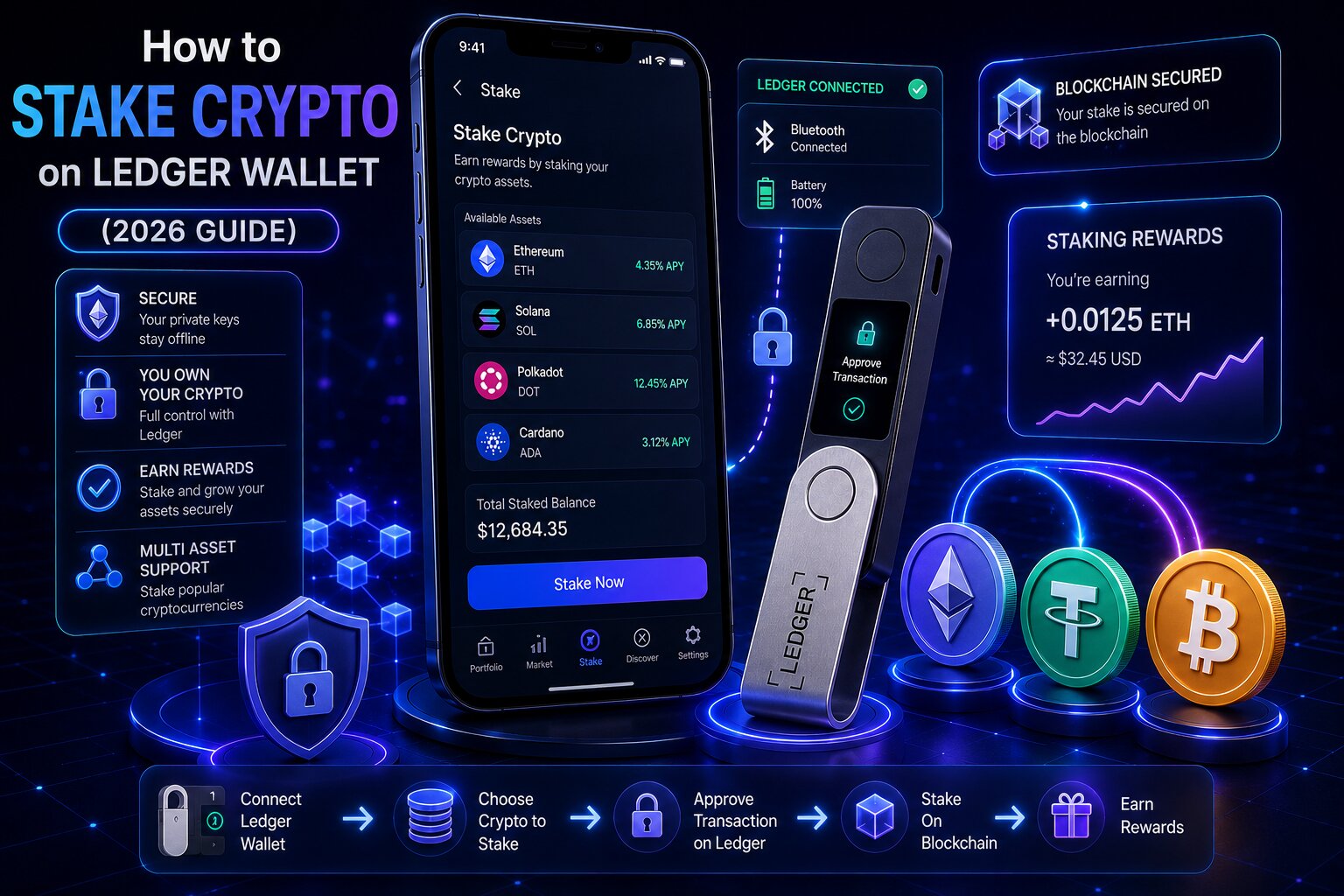
To stake crypto on a Ledger hardware wallet, open the Earn section in Ledger Wallet app, select an eligible asset, choose a Validator or staking provider, and confirm with Physical Confirmation on the device. Private keys stay offline in the Secure Element chip throughout – on-chain staking never requires transferring assets to an exchange or custodian.
| Staking Method | Provider | Annualized Yield (2026) | Minimum | Unbonding |
| ETH β Liquid Staking | Lido | ~3% | Any amount | None β swap stETH |
| ETH β Native Pooled | Kiln | ~3.5% | Any amount | ~4 days |
| SOL β Native | Validator (user selects) | ~5β7% | Gas SOL only | ~2β3 days |
| ATOM β Delegated | Validator (user selects) | ~15β21% | No minimum | 21 days |
| DOT β Nominated PoS | Validator (nominate) | ~12β15% | No minimum | 28 days |
| ADA β Delegation | Stake pool (delegate) | ~2.7% | No minimum | No lockup |
| BTC β Yield | Third-party provider | ~0.38% | Varies | Varies |
- On-chain staking through Ledger keeps private keys isolated in the hardware security chip β custodial staking on exchanges transfers asset control to the exchange operator.
- The Earn section in Ledger Wallet 4.0 automatically identifies idle assets eligible for protocol rewards β no manual portfolio search required.
- Physical Confirmation on the hardware device authorizes every stake and undelegation transaction β no software can trigger these actions remotely.
- Staking Rewards are not guaranteed β annualized yields fluctuate based on network participation rates, Validator commission, and epoch reward schedules.
Staking Terms Explained – Key Definitions
Understanding the core vocabulary prevents confusion when navigating the Earn section and selecting staking options on Ledger.
| Term | Definition |
| Validator | Network node that confirms blockchain transactions and distributes protocol rewards to delegators |
| Delegator | Token holder who assigns stake to a Validator without transferring ownership |
| Epoch | Fixed time interval (hours to days) after which staking rewards are calculated and distributed |
| Unbonding Period | Mandatory waiting time between initiating undelegation and accessing staked assets |
| Slashing | Penalty mechanism that burns a portion of staked tokens when a Validator misbehaves or goes offline |
| Liquid Staking | Staking method that issues a tradeable receipt token (e.g. stETH) while the original asset earns rewards |
| Liquid Staking Derivative | The receipt token itself (stETH, mSOL) β represents staked asset plus accrued yield |
| Native Staking | Direct on-chain delegation to a Validator β no intermediary protocol or smart contract |
| Custodial Staking | Exchange holds assets and stakes on the user’s behalf β user gives up key control |
| Validator Commission | Percentage of block rewards deducted by the Validator before distributing to delegators |
| MEV Rewards | Additional rewards from Maximal Extractable Value β available to ETH Validators via Jito (SOL) |
| Restaking | Using already-staked assets as collateral to secure additional protocols β available via EigenLayer (ETH) |
What is staking on Ledger and how does the Earn section work?
Staking on Ledger means delegating crypto assets to Proof-of-Stake Validators to support network security while earning protocol rewards β all while the hardware security chip retains private key control. The Earn section serves as the central dashboard for discovering eligible assets, initiating delegations, and tracking accumulated yield.
What is Proof-of-Stake and why do delegators earn rewards?
Proof-of-Stake selects Validators to confirm transactions based on the amount of crypto they hold or receive as delegations. Validators distribute a share of block rewards to all delegators proportionally – after deducting Validator commission.
- Validators confirm blocks and receive newly minted tokens plus transaction fees β these are the Staking Rewards distributed to delegators each Epoch.
- Delegators on Ledger retain asset ownership throughout β the Secure Element signs delegation transactions without the private key leaving the chip.
- Validator commission rates typically range from 5β10% of gross rewards β this percentage is deducted before delegators receive their net annualized yield.
What does the Earn section in Ledger Wallet 4.0 do differently?
| Feature | Old Ledger Live | Ledger Wallet 4.0 |
| Idle asset detection | Manual search | Automatic identification in portfolio |
| APR/APY display | Per asset only | Alongside eligible assets with fiat estimate |
| Reward tracking | Basic | Real-time per position with Epoch breakdown |
| Provider comparison | Limited | Multiple providers shown side by side |
| Liquid Staking access | Separate app install | Integrated directly in Earn section |
- The revamped Earn section scans the portfolio and surfaces idle assets with their estimated annual protocol rewards β reducing the discovery friction for new stakers.
- Liquid staking providers like Lido and Kiln are accessible directly from the Earn tab without navigating to the Discover section or installing a separate app.
After understanding what the Earn section offers, the staking flow is consistent across all supported assets – with provider and Validator selection varying by blockchain protocol.
How do you stake crypto on Ledger Wallet app – step by step?
To stake on Ledger, connect the device, open the Earn section, select the asset, review the provider terms and Validator options, and authorize the delegation with Physical Confirmation.
Steps:
- Connect the Ledger signer via USB-C and unlock it by entering the PIN.
- Open Ledger Wallet app and navigate to the Earn tab.
- The Earn section displays all eligible assets with current annualized yield and estimated annual rewards in both token and fiat terms.
- Select the asset to stake β SOL, ATOM, ETH, ADA, DOT, or other eligible holdings.
- Choose the staking method: native delegation to a Validator, or Liquid Staking via Lido or Kiln.
- Enter the amount and review all terms: annualized yield, Unbonding Period, Validator commission, and provider fee.
- Click Continue β the delegation transaction details appear for final review.
- Press the Physical Confirmation buttons on the device to authorize the staking transaction.
- The delegated position appears in the Earn dashboard β protocol rewards begin accruing based on the next Epoch schedule.
Always retain a small amount of the native token in the non-staked wallet balance to cover gas fees for future staking and undelegation transactions.
What assets can you stake directly from the Ledger Earn section?
| Asset | Annualized Yield | Auto-Compound | Slashing Risk | Unbonding |
| ETH (Lido) | ~3% | Daily rebase | Indirect | None |
| ETH (Kiln) | ~3.5% | Manual | Yes | ~4 days |
| SOL | ~5β7% | Per Epoch | Yes | ~2β3 days |
| ATOM | ~15β21% | Manual | Yes | 21 days |
| DOT | ~12β15% | Manual | Yes | 28 days |
| ADA | ~2.7% | Automatic | None | None |
| BTC | ~0.38% | Varies | Varies | Varies |
How do you select a Validator on Ledger for SOL, ATOM, or DOT?
Ledger Wallet app displays a Validator list for native staking assets β each showing commission rate, uptime percentage, and total delegated stake. Selecting a high-uptime, low-commission node operator maximizes net annualized yield while minimizing Slashing exposure.
| Selection Criteria | Target | Why |
| Uptime | 99%+ | Low uptime causes missed Epoch rewards for delegators |
| Commission rate | 5β10% | Higher commission reduces net yield to delegators |
| Total stake | Moderate | Very high stake reduces network decentralization |
| Slashing history | Clean | Past incidents signal elevated future risk |
- Delegators on Ledger can split positions across multiple Validators to reduce single-node Slashing exposure – particularly recommended for ATOM and DOT positions.
- MEV rewards on Solana are available through Jito-enabled Validators β these staking nodes capture additional yield from transaction ordering that standard Validators do not receive.
How do you stake ETH on Ledger without 32 ETH – Lido and Kiln explained?
Yes. Ledger supports ETH staking with any amount through Lido and Kiln β both accessible from the Earn section. Neither requires the 32 ETH threshold needed to run a solo Ethereum Validator node.
What is the difference between Lido liquid staking and Kiln native staking on Ledger?
| Feature | Lido (Liquid Staking) | Kiln (Native Pooled) |
| Annualized yield | ~3% | ~3.5% |
| Output token | stETH β Liquid Staking Derivative | ETH (native rewards) |
| Liquidity | Instant – swap stETH via Paraswap | ~4 day Unbonding Period |
| Provider fee | 10% on rewards (DAO + node operators) | Varies by configuration |
| MEV rewards | Included in Lido node operator rewards | Included via Kiln infrastructure |
| Smart contract risk | Present | Present |
| DeFi composability | stETH usable as collateral | No derivative token |
| Best for | Users needing liquidity + DeFi access | Users preferring higher yield without lockup |
- Lido issues stETH – a Liquid Staking Derivative – which tracks the deposited ETH balance plus accrued rewards and can be swapped back to ETH at any time via Paraswap inside Ledger Wallet app.
- Kiln’s native pooled staking operates via audited smart contracts and delivers native ETH rewards – staked assets require approximately 4 days to unstake and withdraw after undelegation.
- Both Kiln and Lido capture MEV rewards through their node operator networks β these additional yield sources are built into the displayed annualized yield figures.
What are the risks of staking ETH via Lido and Kiln on Ledger?
| Risk | Lido | Kiln | Native Solo Staking |
| Smart contract exploit | Present | Present | Minimal |
| Slashing | Applies to Lido node operators | Applies | Applies |
| stETH depeg | Traded 6% below ETH in 2022 | No derivative | No derivative |
| Governance risk | Lido DAO controls fee changes | Minimal | None |
| Supply chain attack | Possible | Occurred in 2025 ($41.5M) | Not applicable |
- The 2025 Kiln supply chain attack injected malicious logic into unstaking transactions – resulting in $41.5 million in losses. The Ledger hardware security chip was not compromised – the exploit targeted the smart contract layer.
- Lido’s stETH depegged approximately 6% below spot ETH during the 2022 Terra collapse – Liquid Staking Derivatives can temporarily lose their 1:1 peg under extreme market stress.
- ETH staking through Ledger introduces smart contract risk absent from ADA or SOL native delegation – position-sizing conservatively for Lido and Kiln reduces maximum loss exposure.
Which crypto offers the best staking rewards on Ledger in 2026?
The best staking asset depends on the balance between annualized yield, Unbonding Period duration, Slashing risk, and price volatility tolerance. Higher yield assets carry longer lockups and greater delegation risk.
Best Ledger staking options for beginners
Beginners should prioritize low Slashing risk, no Unbonding Period, and automatic reward compounding – reducing complexity and preserving liquidity.
| Asset | Annualized Yield | Slashing Risk | Unbonding | Auto-Compound | Why Suitable |
| ADA | ~2.7% | None | None | Yes | Safest entry – no penalty, no lockup |
| ETH (Lido) | ~3% | Indirect | None | Daily rebase | Liquid – swap stETH anytime |
| SOL | ~5β7% | Yes | ~2β3 days | Per Epoch | Short lockup, auto-compound |
- ADA staking on Ledger has no Slashing mechanism and no Unbonding Period – the ideal first staking experience for users unfamiliar with Validator dynamics.
- SOL auto-compounds rewards every Epoch (approximately 2β3 days) – earned rewards are automatically added to the staked balance, increasing the effective annualized yield over time without user action.
Best Ledger staking options for passive income
Higher-yield assets like ATOM and DOT suit long-term holders who can commit to extended lockups and understand the risk of Validator Slashing.
| Asset | Annualized Yield | Unbonding | Validator Selection | Auto-Compound |
| ATOM | ~15β21% | 21 days | Required – user selects | Manual |
| DOT | ~12β15% | 28 days | Required – user nominates | Manual |
- ATOM staking via Cosmos Hub Delegated Proof-of-Stake (DPoS) delivers the highest available annualized yield on Ledger β but assets are completely illiquid for 21 days after undelegation.
- DOT’s 28-day Unbonding Period is the longest among major Ledger staking assets β a full month of illiquidity must be modeled against any position before committing.
- Price depreciation is the dominant risk for both ATOM and DOT β a 20% yield does not offset a 50% price drop during a 28-day lockup with no early exit.
Best liquid staking options on Ledger
Liquid staking suits users who want to earn protocol rewards while retaining the ability to use or sell their staked position at any time.
| Asset | Provider | Annualized Yield | Liquid Token | DeFi Use |
| ETH | Lido | ~3% | stETH | Collateral, lending, DEX |
| ETH | Kiln | ~3.5% | None | β |
- stETH β Lido’s Liquid Staking Derivative β can be used as collateral in DeFi lending protocols, traded on DEXs, or swapped back to ETH at any time via Paraswap inside Ledger Wallet app.
- Liquid Staking through Lido introduces Liquid staking derivative risk, Lido DAO governance risk, and smart contract exploit risk that native ADA or SOL delegation does not carry.
- Restaking via EigenLayer allows staked ETH to secure additional protocols simultaneously β this emerging sector builds on the Liquid Staking infrastructure but adds compounding smart contract risk layers.
How do you unstake crypto on Ledger and what are the unbonding periods per asset?
To unstake on Ledger, open the Earn section, select the active delegation, click Unstake, enter the withdrawal amount, and confirm with Physical Confirmation. The Unbonding Period begins immediately β staked assets earn no rewards and cannot be transferred during this time.
How long does Ledger unstaking take by asset?
| Asset | Unbonding Time | Rewards During Unbonding | Immediate Alternative |
| ADA | None β instant | N/A | β |
| ETH (Lido) | None β swap stETH | N/A | Paraswap swap |
| SOL | ~2β3 days | Stop at undelegation | β |
| ETH (Kiln) | ~4 days | Stop at undelegation | β |
| ATOM | 21 days | Stop at undelegation | β |
| DOT | 28 days | Stop at undelegation | β |
- Protocol rewards stop accruing at the moment the undelegation transaction confirms – no yield is earned during the Unbonding Period for any native staking asset.
- ADA and stETH (Lido) are the only staking positions that can be exited without any waiting period – making them the most liquid staking options available on Ledger.
- DOT’s 28-day lockup exposes capital to a full month of price volatility with no ability to sell or reposition – model liquidity needs carefully before committing to DOT staking.
Can you unstake early on Ledger?
No. Unbonding Periods are enforced at the blockchain protocol level β they cannot be shortened by Ledger, the staking provider, or any third party. The only assets without an Unbonding Period on Ledger are ADA (instantly undelegatable) and stETH from Lido (swappable at any time via Paraswap).
What are the risks of staking on Ledger?
Staking on Ledger carries five risk categories β none expose the private key or compromise the hardware security chip, but all can reduce the fiat value of delegated positions.
| Risk | Description | Assets Affected | Mitigation |
| Slashing | Validator misbehavior burns portion of delegated assets | ETH, SOL, ATOM, DOT | Select high-uptime Validators with clean history |
| Smart contract exploit | Bug in staking provider code drains staked assets | ETH via Lido/Kiln | Audit status check β conservative position sizing |
| Price depreciation | Token price drops during Unbonding Period | All assets | Match lockup duration to holding conviction |
| Token inflation | New token issuance may offset nominal staking yield | ATOM, DOT | Check real yield after inflation adjustment |
| Validator centralization | Concentrating stake reduces network security | All PoS assets | Distribute delegations across multiple node operators |
What is Slashing and what happens to Ledger stakers?
Slashing burns a portion of staked tokens when a Validator double-signs transactions or fails to maintain uptime during an Epoch. Delegators assigned to the penalized Validator lose a proportional share of their staked position.
- Slashing applies to ETH, SOL, ATOM, and DOT staking β ADA is the only major Ledger staking asset with no Slashing mechanism built into the protocol.
- The Ledger Wallet app displays Validator uptime and commission metrics to help users avoid high-risk node operators before delegating.
- Spreading delegations across multiple Validators reduces the impact of any single Slashing event on the overall staking portfolio.
What is token inflation risk in staking?
Token inflation risk occurs when a blockchain protocol issues new tokens at a rate that partially offsets the nominal staking yield. If ATOM has a 20% annualized yield but 15% token inflation, the real yield is closer to 5% β not 20%.
- ATOM and DOT carry higher inflation rates than ETH or ADA β nominal APY figures overstate real purchasing power gains when not adjusted for network token issuance.
- Ledger Wallet app displays nominal APY β users should research each protocol’s token inflation rate separately before comparing staking yields across different assets.
What happened in the Kiln supply chain attack?
In 2025, a supply chain attack on Kiln β a staking infrastructure provider partnered with Ledger and other platforms β injected malicious logic into unstaking transactions. The attack resulted in $41.5 million in losses across affected users.
- The exploit targeted the Kiln smart contract layer β the Ledger Secure Element chip was not compromised and private keys were not exposed.
- Audited smart contracts still carry residual exploit risk β the Kiln contracts passed security audits before the attack occurred.
- Conservative position sizing for third-party provider staking reduces the maximum loss exposure from future smart contract exploits.
Is staking on Ledger better than staking on an exchange?
Ledger staking keeps assets in self-custody with private keys offline β exchange staking transfers custody to the exchange operator. Self-custody eliminates exchange insolvency risk, withdrawal freeze risk, and hack exposure that custodial staking carries.
How does Ledger staking compare to Coinbase, Binance, and Trezor?
| Factor | Ledger | Coinbase | Binance | Trezor |
| Key custody | Self-custody | Custodial | Custodial | Self-custody |
| Validator selection | User-controlled | Exchange-controlled | Exchange-controlled | User-controlled |
| ETH APY | ~3β3.5% | ~2.16% | ~2.65% | ~3.52% |
| SOL APY | ~5β7% | ~7.76% | ~6.96% | ~6β7% |
| ADA APY | ~2.7% | ~1.78% | N/A | ~2.5% |
| Exchange hack risk | None | Present | Present | None |
| Slashing transparency | Visible to user | Abstracted by exchange | Abstracted | Visible |
- Ledger offers higher ETH and ADA annualized yield than Coinbase and Binance β while keeping assets in self-custody where no exchange freeze or insolvency can block access.
- Coinbase leads on SOL annualized yield (7.76%) versus Ledger’s 5β7% range β exchange staking occasionally outperforms hardware wallet staking on specific assets.
- Trezor is Ledger’s primary hardware wallet competitor for staking β both deliver similar self-custody security. Ledger has broader staking asset coverage and a more integrated Earn section interface.
- The self-custody advantage of Ledger outweighs marginal APY differences for users prioritizing security β custodial staking should be reserved for users who accept exchange custody risk in exchange for simplicity.
The Ledger staking ecosystem – entity relationships explained
Understanding how Ledger’s staking components interact clarifies why hardware wallet staking differs fundamentally from custodial alternatives.
- The Ledger signer holds private keys inside the Secure Element chip and signs every delegation transaction via Physical Confirmation β no external entity can authorize staking or undelegation.
- The Ledger Wallet app constructs and proposes staking transactions β it interfaces with third-party staking providers (Lido, Kiln) and blockchain protocols (Ethereum, Solana, Cosmos) on the user’s behalf.
- Validators receive delegated stake from the Ledger wallet address and distribute protocol rewards back to the delegator’s address each Epoch β after deducting their Validator commission.
- Liquid Staking providers like Lido issue Liquid Staking Derivatives (stETH) that represent the staked position and accrued yield β these can be used in DeFi protocols or swapped back to ETH.
- Smart contracts underpin all Lido and Kiln staking operations β they are the source of smart contract risk that does not exist in native Validator delegation for SOL, ATOM, DOT, or ADA.
FAQ
How do I stake crypto on my Ledger?
Open Ledger Wallet app, connect the device, navigate to the Earn section, select an eligible asset, choose a Validator or staking provider, review the annualized yield and Unbonding Period, click Continue, and press both buttons on the device. Physical Confirmation authorizes the delegation transaction.
What crypto can I stake on Ledger?
Ledger supports staking for ETH (via Lido and Kiln), SOL, ATOM, DOT, ADA, and BTC yield, plus additional assets in the Earn section. SOL and ADA have no minimum staking amount. ETH staking does not require 32 ETH β Lido and Kiln both accept any amount through pooled delegation.
Is staking on Ledger safe?
Ledger staking keeps private keys offline in the hardware security chip β exchange hack and custodial risk do not apply. The main risks are Validator Slashing, smart contract exploits in Lido or Kiln, price depreciation during Unbonding Periods, and token inflation reducing real yield. ADA staking carries the lowest risk profile β no Slashing, no lockup.
Which crypto offers the best staking rewards on Ledger in 2026?
ADA offers the safest profile β no Slashing, no Unbonding Period, automatic compounding. SOL delivers the best risk-adjusted yield (~5β7%) with short lockup (~2β3 days) and auto-compounding per Epoch. ATOM offers the highest nominal yield (~15β21%) but requires a 21-day Unbonding Period and carries Slashing risk.
How do I unstake crypto on Ledger?
Open the Earn section, select the active staking position, click Unstake, enter the amount, and confirm with Physical Confirmation. The Unbonding Period begins immediately β ADA and Lido stETH have no lockup, SOL takes ~2β3 days, ETH via Kiln ~4 days, ATOM 21 days, and DOT 28 days.
Does Ledger charge fees for staking?
Ledger charges no platform fee for staking. Users pay a one-time blockchain gas fee when delegating and undelegating. Third-party providers charge separately β Lido deducts 10% of protocol rewards (split between node operators and the DAO), and Kiln’s fee varies. Validator commission (typically 5β10%) is deducted at the protocol level before rewards reach delegators.
Can I stake ETH on Ledger without 32 ETH?
Yes. Lido and Kiln both enable ETH staking with any amount through pooled delegation β no minimum is required. Lido issues stETH and requires no Unbonding Period. Kiln offers native pooled staking at ~3.5% annualized yield with approximately 4 days to withdraw after undelegation. Both are accessible directly from the Earn section.
Is it better to stake on Ledger or an exchange?
Ledger staking keeps assets in self-custody β exchange insolvency, hacks, and withdrawal freezes cannot affect staked positions. Ledger offers higher annualized yield than Coinbase and Binance for ETH and ADA. Coinbase leads on SOL yield. For long-term holders prioritizing security, Ledger’s self-custody advantage outweighs marginal APY differences with custodial platforms.