Bitcoin Staking in 2026: The Four Ways to Stake BTC Explained | CryptoLurk
Bitcoin Staking in 2026: The Four Ways to Stake BTC Explained
CrisCoin 11 min readBitcoin
Bitcoin staking is real in 2026 – but it works fundamentally differently from Ethereum, Solana, or any other proof-of-stake network.
Bitcoin’s base layer uses proof-of-work and cannot generate native staking rewards. Every “Bitcoin staking” product that exists does so through external protocols that use BTC as economic collateral to secure other networks. Rewards are paid in external tokens – primarily BABY (Babylon’s native token) – not in Bitcoin itself.
Why Bitcoin Doesn’t Natively Stake
Bitcoin’s consensus mechanism is proof-of-work – miners compete to solve computational puzzles to produce blocks. There is no mechanism to lock BTC and earn new BTC through protocol emissions, as there is on Ethereum or Cosmos. Any product that claims to pay you yield “in BTC” is either lending your BTC to third parties (CeFi yield), using synthetic wrapped BTC on other chains, or denominating returns in a non-BTC token.
This matters for platform selection: there is no “native Bitcoin staking” equivalent to running an Ethereum validator and earning ETH. The closest thing is Babylon Protocol, which locks your actual BTC on the Bitcoin blockchain and uses it to secure external proof-of-stake networks – but even Babylon pays rewards in BABY tokens, not Bitcoin.
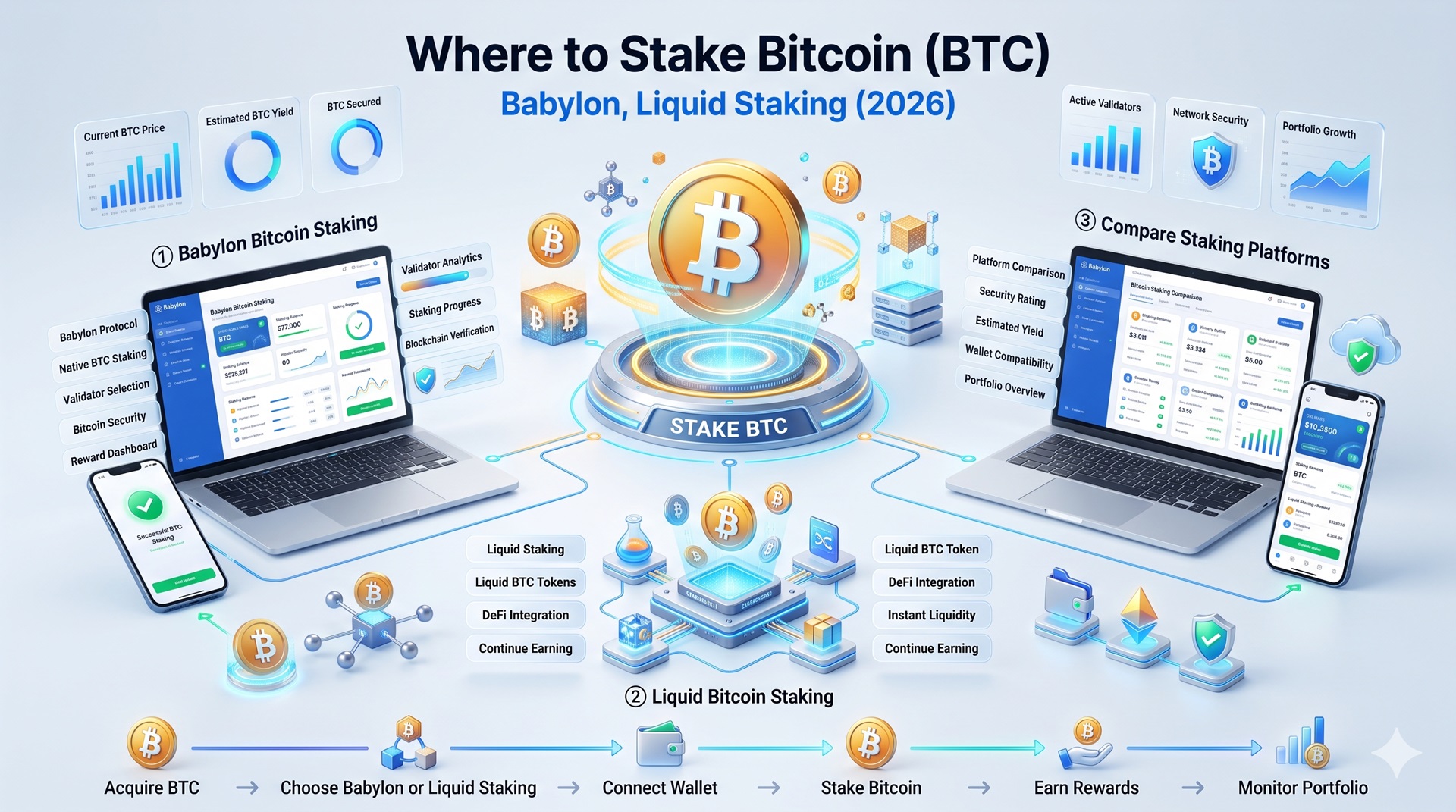
Babylon is the dominant Bitcoin staking protocol in 2026 with over $5.6 billion in total value locked and 56,853 BTC actively staked as of mid-2026. It is the only major protocol that lets you stake actual Bitcoin without wrapping, bridging, or transferring custody to a third party.
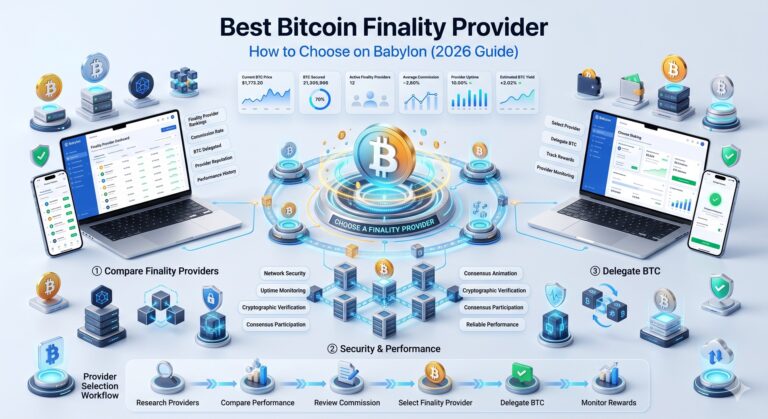
How it works: Babylon creates a time-locked Taproot output (UTXO) on the Bitcoin blockchain. Your BTC never leaves the Bitcoin network. You delegate your stake to a Finality Provider – analogous to a validator – who uses your BTC as economic security to validate transactions on Bitcoin Supercharged Networks (BSNs). If the Finality Provider behaves correctly, you earn BABY tokens as rewards.
Key Parameters
Minimum stake: 0.005 BTC per transaction
Maximum stake: 5,000 BTC per transaction
Rewards: BABY tokens (not Bitcoin)
APY: 1–3% in BABY (variable, dependent on BABY price)
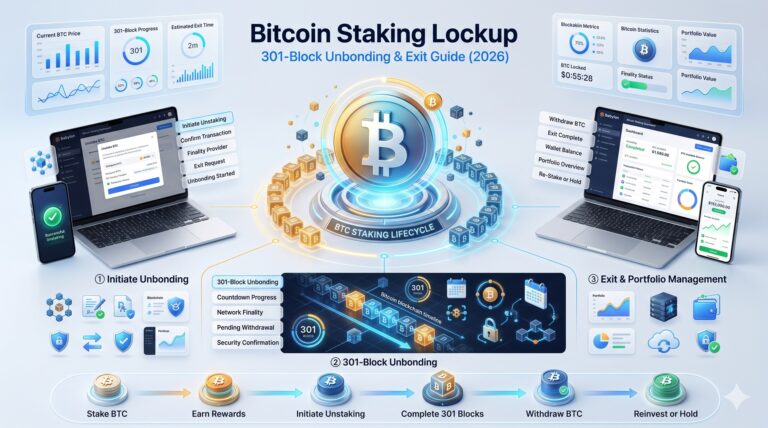
Unbonding: ~301 Bitcoin blocks (~50 hours) for on-demand exit
Custody: You retain private keys throughout
Babylon is the correct choice for holders who prioritize self-custody and want to keep BTC on the Bitcoin blockchain without any synthetic representation.
2. Rewards Are Paid in BABY Tokens – Not Bitcoin
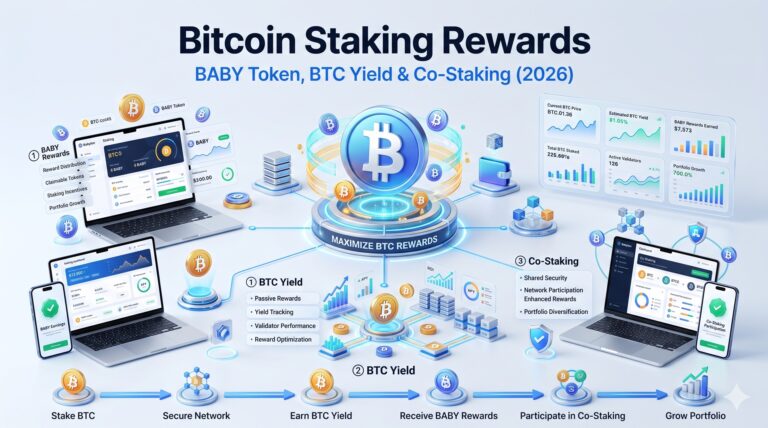
This is the single most important fact most guides bury or omit entirely: Babylon staking rewards are denominated in BABY, Babylon’s native token – not in BTC. BABY launched in January 2026 alongside the Babylon Genesis chain.
What This Means Practically: BABY’s price is highly volatile – it launched at ~$0.06, dropped to $0.0107 in March 2026, then bounced above $0.02 in May 2026 – a 90% drawdown from launch. A listed “2% BABY APY” at a BABY price of $0.02 becomes effectively 0% BTC-denominated yield if BABY drops to $0.00. There is no mechanism to convert BABY rewards to BTC automatically within the protocol.
This is categorically different from Ethereum staking where rewards are paid in ETH (the same asset you staked). The largest economic draw from early Babylon staking was not the recurring yield but the BABY token airdrop allocation – which was one-time.
3. Liquid Bitcoin Staking – LBTC, SolvBTC, and stBTC
Liquid staking protocols accept your BTC (or delegate to Babylon on your behalf) and issue a liquid token in return, allowing you to use your staked BTC position in DeFi while earning Babylon rewards.
Lombard Finance (LBTC): The dominant Bitcoin liquid staking token with nearly $2 billion in circulation and 40%+ market share of the Bitcoin LST sector. LBTC is backed 1:1 by BTC staked through Babylon and can be deployed across Ethereum, Base, BNB Chain, and Sui for additional DeFi yield.
Solv Protocol (SolvBTC.BBN): The second-largest Bitcoin liquid staking protocol, with SolvBTC.BBN representing BTC staked through Babylon’s system.
Acre (stBTC): Automatically allocates deposited BTC across various Bitcoin L2 protocols and pools, using tBTC (Threshold Network) as the wrapped intermediary.
Liquid staking adds smart contract risk on top of Babylon’s staking script risk, but provides instant liquidity by allowing DEX sales without waiting for unbonding.
4. Exchange and CeFi Bitcoin Staking
Kraken (Babylon-powered): Kraken offers BTC staking via Babylon in three modes — bonded (7-day lockup, higher APY), flexible (no lockup, instant withdrawal), and Auto Earn. Rewards are paid in BABY tokens weekly. Up to ~1% APR. Available in the US (excluding some states), UK, Australia, and UAE.
Binance (On Chain Yields): Babylon BTC staking via Binance’s On Chain Yields feature with tiered lockups: 15 days (1.5%), 30 days (1.8%), 60 days (2.1%), 90 days (2.5% VIP). No external wallet required. Subscriptions fill quickly.
Bybit: Zero fee BTC staking with multiple reward models. US users restricted.
Not Babylon Staking: CeFi yield platforms (YouHodler, Nexo, and similar) advertise BTC yields of 4–12% APY. These are lending products — your BTC is lent to borrowers — not staking. They carry counterparty and platform insolvency risk, as demonstrated by the collapse of similar platforms during 2022–2023. Do not conflate CeFi lending yield with Bitcoin staking.
Platform Comparison
Method
Custody
APY (BABY)
BTC Stays on Bitcoin
Minimum
Instant Exit
Babylon native
Self-custody
1–3%
✅ Yes
0.005 BTC
❌ 301 blocks
Lombard (LBTC)
Smart contract
1–3%+ DeFi
✅ (delegated)
Small
✅ via DEX
Kraken flexible
Custodial
~1%
✅ (via Babylon)
Any
✅ Yes
Kraken bonded
Custodial
~1%
✅ (via Babylon)
Any
❌ ~7 days
Binance 90-day
Custodial
~2.5%
✅ (via Babylon)
0.01 BTC
❌ 90 days
CeFi yield
Custodial
4–12%
❌ BTC lent out
Varies
Platform terms
Frequently Asked Questions
Yes, through Babylon Protocol. Your BTC is locked in a time-locked Taproot output on the Bitcoin blockchain — it never leaves the Bitcoin network, and you retain your private keys. No wrapping or bridging is required. Other platforms (exchanges, liquid staking) use Babylon under the hood and stake BTC on your behalf while you hold a derivative token.
For self-custody with maximum Bitcoin purity: Babylon’s native staking portal (staking.babylonlabs.io). For no technical setup and instant liquidity: Kraken’s flexible BTC staking (powered by Babylon). For DeFi participation while earning staking rewards: Lombard Finance’s LBTC token. For the highest nominal APY with lockup: Binance’s 90-day On Chain Yields product at ~2.5% in BABY tokens.
No. Babylon staking rewards are paid in BABY tokens — Babylon’s native token — not in Bitcoin. The listed APY percentage refers to BABY-denominated yield, and your actual BTC-denominated return depends on BABY’s market price, which is highly volatile. There is currently no major staking protocol that pays BTC holders yields denominated in BTC itself.
Babylon’s minimum is 0.005 BTC per transaction. Kraken and Binance have exchange-specific minimums (typically 0.001–0.01 BTC). There is no protocol-enforced maximum on the standard Babylon dashboard.
Babylon native staking preserves BTC on the Bitcoin blockchain with no bridge or custodial risk. The primary risks are: slashing if your chosen Finality Provider double-signs (EOTS mechanism can extract staked BTC), BABY token price volatility reducing real yield, and smart contract risk for liquid staking protocols. CeFi lending platforms carry counterparty and insolvency risk that is categorically higher than Babylon native staking.
Final Tip: Match the platform to your priority — self-custody purity (Babylon native), no setup and instant exit (Kraken flexible), or DeFi flexibility (Lombard LBTC) — and always factor BABY’s market price into any advertised APY.