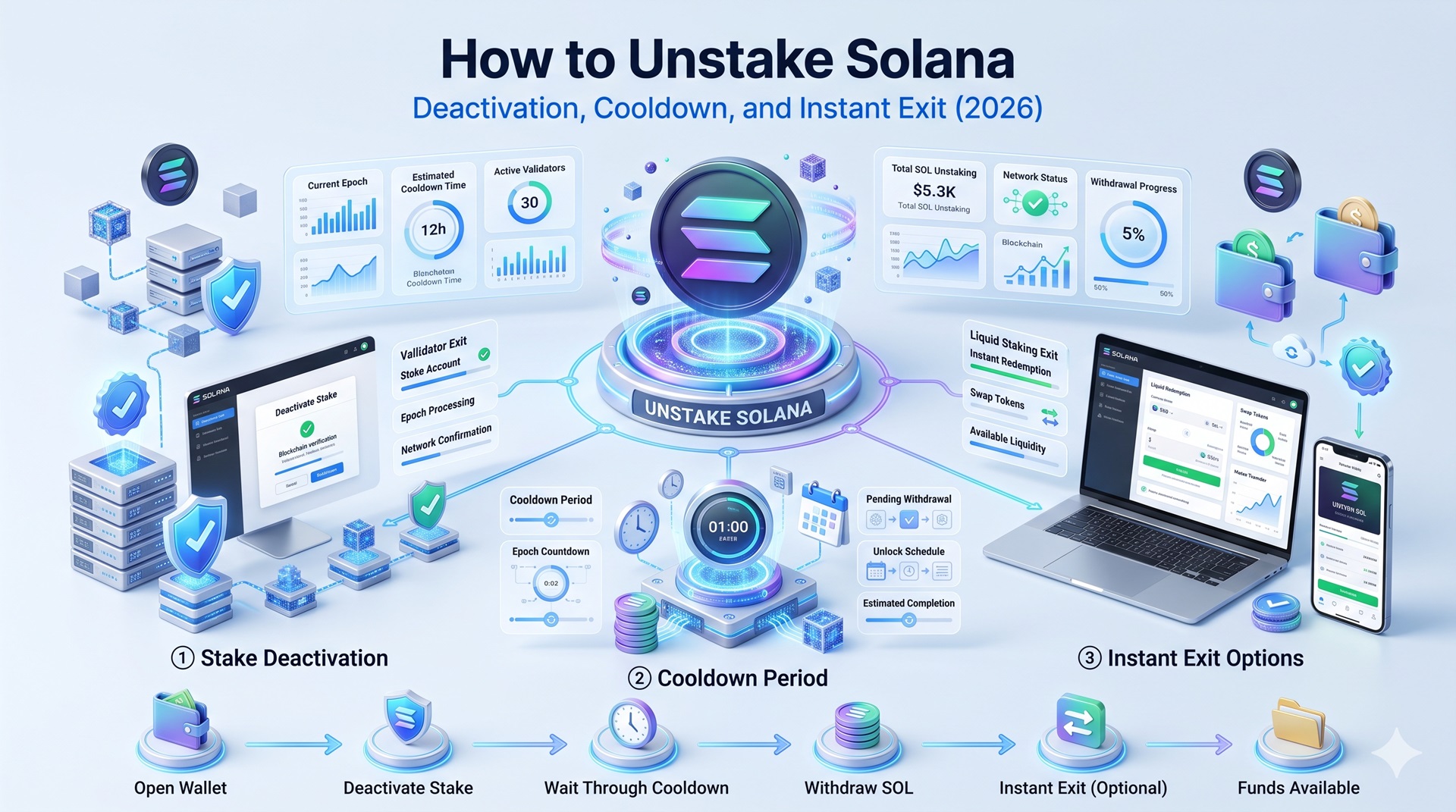
Unstaking Solana is a three-step process, not a single action.
You deactivate the stake, wait out a cooldown tied to Solana’s epoch cycle, then manually withdraw the SOL back to your wallet. The cooldown typically runs 1-3 days because stake changes only take effect at epoch boundaries, and the manual withdraw step is where most stakers get stuck.
This guide walks through the full native unstaking process, explains the epoch timing that governs it, and shows how liquid staking lets you skip the wait entirely.
What “Solana Unstaking Process” Actually Means
The Solana unstaking process is the sequence that converts your delegated, reward-earning SOL back into freely usable SOL in your wallet. Unlike staking, which is a single delegation action, unstaking involves deactivating your stake, waiting for the network to process the change, and then withdrawing.
Rewards Stop Immediately: Unstaking stops your rewards the moment you initiate deactivation, even though your SOL is not yet withdrawable. The cooldown period is dead time: your SOL is neither earning nor accessible.
The Three Steps of Native Unstaking
Step
Action
Result
Deactivate
Select Unstake on your active stake account
Rewards stop, stake enters cooldown
Cooldown
Wait for the epoch to complete
Stake moves to inactive status
Withdraw
Manually withdraw the inactive stake
SOL returns to your wallet balance
How to Unstake Solana in Phantom
1
Open Your Stake
Open Phantom, select Solana in your portfolio, open Your Stake and select Other.
2
Select Unstake
Choose the validator or stake account you want to exit, then select Unstake. Your stake stops earning and enters the cooldown.
3
Wait for Cooldown
You will be able to withdraw about 2-3 days after you initiate the unstake, once your stake account shows inactive status.
4
Withdraw Stake
Open Phantom again, select Solana, open Your Stake and Other, choose the inactive stake account, and select Withdraw Stake. Your SOL returns to your wallet within seconds.
The same basic pattern applies in Solflare and Ledger, since it is the protocol, not the wallet, that enforces the timeline.
Why the Manual Withdraw Step Traps So Many Stakers
Unstaking does not return SOL to your wallet automatically. After the cooldown completes and your stake account shows inactive, the SOL sits in that inactive stake account doing nothing until you explicitly withdraw it.
If Your SOL Seems Missing: The inactive stake account is a distinct on-chain object that still holds your SOL plus a small rent deposit. Withdrawing closes the account and moves the funds. Open the stake section, find the inactive account, and select Withdraw Stake.
How Solana Epochs Control Unstaking Time
An epoch is a period of approximately 432,000 slots, which in 2026’s optimized network conditions typically lasts between two and three days. Stake changes only finalize at epoch boundaries: a deactivating stake becomes inactive at the start of the next epoch, not the moment you request it.
If you initiate deactivation near the beginning of an epoch, you wait closer to the full 2-3 days, and worst-case timing can stretch the total to 4-6 days. If you unstake near the end of an epoch, you may wait only a few hours.
Why Solana Enforces the Cooldown
By aligning stake changes to epoch boundaries, the protocol prevents sudden mass withdrawals that could compromise validator operations and destabilize consensus. Once you deactivate, your stake remains active for the remainder of the current epoch, ensuring the validator set does not shrink abruptly mid-epoch.
How to Unstake Solana Instantly
If you cannot wait for the cooldown, there are two ways to exit almost instantly. If you hold a liquid staking token, you simply swap the LST, such as JitoSOL or mSOL, for native SOL on a decentralized exchange like Jupiter, in under ten seconds for most retail amounts.
The second method works even for native stakers: tools like Unstake.it immediately unstake your SOL in exchange for a small fee of roughly 0.3%.
Exit Method
Speed
Cost
Native unstake via wallet
1-3 days (epoch-bound)
Network fee only (~0.000005 SOL)
Swap LST on a DEX
Seconds
Slippage or swap fee
Unstake.it for native stake
Near-instant
~0.3% fee
Is Unstaking Solana Reversible?
Once you initiate unstaking, the deactivation process cannot be reversed, and your stake stops earning rewards immediately. There is no way to cancel a deactivation midway and resume earning on the same stake account.
After you withdraw your SOL, you are free to re-stake it at any time, creating a new stake account with a fresh delegation if you change your mind.
Common Solana Unstaking Mistakes
Mistake
Result
Prevention
Forgetting the manual withdraw step
SOL stuck in inactive account
Complete the withdraw after cooldown
Unstaking at the start of an epoch
Longest possible wait
Time the exit near an epoch boundary
Expecting instant native withdrawal
Confusion over the cooldown
Plan for a 1-3 day wait
Unstaking when only needing liquidity
Lost rewards during dead time
Hold an LST for instant exit instead
Ignoring instant-exit fees
Unexpected slippage or fee cost
Compare native wait vs instant fee
What the Solana Unstaking Process Cannot Guarantee
Because the wait depends on where you are in the epoch and on overall network conditions, the same deactivation can complete in hours or in several days. The typical range is 1-3 days, but worst-case timing can reach 4-6 days.
Instant-exit routes carry their own caveats: a DEX swap depends on available liquidity that can thin during market stress, and instant-unstake tools charge a fee.
Educational Note: This guide is educational and not financial advice.
Frequently Asked Questions
In a wallet like Phantom, select Solana, open Your Stake then Other, choose your stake account, and select Unstake to begin deactivation. Wait roughly 1-3 days for the cooldown, then select Withdraw Stake to return your SOL to your wallet balance.
Native unstaking typically takes 1-3 days because stake changes finalize at epoch boundaries, and each epoch lasts about 2-3 days. Worst-case timing can reach 4-6 days, while unstaking near the end of an epoch can complete in just a few hours.
Yes, in two ways. If you hold a liquid staking token like JitoSOL or mSOL, swap it for SOL on a DEX in seconds. For native stakes, a tool like Unstake.it can unstake immediately for a fee of roughly 0.3%. Both bypass the standard epoch cooldown.
Solana aligns stake changes to epoch boundaries to keep the validator set stable and prevent sudden mass withdrawals that could disrupt consensus. Once you deactivate, your stake stays active for the rest of the current epoch before becoming withdrawable.
Yes, rewards stop immediately when you initiate deactivation, before your SOL is withdrawable. The cooldown period is therefore dead time, during which your SOL neither earns rewards nor is accessible.
Unstaking does not return SOL to your wallet automatically. After the cooldown, your stake account shows inactive but still holds the SOL. You must manually select Withdraw Stake to move the funds to your wallet balance and close the stake account.
No, once you initiate unstaking, the deactivation cannot be reversed and your stake stops earning immediately. The account completes its cooldown regardless. However, after withdrawal you can re-stake your SOL at any time by creating a new stake account.
Native unstaking only costs the standard Solana network fee of roughly 0.000005 SOL per transaction. Instant-exit methods cost more: a DEX swap may incur slippage or swap fees, and a tool like Unstake.it charges around 0.3% for immediate access.