How to Unstake Polygon (POL) — Complete Guide | CryptoLurk
How to Unstake Polygon (POL) — Complete Guide
CrisCoin 9 min readPolygon
Unstaking Polygon (POL) from the native staking portal is a two-transaction, three-phase process — and the single most common mistake delegators make is assuming their POL automatically returns to their wallet when the unbonding period ends.
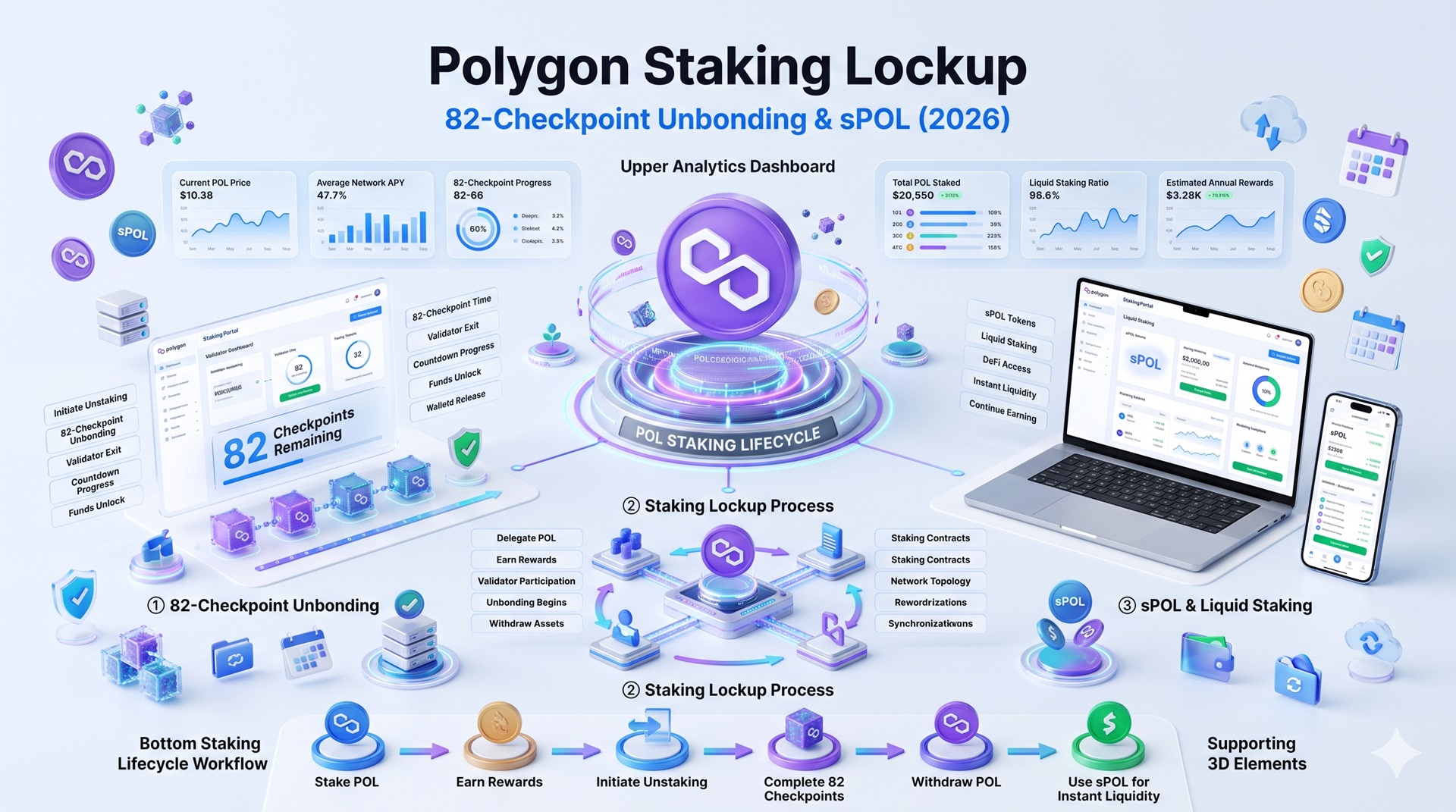
It does not. After the 80–82 checkpoint wait (~3–4 days), you must manually submit a second “claim stake” transaction on the Polygon Staking Dashboard before your POL becomes accessible. This guide covers the complete unstaking process, what happens to rewards during unbonding, and how sPOL and MaticX provide instant exit alternatives without the wait.
Before You Unstake – Important Facts
Know This Before You Start
Rewards stop immediately. The moment you initiate an unbonding transaction, your POL stops earning staking rewards. There is no grace period — checkpoint rewards for any cycle starting after your unbond transaction are forfeited for that position.
You need ETH for two transactions. Unstaking requires (1) an unbonding initiation transaction and (2) a final claim transaction after unbonding completes. Both cost Ethereum gas. Budget 0.05–0.1 ETH total.
Consider redelegating instead. If you want to switch validators rather than exit entirely, redelegation moves your POL directly to a new validator without triggering the 80–82 checkpoint unbonding wait.
Redelegation is the better choice if you plan to continue staking — unstaking should be reserved for situations where you need to sell, withdraw, or move POL off the Ethereum network.
Step-by-Step: How to Unstake Polygon via the Native Portal
1
Connect Your Wallet on Ethereum Mainnet
Navigate to staking.polygon.technology and connect your MetaMask (or other compatible wallet). Ensure MetaMask is set to Ethereum Mainnet — all Polygon staking transactions occur on Ethereum.
2
Go to My Account and Find Your Delegations
Click “My Account” in the top navigation. Under “Your Delegations,” you will see each validator you have delegated to, the amount staked, and your accumulated rewards.
3
Click Unbond
Next to the validator you want to unstake from, click the Unbond button. A confirmation dialog appears showing the amount and the estimated gas fee. Review and confirm this transaction in MetaMask.
This Is Transaction 1 of 2: The unbonding clock starts as soon as this transaction is confirmed on Ethereum. After confirming, the portal shows “Unbonding Initiated.” The Unbond button is replaced with a countdown showing how many of the 80–82 checkpoints have passed.
4
Wait for 80–82 Checkpoints (3–4 Days)
Each checkpoint takes approximately 34 minutes to complete. 82 checkpoints therefore require approximately 46 hours at minimum — roughly 2 days under ideal conditions. However, Ethereum network congestion can delay individual checkpoints up to 1 hour each, pushing the total unbonding period to 3–4 days in practice.
During This Wait
Your POL earns no staking rewards
Your POL cannot be traded, transferred, or moved in any way
You cannot cancel the unbonding (once initiated, the process is irreversible)
You do not need to remain logged in during the wait. Return to the Polygon Staking Dashboard after 3–4 days.
5
The Mandatory Second Transaction — Why Your POL Doesn’t Auto-Release
This is the step every competitor guide either skips or mentions only briefly: after the 80–82 checkpoints complete, your POL does NOT automatically return to your wallet.
You must return to the Polygon Staking Dashboard, go to “My Account,” and click the Claim Stake button. This button is greyed out during the unbonding wait and becomes active only after the full 80–82 checkpoints have passed.
Don’t Forget to Claim: Clicking “Claim Stake” initiates Transaction 2 of 2 — a second Ethereum transaction that finalizes your withdrawal and transfers your POL from the staking contract back to your wallet address. This transaction also costs ETH gas. If you do not click Claim Stake, your POL remains locked in an “unclaimed” state in the staking contract indefinitely. It earns no rewards in this state, but it also does not expire — you can claim it weeks or months later when you choose.
6
Confirm and Receive Your POL
After Transaction 2 confirms on Ethereum, your POL balance appears in your wallet. The entire unstaking cycle from initiating unbonding to receiving funds is typically completed within 3–5 days, depending on Ethereum congestion.
Instant Exit Alternatives – No Unbonding Required
If you need liquidity before 3–4 days, two paths exist that bypass the unbonding wait entirely.
sPOL – Sell on a Polygon DEX
sPOL, launched by Polygon Labs in April 2026, is the network’s native liquid staking token. If you have staked into the sPOL program, you can sell sPOL directly on supported Polygon ecosystem DEXs at any time — no unbonding required. The exit price reflects the prevailing sPOL/POL exchange rate on secondary markets, which typically trades near par but can trade at a slight discount during high-volatility periods.
MaticX – Sell on Uniswap
Stader Labs’ MaticX operates similarly. MaticX holders can sell on Uniswap or QuickSwap for immediate POL liquidity. Native redemption through Stader follows the standard ~3-day Polygon unbonding cycle, but DEX selling exits instantly at market rates.
ankrPOL – Sell on Supported DEXs
Ankr’s ankrPOL is a reward-bearing token (appreciation reflected in exchange rate, not quantity). ankrPOL can be sold on supported DEXs for immediate liquidity.
Exchange Staking Flexible Products
If you staked POL through Kraken’s flexible staking, Bybit’s flexible product, or Coinbase’s standard staking, check the platform’s withdrawal terms. Flexible exchange staking products typically process withdrawals within hours to a few days — often faster than the native protocol 3–4 day unbonding.
Redelegate vs. Unstake – The Faster Path When Switching Validators
If your goal is to move POL from one validator to another (rather than exit entirely), redelegate instead of unstake:
Redelegation Benefits
Redelegation moves POL from Validator A to Validator B in a single transaction
No 80–82 checkpoint wait — the redelegate transaction completes in one Ethereum block confirmation
Rewards continue accruing from Validator B immediately after redelegation
One Restriction: After redelegating, you cannot redelegate from the new validator for 21 days (to prevent rapid redelegation from being used to escape slashing obligations). Direct unstaking from the new validator is still possible within this window.
Frequently Asked Questions
The native portal unbonding period is 80–82 checkpoints, equaling approximately 3–4 days at normal Ethereum network conditions. After the unbonding wait completes, you must submit a second “Claim Stake” transaction to receive your POL — adding time for that Ethereum transaction to confirm. Total time from initiating unbonding to receiving POL in your wallet: typically 3–5 days.
No. Staking rewards stop immediately when you submit the unbonding transaction. The 80–82 checkpoints during the unbonding wait pass without any reward accumulation on your exiting position. This reward loss should factor into your decision about whether to unstake or redelegate.
After the 80–82 checkpoint unbonding period ends, your POL remains locked in an unclaimed state in the staking contract. You must manually return to the Polygon Staking Dashboard, go to “My Account,” and click the Claim Stake button to submit a second transaction that finalizes your withdrawal. This is a mandatory step that many guides do not mention clearly.
Not through the native portal. However, liquid staking alternatives offer instant exit: sPOL and MaticX can be sold on Polygon DEXs immediately, and exchange flexible staking products typically process withdrawals faster than the protocol unbonding period. The trade-off is that DEX sales occur at market exchange rates, which may include a small discount to the underlying POL value.
Unstaking Polygon requires two Ethereum transactions: the unbonding initiation and the final Claim Stake. At moderate Ethereum gas prices, budget approximately 0.03–0.05 ETH per transaction, or 0.06–0.1 ETH total. During high Ethereum network congestion, costs can be 3–5x higher — check Etherscan’s gas tracker before initiating the process.
Final Tip: Always return to the dashboard to click Claim Stake after unbonding completes — your POL will not move on its own, and skipping this step is the single most common mistake delegators make.