Cardano Staking Rewards: How They Work in 2026 | CryptoLurk
Cardano Staking Rewards: How They Work in 2026
CrisCoin 11 min readCardano
Cardano staking rewards come from two sources, transaction fees and a shrinking reserve of ADA, and they currently pay a gross APY of roughly 3% to 5% that compounds automatically every five-day epoch.
Your ADA never leaves your wallet to earn them, there is no lockup, and rewards are calculated by the protocol rather than the pool. But a recent governance change means you now must delegate your voting power to a DRep before you can withdraw those rewards.
What “Cardano Staking Rewards” Actually Means
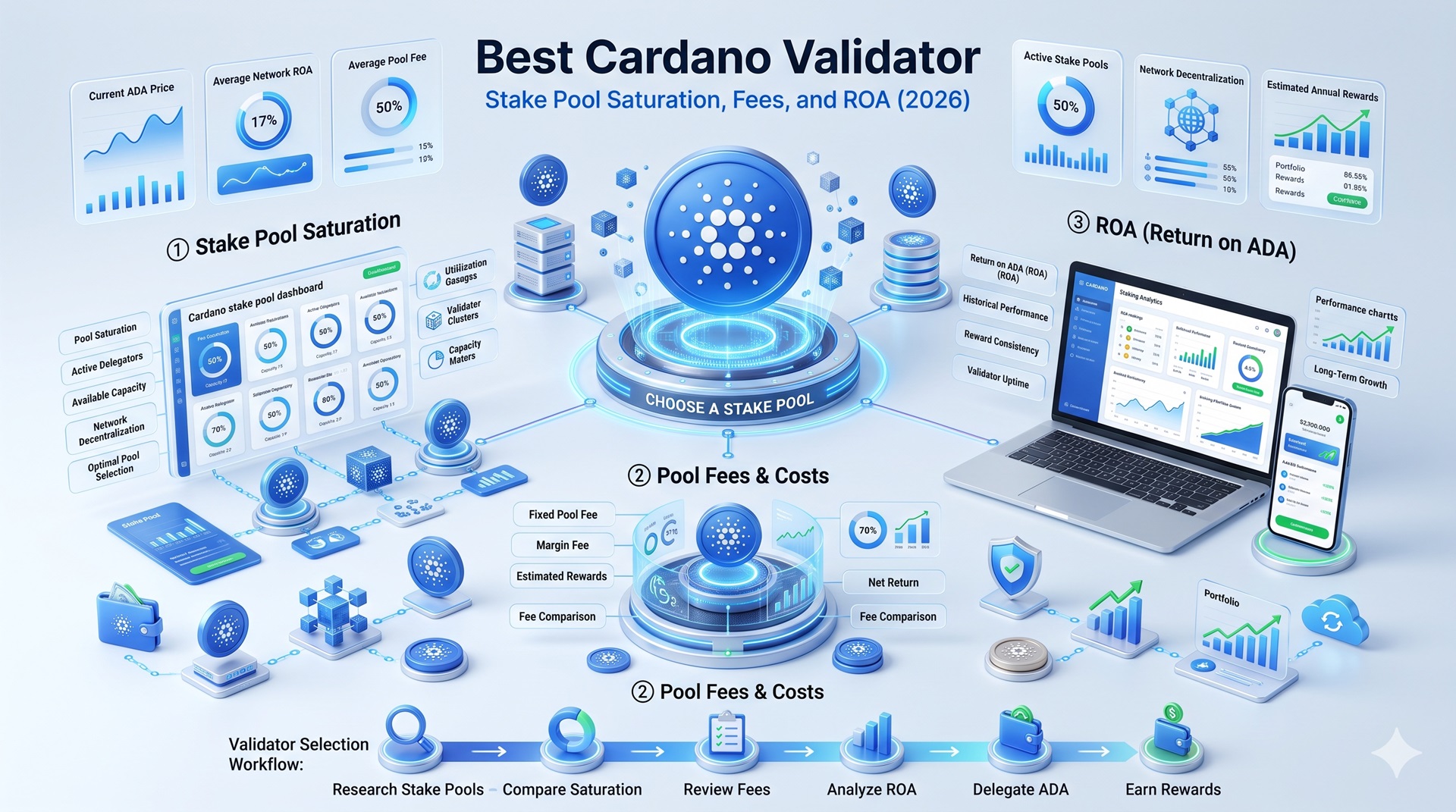
Cardano staking rewards are the share of network revenue you earn for delegating your ADA to a stake pool that helps secure the Ouroboros proof-of-stake network. When you delegate, the pool uses your stake to increase its chance of being selected to produce blocks each epoch, and you earn rewards proportional to your stake, minus the pool’s fees. Crucially, your ADA never leaves your wallet, there is no lockup, and the rewards are auto-generated by the protocol rather than managed by the stake pool operator.
The rewards are not a fixed interest rate set by any platform. They are a function of how much ADA is being issued from the reserve, how much your pool earns in fees, your pool’s performance, and its fees. Because these factors move over time, the advertised APY is an estimate that shifts gradually rather than a guaranteed yield.
Rewards Are Paid Per Epoch and Compound Automatically
Cardano measures time in epochs of five days, and rewards follow that rhythm. At the end of each epoch, rewards are distributed to all delegators based on their stake and their pool’s performance, then paid into your wallet. Because those rewards are automatically added to your staked balance, they compound at no gas cost, so each epoch’s rewards begin earning the next epoch’s rewards.
No Manual Claiming: You do not need to claim or re-delegate to compound; your full balance is always staked, and new rewards join it automatically — unlike chains that require manual claim transactions and gas costs.
Over years of holding, this frictionless compounding meaningfully outperforms a manual-claim approach at the same headline rate, which is part of why the modest APY is more attractive in practice than the raw percentage suggests.
Where Cardano Staking Rewards Come From
Cardano funds staking rewards from two distinct sources, and understanding them explains why the yield behaves the way it does. The first source is transaction fees, collected from all the transactions included in blocks minted during an epoch. The second is monetary expansion, which draws from Cardano’s reserve of as-yet-unissued ADA.
Reward Source
What It Is
Trend Over Time
Transaction fees
Fees from blocks minted in the epoch
Grows with network usage
Monetary expansion
A fixed % of the shrinking reserve
Declines as reserve depletes
Treasury allocation
A portion of expansion routed to treasury
Funds governance and development
Because the reserve shrinks every epoch, the monetary-expansion component of rewards gradually declines, which is why Cardano’s gross APY is expected to drift lower over the years. As that happens, transaction fees become relatively more important, so higher network usage helps offset the declining reserve emissions.
How Cardano Staking Rewards Are Calculated
The size of your rewards is determined primarily by the size of your stake, your pool’s performance, and the pool’s pledge, combined through the protocol’s reward formula. In simplified terms, rewards are proportional to your pool’s stake up to the saturation point, adjusted by a pledge influence factor the protocol calls a0.
Pool performance is the variable that introduces real variance. The actual ADA you receive depends on the number of blocks your stake pool is observed to produce in an epoch versus the number it was expected to produce. This is why pool selection, not the wallet you use, is the primary driver of your realized yield.
Pledge Influence: When the a0 parameter is greater than zero, a higher pledge increases a pool’s rewards, rewarding operators who have meaningful skin in the game — though the effect is modest at current parameter values.
What APY to Expect From ADA Staking
Realistic Cardano staking yields cluster in a modest range, and the exact figure depends on your pool and the network’s current parameters. Cardano’s gross network-wide APY is approximately 3% to 5%, and after pool fees a well-chosen pool with a 0% to 2% margin typically delivers a net APY of roughly 3.5% to 4.8%. Some trackers cite figures closer to 2% to 3%, reflecting both conservative methodology and the gradual decline in reserve emissions.
This is not high yield by crypto standards, but it carries unusually low risk because ADA never leaves your wallet and there is no slashing. The practical takeaway is to treat the rate as a moving figure on a slowly declining trajectory, and to verify current rates on a tool like ADApools.org before delegating.
Why You Must Delegate to a DRep to Withdraw Rewards
Here is the requirement that surprises many Cardano stakers in 2026: following the Plomin hard fork that activated Cardano’s Voltaire governance era, you must delegate your voting power to a Delegated Representative, or DRep, before you can withdraw your staking rewards. Without delegating to a DRep, stakers cannot withdraw their accumulated rewards, even though the rewards continue to accrue normally.
DRep Delegation Options
Delegate to a specific registered DRep of your choice
Choose Abstain to stay neutral while unlocking withdrawals
Choose No Confidence as an alternative neutral option
Most modern wallets prompt you through this step automatically
Don’t Get Locked Out: Setting up Cardano staking now has two delegation steps rather than one — delegating stake to a pool, and delegating voting power to a DRep. Overlooking the second step is the most common reason stakers can’t access rewards they’ve clearly earned.
Common Cardano Staking Rewards Mistakes
The errors below cause stakers to earn less, misjudge their yield, or get locked out of withdrawing, each with a simple fix.
Mistake
Result
Prevention
Skipping DRep delegation
Cannot withdraw rewards
Delegate voting power, use Abstain if neutral
Expecting a fixed APY
Surprise as reserve-driven yield declines
Treat the rate as gradually decreasing
Ignoring pool performance
Lower realized rewards
Choose a pool with consistent block production
Delegating to an oversaturated pool
Capped, diluted rewards
Pick a pool below its saturation cap
Confusing APR with APY
Underestimating compounding
Use APY, which includes compounding
Panic over the first-reward delay
Unnecessary worry or redelegation
Expect first rewards after ~15-20 days
What Cardano Staking Rewards Cannot Guarantee
No pool or wallet can guarantee a fixed return, and the 3% to 5% range is an estimate that moves with network conditions. The monetary-expansion component declines as the reserve depletes, so the base yield trends gradually lower over time, while transaction-fee revenue depends on network usage that cannot be predicted.
Because ADA never leaves your wallet and Cardano has no slashing, your principal stays safe regardless of pool choice, but the dollar value of your rewards depends far more on ADA’s market price than on the precise APY. This guide is educational and not financial advice.
Frequently Asked Questions
Cardano staking pays a gross APY of roughly 3% to 5%, and a well-chosen pool with low fees typically delivers a net APY around 3.5% to 4.8%. Your exact rate depends on your pool’s performance, fees, and the network’s current parameters.
Rewards are proportional to your stake up to the saturation point, adjusted by a pledge influence factor and your pool’s performance. The protocol sets the base rate, so pool selection mainly affects consistency and fees rather than the underlying rate.
Rewards come from two sources: transaction fees collected from blocks minted during an epoch, and monetary expansion, which takes a fixed percentage of Cardano’s shrinking reserve each epoch.
Rewards are paid once per epoch, roughly every five days. They are automatically added to your staked balance and compound at no gas cost, with no manual claiming or re-delegation needed.
The monetary-expansion part of rewards draws from a reserve that shrinks every epoch, so as the reserve depletes, that component of the yield gradually falls. Transaction fees become relatively more important over time.
You earn rewards just by delegating to a stake pool, but since the Plomin hard fork you must also delegate your voting power to a DRep before you can withdraw those rewards. You can use the Abstain option to stay neutral.
Yes. Rewards are added to your staked balance each epoch and compound automatically with no gas cost, so your full balance is always staked and your rewards earn further rewards.
Your first rewards arrive about 15 to 20 days after delegating, because Cardano’s reward cycle runs on epoch snapshots that span several five-day epochs before your stake produces blocks and is paid.
Final Tip: Don’t forget the DRep delegation step — your rewards will keep accruing without it, but you won’t be able to withdraw them until you do.