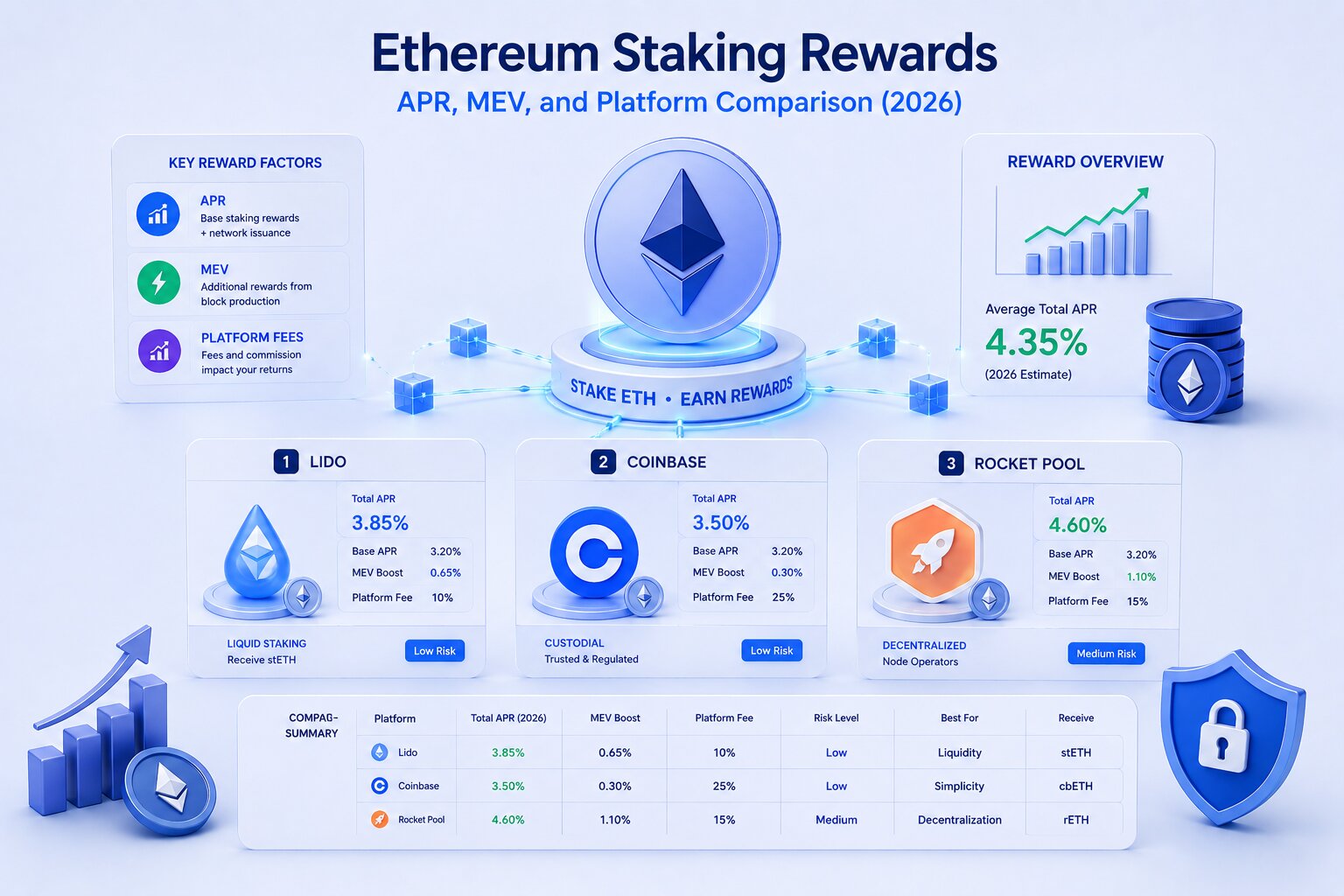
Ethereum Staking Rewards Explained: How Much You Can Earn in 2026
Ethereum Staking Rewards Explained: How Much You Can Earn in 2026
CrisCoin 9 min readEthereum
Ethereum staking rewards are protocol payments earned by validators participating in Beacon Chain consensus, originating from consensus-layer issuance, priority fees, and MEV.
In 2026, the average network staking APR is approximately 2.84-3.3% from consensus rewards alone, with total returns reaching 3.8-5% for optimized solo validators including MEV. This guide breaks down exactly where the yield comes from and how to maximize it.
Where Do Ethereum Staking Rewards Come From?
Ethereum staking rewards are protocol payments earned by validators participating in Beacon Chain consensus, originating from three distinct sources: consensus-layer issuance, execution-layer priority fees, and MEV captured via MEV-Boost relay software. In 2026, the average network staking APR is approximately 2.84-3.3% from consensus rewards alone, with total returns reaching 3.8-5% for optimized solo validators including MEV.
Reward Source
APR Contribution
Volatility
Consensus-layer issuance
~2.84%
Low — protocol-defined
Execution-layer priority fees
~0.3-0.5%
Medium — network activity dependent
MEV-Boost rewards
~0.5-1%
High — varies with MEV opportunities
Total solo validator (optimized)
~3.8-5%
Medium
Consensus-layer rewards are mathematically linked to the number of active validators — as total staked ETH increases, the base reward rate decreases to ensure sustainable network issuance. Execution-layer rewards are only earned when a validator is randomly selected to propose a block, introducing high variability compared to steady attestation rewards.
How Are Ethereum Staking Rewards Calculated?
The formula for estimating annual solo validator rewards is: Annual ETH Rewards = 32 ETH × Network APR. At a 3.1% network APR, that works out to approximately 0.992 ETH per year before fees and penalties.
The network APR is dynamically calculated from the total active validator set — as more ETH is staked, the per-validator reward decreases proportionally to maintain total issuance within protocol targets. Auto-compounding applies to validators with 0x02 withdrawal credentials post-Pectra, where excess balance above 32 ETH automatically re-stakes.
APR vs APY — What Is the Difference?
APR is the simple annualized reward rate without compounding. APY includes the compounding effect, representing the actual return when rewards are reinvested periodically. For Ethereum staking at current rates around 3%, the difference is relatively small — compounding adds approximately 0.04-0.05% over a year.
Comparison Tip: Platforms that display APY appear to offer higher returns than those displaying APR at the same underlying rate. Always verify which metric is being quoted before comparing platforms.
Ethereum Staking Rewards by Platform — May 2026
Platform
Net APR/APY
Fee
Solo validator (with MEV-Boost)
3.8-5% APR
0%
Rocket Pool (rETH)
~3.46% APR
~5-10% of rewards
Lido (stETH)
~2.4% APR
10% of rewards
Kraken
~3.5-4% APR
~15% of rewards
Coinbase
~3.2-3.5% APR
~25% of rewards
Binance (WBETH)
~2.5-3.0% APR
Varies
Solo staking with MEV-Boost delivers the highest net yield since zero protocol fee means the validator captures 100% of consensus, priority fee, and MEV rewards. Coinbase’s ~25% fee significantly reduces net yield from the ~3.3% gross network rate to approximately 2.5% net.
What Factors Affect Ethereum Staking Reward Rates?
Factor 1 — Total ETH Staked
The consensus-layer issuance rate is inversely proportional to the square root of total staked ETH — more validators means lower rewards per validator.
Total ETH Staked
Approximate Consensus APR
20 million ETH
~4.5%
30 million ETH
~3.7%
35.85 million ETH (May 2026)
~2.84%
50 million ETH
~2.4%
Staking participation grew from 32 million ETH in early 2025 to 35.85 million ETH by May 2026, reflecting increasing institutional confidence.
Factor 2 — Validator Uptime and Attestation Effectiveness
A validator’s actual rewards depend heavily on attestation timeliness — the protocol pays higher rewards for timely attestations. A validator with 99%+ uptime earns near-maximum consensus rewards, while extended offline periods trigger inactivity leaks, an escalating penalty that accelerates the longer the validator has been offline.
Factor 3 — MEV and Network Activity
MEV rewards are highly variable, depending on DeFi activity levels, arbitrage opportunities, and liquidation events. Running multiple MEV-Boost relays (Flashbots, BloXroute, Agnostic Gnosis, Ultra Sound) increases the frequency of receiving high-value MEV block templates.
How to Maximize Ethereum Staking Rewards
Optimization Strategies
Run a solo validator with MEV-Boost to capture 100% of consensus, execution, and MEV rewards with zero protocol fee
Use 0x02 withdrawal credentials to enable auto-compounding above the 32 ETH cap
Configure multiple MEV-Boost relays simultaneously to increase MEV capture probability
Choose a minority consensus client for a positive externality to network health
Use Rocket Pool for pooled staking, since ~3.46% APR is notably higher than Lido’s ~2.4%
Ethereum Staking Rewards and Tax Implications
Jurisdiction
Treatment
When Taxable
United States
Ordinary income (IRS Rev. Rul. 2023-14)
At time of receipt
United Kingdom
Miscellaneous income (HMRC)
At time of receipt
Germany
Income tax if held under 1 year; potentially exempt if over 1 year
Complex — seek specialist advice
Record the fair market value of all staking rewards at the time of receipt — each reward event is a separate taxable income event in most jurisdictions.
What Ethereum Staking Rewards Do Not Guarantee
Educational Note: Fixed returns are not guaranteed since consensus APR decreases as more ETH enters the validator set. MEV income is inconsistent, immediate access is not always available, and staking rewards remain taxable income in most jurisdictions regardless of whether they are withdrawn or reinvested.
Frequently Asked Questions
The average network consensus APR is approximately 2.84% as of May 2026. Total returns including priority fees and MEV range from 3.3-5% for solo validators with MEV-Boost. Liquid staking protocols deliver 2.4-3.46% after fees.
Annual rewards approximate to 32 ETH × Network APR. At a 3.1% network rate, one solo validator earns approximately 0.99 ETH per year. MEV rewards are additive but highly variable.
APR is the simple annualized reward without compounding. APY includes compounding effects, slightly higher than APR at the same rate. For Ethereum staking at ~3%, the difference is approximately 0.04-0.05% annually.
For validators with 0x02 withdrawal credentials, excess balance above 32 ETH automatically sweeps back into the effective balance. stETH rebases daily and rETH appreciates in exchange rate, both forms of automatic compounding.
Consensus rewards accrue continuously in the validator’s effective balance, with partial withdrawals sweeping periodically. MEV and priority fee rewards are earned per block proposal and deposited immediately.
Consensus rewards decrease as total staked ETH increases, since the issuance formula is inversely proportional to the square root of total stake. ETH staked grew from 32 million in early 2025 to 35.85 million by May 2026, compressing base APR.
MEV rewards are earned when a validator proposes a block and uses MEV-Boost relay software to source block templates from searchers. MEV-Boost adds approximately 0.5-1% APR on average, with significant variability.
Staking earns approximately 3-5% annual ETH-denominated returns on top of any price appreciation, increasing the staker’s ETH balance while contributing to network security. Holding earns no yield but carries no staking-related risks.