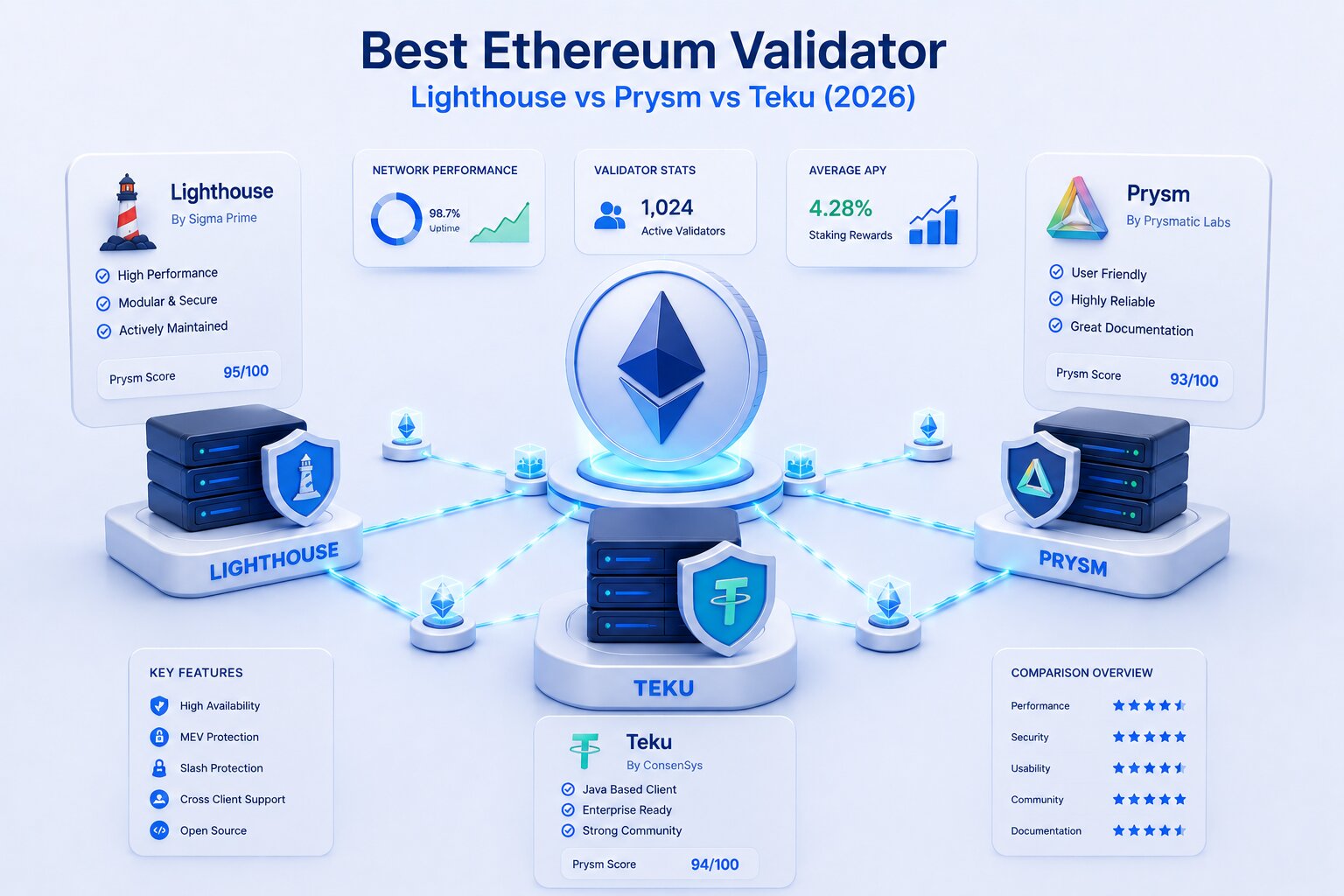
An Ethereum validator is a node that stakes 32 ETH to the Beacon Chain deposit contract and participates in Proof-of-Stake consensus — proposing blocks, attesting transactions, and earning protocol rewards. Choosing the best validator configuration involves selecting a consensus client, an execution client, and optionally an MEV-Boost relay. For users without 32 ETH, liquid staking validators (Lido, Rocket Pool) provide pooled validator access.
Validator Type
ETH Required
Operator
Annual Yield
Best For
Solo validator
32 ETH
Self
3.5–5% + MEV
Maximum yield + full decentralization
Staking-as-a-service
32 ETH
Third-party node operator
3.3–4%
Solo yield without node management
Liquid staking — Rocket Pool
0.01 ETH
Rocket Pool operators
~3.46% APR
Decentralized pooled staking
Liquid staking — Lido
No minimum
Lido node operators
~2.4% APR
DeFi composability
CEX validator pool
0.001 ETH
Exchange operators
2.5–4%
Simplicity
As of May 2026, Ethereum has approximately 1.1 million active validators securing the Beacon Chain — making it the largest Proof-of-Stake validator set of any blockchain by count.
Client diversity is a critical security requirement — Prysm currently holds approximately 40% of validator market share, creating a systemic risk if a Prysm-specific bug caused consensus failures affecting more than 33% of the network.
Running a minority consensus client (Lighthouse, Teku, Nimbus, Lodestar) directly improves Ethereum’s resilience — the Ethereum Foundation and client teams actively encourage choosing underrepresented clients.
What is an Ethereum validator — and what does it do?
An Ethereum validator is a node bonded to the Beacon Chain through a 32 ETH deposit that participates in two consensus duties: attesting to the validity of blocks proposed by other validators, and occasionally proposing new blocks when selected by the beacon chain’s randomized slot assignment.
Validators earn consensus-layer rewards for correct, timely attestations — approximately 2.8–3.8% APR at current network participation levels.
Block proposers earn execution-layer rewards — priority fees from transactions included in the proposed block, and MEV captured via MEV-Boost relay software.
Validators incur small inactivity penalties for missed attestations and larger inactivity leaks for extended offline periods.
Slashing penalizes equivocation (signing conflicting blocks at the same slot) — the initial slash is 1/32 of staked ETH (~1 ETH minimum) plus a correlation penalty if many validators slash simultaneously.
Which is the best Ethereum consensus client in 2026?
A consensus client is the software that handles Beacon Chain communication, validator duties, and block attestation. Every solo validator runs one consensus client paired with one execution client.
Consensus Client
Language
Market Share
Best For
Resource Usage
Prysm
Go
~40%
Familiarity, large community
Moderate
Lighthouse
Rust
~33%
Performance, security track record
Low (~5 GB RAM, ~130 GB disk)
Teku
Java
~8%
Enterprise, institutional operators
Higher — JVM overhead
Nimbus
Nim
~7%
Resource-constrained hardware (Raspberry Pi)
Very low
Lodestar
TypeScript
~3%
JavaScript developers, research
Moderate
Grandine
Rust
Growing
Performance optimization
Low
Lighthouse is widely recommended for solo stakers in 2026 — its Rust implementation delivers high-speed synchronization and secure validator operations with low resource requirements. Recent updates (v7.1.0) reduced disk I/O by 4x and data on disk by 10x during non-finality periods.
Teku is the preferred choice for institutional and enterprise operators — its Java implementation integrates cleanly with enterprise monitoring systems and ConsenSys’s existing blockchain infrastructure.
Nimbus performs exceptionally on resource-limited hardware — solo stakers running validators on Raspberry Pi or modest home hardware achieve reliable validator operation with Nimbus’s low memory footprint.
Prysm’s ~40% market share makes it the single highest centralization risk — running Prysm contributes to a potential single point of failure if a critical bug affects consensus for more than 33% of validators simultaneously.
Ethereum client diversity — why it matters for validator selection
If any single consensus client exceeds 33% of the validator set and experiences a critical bug, Ethereum’s finality could be at risk. If a client exceeds 66%, a buggy release could finalize incorrect state — causing irrecoverable chain damage.
Client Market Share
Risk Level
Ethereum Health Impact
Below 33%
Low
Safe — cannot cause finality failure alone
33–66%
Medium
Could halt finality if buggy
Above 66%
Critical
Could finalize incorrect state
clientdiversity.org provides real-time client market share data — checking it before choosing a client ensures the selection supports a healthier network distribution.
The Ethereum Foundation recommends choosing the client with the lowest current market share when technically equivalent — Nimbus and Lodestar are consistently underrepresented.
Which is the best Ethereum execution client in 2026?
An execution client handles transaction processing, state management, and the EVM — it is required alongside the consensus client for a complete validator setup.
Execution Client
Language
Market Share
Best For
Geth
Go
~55% (dominant)
Widest documentation, most tested
Nethermind
C#
~20%
Client diversity, good Windows support
Besu
Java
~10%
Enterprise, Hyperledger ecosystem
Erigon
Go
~8%
Archive nodes, reduced disk usage
Reth
Rust
Growing
High performance, next-gen architecture
Geth’s ~55% execution client dominance is also a centralization concern — pairing a minority consensus client with a minority execution client (e.g., Lighthouse + Nethermind) maximizes client diversity contribution.
Erigon uses a more efficient database architecture than Geth — significantly reducing disk space requirements for full node operation.
How do you set up the best Ethereum validator configuration?
The recommended solo validator setup combines a minority consensus client with a minority execution client, MEV-Boost relay, and dedicated hardware.
Recommended validator stack (2026):
Component
Recommended
Alternative
Consensus client
Lighthouse or Teku
Nimbus (low hardware)
Execution client
Nethermind or Besu
Erigon (disk efficiency)
MEV relay
MEV-Boost (Flashbots)
Multiple relays
Key management
Vouch or Web3Signer
Client native key store
Monitoring
Grafana + Prometheus
beaconcha.in dashboard
Steps — Ethereum validator setup:
Acquire 32 ETH and a dedicated machine or cloud server meeting minimum requirements (8-core CPU, 32 GB RAM, 2 TB NVMe SSD, 25 Mbps upload).
Install the chosen execution client (Nethermind recommended for diversity) and sync the Ethereum execution layer.
Install the chosen consensus client (Lighthouse recommended for performance) and sync the Beacon Chain.
Generate validator keys using the official Ethereum Staking Launchpad at launchpad.ethereum.org — using the staking deposit CLI tool.
Install MEV-Boost relay software and configure multiple relays (Flashbots, BloXroute, Agnostic Gnosis, Ultra Sound) for maximum MEV capture.
Submit the 32 ETH deposit transaction via the Launchpad — wait for validator activation (hours to days depending on queue length).
Monitor validator performance via beaconcha.in and the Grafana dashboard.
What are the best liquid staking validators for Ethereum?
For users below the 32 ETH threshold, liquid staking protocols operate Beacon Chain validators on behalf of depositors and issue Liquid Staking Tokens as reward-bearing receipts.
Rocket Pool — best decentralized validator network
Rocket Pool operates the most decentralized liquid staking validator network — any node operator with 8–16 ETH can run a mini-pool, distributing Beacon Chain validation across thousands of independent operators globally.
Rocket Pool delivers approximately 3.46% APR as of May 2026 — the highest net yield among major liquid staking protocols.
rETH is a non-rebasing token whose ETH exchange rate appreciates over time as validator rewards accumulate.
Rocket Pool’s permissionless operator model means no entity controls validator selection — improving censorship resistance and reducing correlated slashing risk.
Lido — best liquid staking validator for DeFi composability
Lido operates 30 permissioned node operators managing validators that collectively hold 24.2% of all staked ETH — issuing stETH as a rebasing daily-reward receipt token.
Lido charges 10% of all rewards — delivering approximately 2.4% APR net to stakers as of May 2026.
stETH is accepted as collateral on Aave, MakerDAO, and Compound — and is usable in yield strategies via Pendle, Morpho, and Curve.
Lido’s Distributed Validator Technology (DVT) module — live since April 2024 — uses Obol and SSV Network to distribute validator key management across multiple nodes, reducing single-operator risk.
What is MEV-Boost — and why does it matter for validators?
MEV-Boost is open-source relay software that connects Ethereum validators to professional MEV (Maximal Extractable Value) searchers — capturing transaction ordering and inclusion value that would otherwise not accrue to the validator.
MEV-Boost adds approximately 0.5–1% APR to solo validator yields — increasing all-in annual returns from approximately 3.3–4% to approximately 3.8–5%.
Multiple relays can be configured simultaneously — running Flashbots, BloXroute, and Agnostic Gnosis relays increases the probability of receiving high-value MEV blocks.
MEV-Boost is optional but strongly recommended for all solo validators — it is the single highest-impact configuration change for improving validator economics without increasing staked capital.
What Ethereum validator operation does not guarantee
Slashing cannot be guaranteed against — misconfiguration causing double-signing (equivocation) results in a mandatory slash even for technically competent operators.
MEV rewards are not fixed — MEV capture depends on block proposal luck and current network transaction volume.
Client software cannot guarantee zero bugs — client diversity reduces the probability of a systemic failure affecting more than 33% of the network.
Validator activation timing is not fixed — the activation queue scales with the number of pending deposits.
Common mistakes when setting up an Ethereum validator
Mistake
Result
Prevention
Running Prysm as consensus client
Contributing to 40%+ centralization risk
Choose Lighthouse, Teku, Nimbus, or Lodestar
Running Geth as execution client
Contributing to 55%+ centralization risk
Choose Nethermind, Besu, or Erigon
Not configuring MEV-Boost
Missing 0.5–1% APR
Install MEV-Boost with multiple relay endpoints
Running validator keys on multiple machines
Double-signing = slashing
One active validator key per machine only
Not monitoring validator performance
Missed attestations accumulate silently
Set up beaconcha.in alerts + Grafana dashboard
Skipping key backup
Validator keys lost if hardware fails
Back up keystore + withdrawal credentials securely
FAQ — 8 Questions from People Also Ask
What is the best Ethereum validator client in 2026?
Lighthouse is the most recommended consensus client for solo stakers — its Rust implementation delivers high performance, low resource usage (~5 GB RAM, ~130 GB disk), and a strong security track record. Teku is preferred for institutional operators. Nimbus is best for low-power hardware. Choosing any client except Prysm (currently ~40% market share) actively improves Ethereum’s client diversity and network resilience.
How many validators does Ethereum have in 2026?
Ethereum has approximately 1.1 million active validators as of May 2026, securing over 35.85 million staked ETH — approximately 28.91% of total ETH supply. This makes Ethereum’s Proof-of-Stake validator set the largest of any blockchain by active validator count (Source: beaconcha.in).
What is client diversity and why does it matter for Ethereum validators?
Client diversity ensures no single validator software controls more than 33% of the network. If a consensus client exceeds 33% market share and experiences a critical bug, Ethereum’s finality mechanism could be disrupted. Above 66%, a buggy client could finalize incorrect state. Prysm’s current ~40% share represents the highest centralization risk — running minority clients reduces this systemic exposure.
What is MEV-Boost and should I use it for Ethereum staking?
MEV-Boost is relay software that connects validators to professional MEV searchers, capturing transaction ordering value that adds approximately 0.5–1% APR to solo validator yields. Running multiple relays (Flashbots, BloXroute, Agnostic Gnosis) maximizes capture probability. MEV-Boost is strongly recommended for all solo validators — it is the single highest-impact configuration change for improving validator economics.
How much does an Ethereum validator earn per year?
Solo validators with MEV-Boost earn approximately 3.8–5% annually — combining ~3.3% base consensus APR with ~0.5–1% MEV-Boost rewards. Without MEV-Boost, solo validators earn approximately 3.3–4%. Rocket Pool node operators earn higher returns because mini-pool commissions add to standard consensus rewards. Lido node operators earn a commission on the 10% fee taken from depositors.
What is the minimum ETH needed to run an Ethereum validator?
Solo validator staking requires exactly 32 ETH per validator — the Beacon Chain deposit contract does not activate validators below this threshold. Mini-pool operators on Rocket Pool can run a validator with 8–16 ETH (the remainder filled by Rocket Pool depositors). For non-operators, Rocket Pool accepts 0.01 ETH minimum and Lido has no minimum for pooled staking.
What happens if an Ethereum validator goes offline?
A validator offline for short periods incurs small inactivity penalties — approximately equal to the rewards that would have been earned during the offline period. Extended offline periods trigger inactivity leaks — a gradually increasing penalty designed to slowly reduce stake to 16 ETH, triggering automatic exit. Slashing does not occur from going offline — only from equivocation (signing conflicting blocks at the same slot).
Should I run Prysm as my Ethereum validator client?
No — not for new validators in 2026. Prysm’s approximately 40% market share already approaches the 33% threshold where a critical bug could disrupt Ethereum finality. Choosing Lighthouse, Teku, Nimbus, Lodestar, or Grandine instead contributes to client diversity and reduces systemic network risk. All clients are functionally equivalent for validator rewards — the choice of Prysm carries an externality cost to network health without any validator performance benefit.