How to Stake Ethereum: Complete 2026 Guide to Every Method
How to Stake Ethereum: Complete 2026 Guide to Every Method
CrisCoin 12 min readEthereum
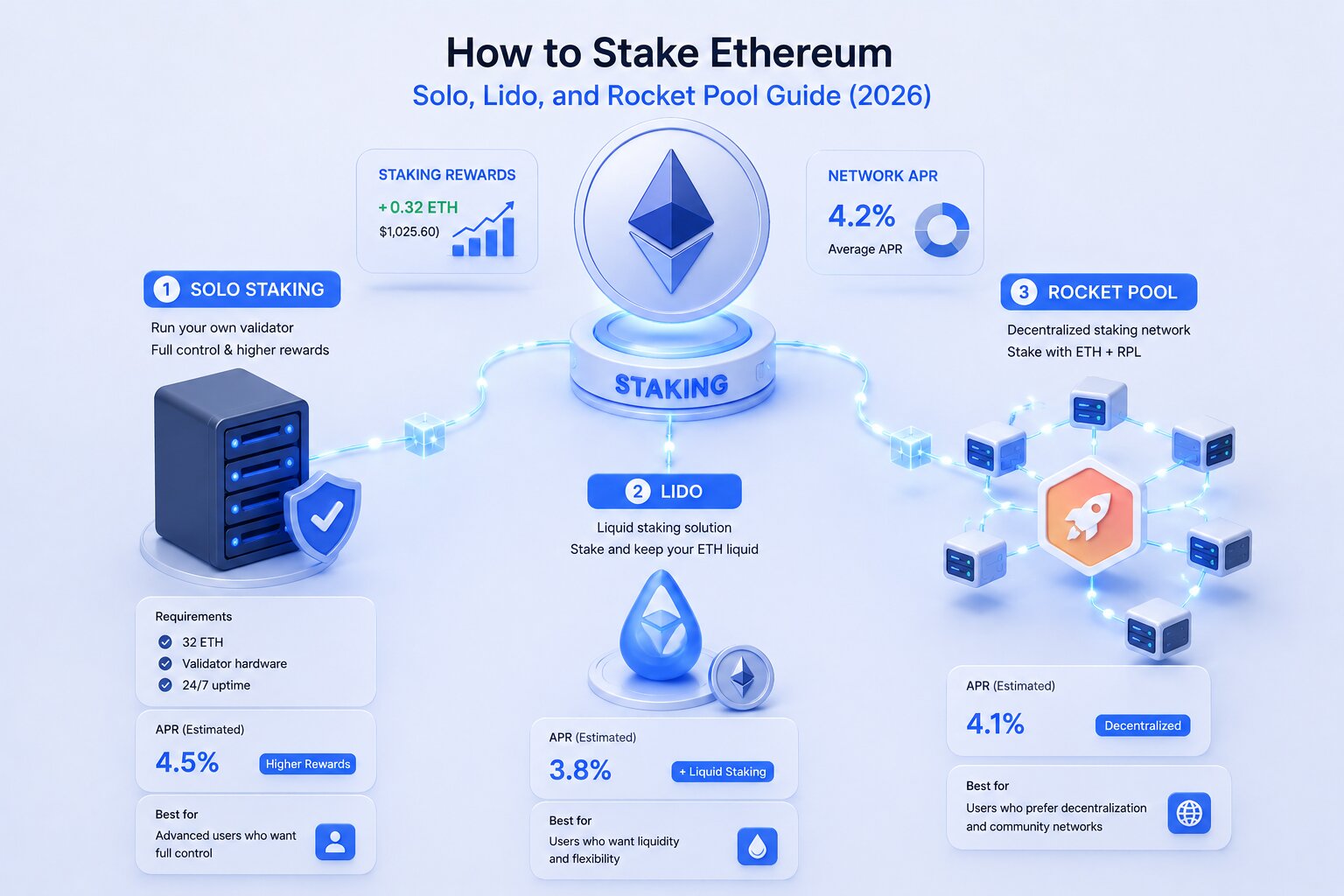
Staking Ethereum earns Proof-of-Stake consensus rewards by committing ETH to validator infrastructure that secures the network.
Since The Merge in September 2022, validators replaced miners, locking ETH as collateral to propose and attest blocks in exchange for newly issued ETH and transaction fees. In 2026, four methods exist for any ETH holder to start earning rewards.
What Is Ethereum Staking — and How Does It Work?
Ethereum staking is the process of depositing ETH to a validator node that participates in Beacon Chain consensus, proposing blocks, attesting transactions, and maintaining network finality in exchange for protocol rewards. Since The Merge in September 2022, validators replaced miners, locking ETH as collateral to secure the network.
As of May 2026, over 35.85 million ETH — approximately 28.91% of total supply — is staked across 1.1 million active validators. The average network staking APR is approximately 3.3%, with solo validators running MEV-Boost earning closer to 3.8-5% all-in.
Four Methods to Stake Ethereum
Method
Minimum ETH
APY (2026)
Custody
Solo validator
32 ETH
3.5-5% + MEV
Self
Liquid staking (Lido, Rocket Pool)
0.01 ETH
2.4-3.46%
Non-custodial
CEX staking (Kraken, Coinbase)
0.001 ETH
2.5-4%
Custodial
Staking-as-a-service
32 ETH
3.3-4%
Shared
Which Ethereum Staking Method Fits Your Situation?
ETH Amount
Technical Skill
Best Method
32+ ETH
High
Solo staking — maximum yield, full control
32+ ETH
Low
Staking-as-a-service — outsourced node operation
Any amount
None
Lido (stETH) — no minimum, DeFi composability
Any amount
None
Rocket Pool (rETH) — decentralized, ~3.46% APR
Any amount
None
Kraken/Coinbase — simplest interface
Method 1 — How to Stake Ethereum via Solo Validator
Solo staking activates an independent Ethereum validator by depositing exactly 32 ETH to the Beacon Chain deposit contract. The validator earns the full consensus APR plus MEV without paying any protocol fee to a third party.
Component
Minimum
Recommended
CPU
4-core
8-core
RAM
16 GB
32 GB
Storage
2 TB NVMe SSD
4 TB NVMe SSD
Internet
10 Mbps upload
25 Mbps+ upload
1
Acquire 32 ETH
Partial amounts do not activate a validator.
2
Install clients
Download an execution client (Geth, Nethermind, or Besu) and a consensus client (Prysm, Lighthouse, Teku, or Nimbus).
3
Visit the Launchpad
Navigate to the official Ethereum Staking Launchpad at launchpad.ethereum.org.
4
Generate validator keys
Use the staking deposit CLI tool provided on the Launchpad.
5
Send the deposit
Send 32 ETH from a hardware wallet or MetaMask to the Beacon Chain deposit contract.
6
Wait for activation
New validators enter an activation queue — timing depends on queue length.
7
Configure MEV-Boost
Set up relay software to capture MEV, adding approximately 0.5-1% additional APR.
Missed attestations incur small inactivity penalties, while slashing occurs only for equivocation — a catastrophic offense resulting in a minimum 1/32 ETH penalty and forced exit.
Method 2 — How to Stake Ethereum on Lido (stETH)
Lido is the largest liquid staking protocol with 24.2% of all staked ETH, issuing stETH as its receipt token. stETH rebases daily, increasing in balance as rewards accrue.
1
Go to lido.fi
Use a browser with MetaMask or any Web3 wallet installed.
2
Connect Wallet
Approve the connection in MetaMask.
3
Enter amount and stake
No minimum required. Review and confirm the transaction, paying the gas fee.
4
Receive stETH
The balance increases daily as Beacon Chain rewards accrue, usable in DeFi as collateral or liquidity.
Lido charges 10% of all staking rewards, split between node operators and the Lido DAO treasury. Net APR to stakers is approximately 2.4% as of May 2026.
Method 3 — How to Stake Ethereum on Rocket Pool (rETH)
Rocket Pool uses a permissionless node operator model with a lower protocol fee than Lido, delivering approximately 3.46% APR as of May 2026.
1
Go to rocketpool.net
Click Launch App and connect your wallet.
2
Enter amount and stake
Minimum 0.01 ETH. Confirm the transaction and pay the gas fee.
3
Receive rETH
A non-rebasing token whose ETH exchange rate appreciates over time.
Rocket Pool’s permissionless node operators, running 8-16 ETH mini-pools, distribute validation across thousands of independent operators, making it the most decentralized major LSP.
Method 4 — How to Stake Ethereum on Coinbase or Kraken
Centralized exchange staking provides one-click ETH staking without wallet setup, hardware, or protocol interaction.
Exchange
APY (May 2026)
Min ETH
Withdrawal
Kraken
3.5-4%
0.001 ETH
Flexible
Coinbase
3.2-3.5%
0.001 ETH
Flexible
Binance (WBETH)
2.5-3.0%
0.001 ETH
Flexible
Custodial Trade-Off: The exchange holds staked ETH and validator withdrawal credentials, not the user. Kraken and Coinbase are regulated US exchanges, offering more accountability than offshore alternatives.
Ethereum unstaking uses a queue-based exit mechanism — validators cannot exit instantly, and wait times depend on how many validators are simultaneously exiting. Lido withdrawal requests typically process in minutes to hours under normal conditions. Solo validator exit requires submitting a voluntary exit message, after which a 256-epoch (~27 hour) delay precedes the principal ETH becoming withdrawable. rETH can be sold instantly on secondary markets or redeemed directly through Rocket Pool’s app.
Ethereum Staking Tax Implications
Jurisdiction
Treatment
United States
Ordinary income at receipt (IRS Rev. Rul. 2023-14); disposal triggers capital gains
United Kingdom
Miscellaneous income at receipt (HMRC); disposal triggers Capital Gains Tax
European Union
Varies by member state — record all reward and disposal events
Common Mistakes When Staking Ethereum
Mistake
Result
Prevention
Staking 100% of ETH on CEX
Full custodial exposure
Keep significant positions in self-custody LSPs
Not installing MEV-Boost for solo staking
Missing 0.5-1% APR
Configure MEV-Boost during validator setup
Selling stETH during peg dip
Realized loss at below-fair-value price
Understand stETH peg dynamics before selling
Ignoring activation queue timing
Unexpected delay before rewards start
Check current queue length on beaconcha.in
Confusing APR and APY
Yield miscalculation
Note whether the platform quotes simple APR or compounded APY
Frequently Asked Questions
Four methods: solo staking (32 ETH minimum via the ethereum.org Launchpad), liquid staking (deposit ETH to Lido or Rocket Pool for stETH or rETH), CEX staking (one-click on Coinbase or Kraken), or staking-as-a-service. Over 35.85 million ETH is currently staked across 1.1 million validators.
Solo validator staking requires exactly 32 ETH per validator. Rocket Pool accepts 0.01 ETH minimum, Lido has no minimum, and Coinbase and Kraken accept 0.001 ETH.
Solo staking yields approximately 3.5-5% APR including MEV-Boost. Rocket Pool delivers approximately 3.46% APR. Lido delivers approximately 2.4% APR after its 10% fee. Average network APR is approximately 3.3% as of May 2026.
Ethereum’s Beacon Chain has operated continuously since December 2020. Risks include smart contract vulnerabilities for liquid staking, custodial risk for exchange staking, slashing for validator misbehavior, and peg risk for LSTs.
Yes. Liquid staking protocols accept any ETH amount with minimums as low as 0.01 ETH, and centralized exchanges accept 0.001 ETH or less. Only solo validator staking requires exactly 32 ETH.
Staking itself takes minutes — deposit to Lido or an exchange and rewards begin accruing immediately or within 1-2 days. Solo validator activation takes hours to days depending on the queue.
stETH is a rebasing token whose balance increases daily as rewards accrue. rETH is a non-rebasing token whose exchange rate appreciates over time instead. stETH has deeper DeFi integrations; rETH comes from a more decentralized protocol.
In most major jurisdictions, yes. The US IRS treats staking rewards as ordinary income at receipt, and HMRC in the UK treats them as miscellaneous income. Subsequent disposal typically triggers capital gains.