Where to Stake Ethereum — Best Platforms, Methods, and APY Guide (2026)

Home / Blog / Article
Facebook Twitter LinkedIn
Copied! Paste in ChatGPT 🚀
Where to Stake Ethereum

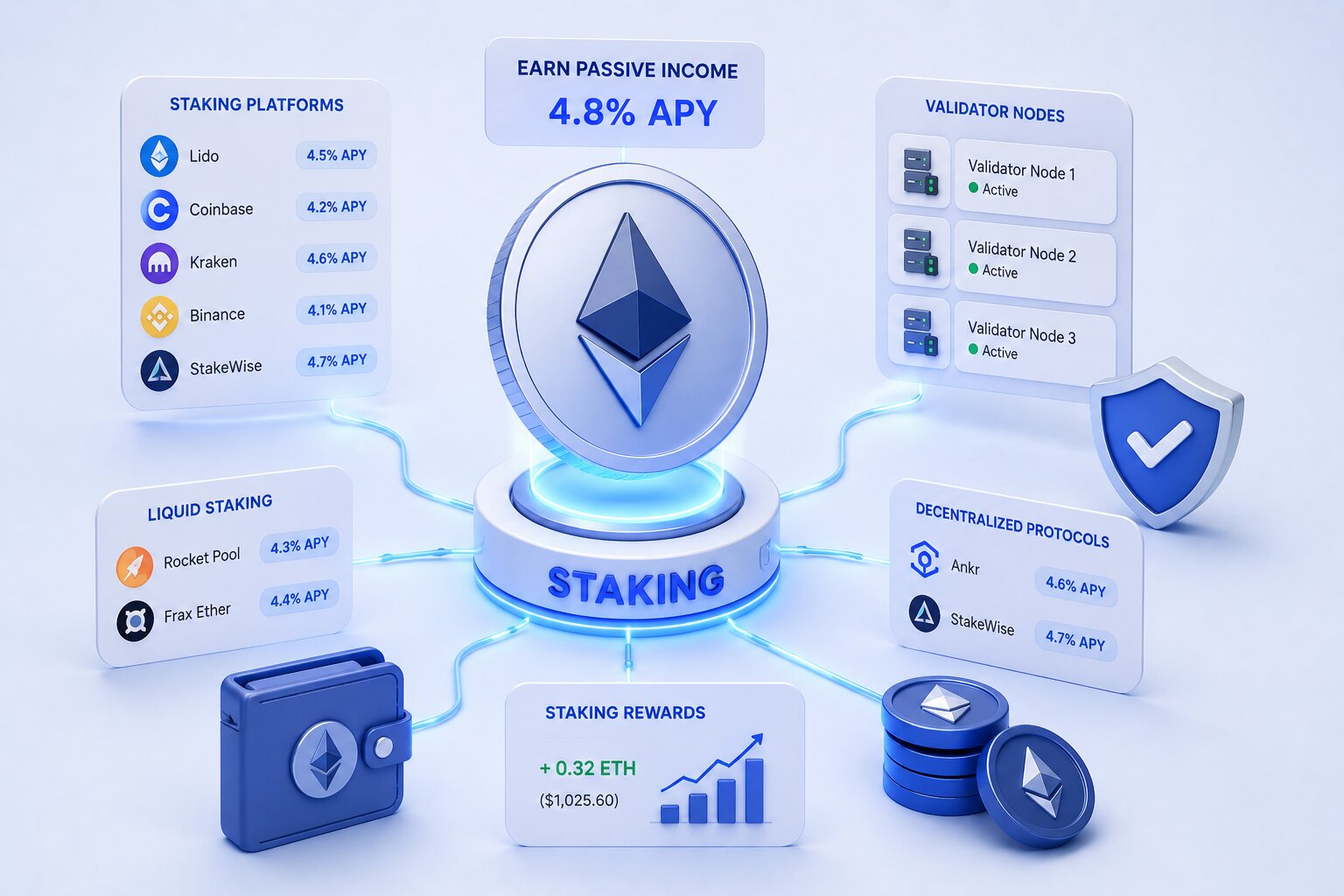
Staking Ethereum earns Proof-of-Stake consensus rewards by committing ETH to validator infrastructure that secures Ethereum’s Beacon Chain. In 2026, four distinct staking methods exist — solo validator staking, liquid staking protocols, centralized exchange staking, and EigenLayer restaking — each producing different yields, requiring different minimums, and carrying different custody and risk profiles.

MethodMinimumNet APY (May 2026)CustodyBest For
Solo validator32 ETH3.3–5% (+ MEV)SelfMaximum yield + decentralization
Liquid staking — Rocket Pool0.01 ETH~3.46% APRNon-custodialDecentralization + higher yield
Liquid staking — LidoNo minimum~2.4% APRNon-custodialDeFi composability (stETH)
Liquid staking — ether.fiNo minimumBase + restakingNon-custodialEigenLayer restaking yield
CEX staking — Kraken0.001 ETH~3.5–4%CustodialBeginners, simplicity
CEX staking — Coinbase0.001 ETH~3.2–3.5%CustodialBeginners, regulated US
EigenLayer restakingVia LSTBase + 0.3–1.5%Non-custodialAdvanced yield maximization

Ethereum staking statistics — May 2026

According to data from the Hildobby Dune Analytics dashboard and beaconcha.in:

MetricValue (May 2026)Source
Total ETH staked35,859,802 ETHHildobby / Dune Analytics
Staking ratio (% of supply)28.91%Hildobby / Dune Analytics
Active validators~1,100,000beaconcha.in
Average validator APY~3.3%beaconcha.in / KuCoin
Lido market share24.2% (8,721,598 ETH)Datawallet
Binance staked ETH9.1% (3,289,104 ETH)Datawallet
ether.fi market share6.0% (2,148,329 ETH)Datawallet
EigenLayer TVL$16.26 billionEigenLayer / May 2026
SSV Network secured ETH4.3 million ETH (1,800+ operators)SSV Network docs

Which Ethereum staking method fits your situation?

GoalBest MethodReason
Maximum yield + full controlSolo staking (32 ETH)Full APR + MEV, zero fee, independent validator
Any amount + DeFi accessRocket Pool (rETH)Permissionless, ~3.46% APR, more decentralized
deepest DeFi liquidityLido (stETH)stETH on Aave, MakerDAO, Curve — most integrations
Restaking yield layerether.fi (eETH)Automatic EigenLayer integration
Simplicity, no wallet setupKraken / Coinbase / BinanceOne-click, familiar exchange interface
Fault-tolerant solo stakingDVT via Obol or SSV NetworkDistributed key — no single point of failure
Advanced yield maximizationEigenLayer AVSsBase ETH yield + layered AVS rewards

Solo staking — maximum yield and full decentralization

Solo staking activates an independent Ethereum validator by depositing exactly 32 ETH to the Beacon Chain deposit contract. Validator nodes earn the full consensus-layer APR plus execution-layer rewards (priority fees and MEV) — with no protocol fee deducted.

  • Consensus rewards originate from Beacon Chain issuance — validators earn approximately 2.8–3.8% APR for correct attestations and block proposals.
  • Execution rewards — priority fees from transaction inclusion — add additional yield dependent on network activity levels.
  • MEV-Boost captures Maximal Extractable Value from transaction ordering — adding approximately 0.5–1% APR for well-configured solo validators using MEV-Boost relay software.
  • Solo staking supports Ethereum decentralization — each independent validator reduces the stake percentage controlled by pooled protocols and centralized exchanges.

Validator client options for solo staking:

ClientTypeLanguageNotes
PrysmConsensusGoMost widely used consensus client
LighthouseConsensusRustStrong security track record
TekuConsensusJavaEnterprise-grade, ConsenSys-built
NimbusConsensusNimLightweight — low hardware requirements
GethExecutionGoMost widely used execution client
NethermindExecutionC#Good client diversity option
BesuExecutionJavaHyperledger-maintained

What is Distributed Validator Technology (DVT) — and how does it improve solo staking?

Distributed Validator Technology (DVT) splits a validator’s private key cryptographically across multiple machines — eliminating the single point of failure present in standard single-node validator setups. If one node in the cluster goes offline, the remaining nodes continue validating as long as the signing threshold is met.

  • The Ethereum Foundation staked 72,000 ETH using DVT-lite in March 2026 — the most prominent single-operator DVT deployment to date and a public signal that the architecture is production-ready.
  • SSV Network secures over 4.3 million ETH across more than 1,800 node operators — representing approximately 12% of all staked ETH operating through DVT infrastructure (SSV Network documentation, April 2026).
  • As of October 2025, approximately 547,968 ETH representing 17,124 validators within Lido alone run on DVT implementations from Obol, SafeStake, and SSV Network.

Obol Network vs SSV Network — DVT comparison

FeatureObol NetworkSSV Network
ArchitectureCharon middleware — cluster of trusted operatorsSecret Shared Validator — independent operators
Key modelDistributed Key Generation (DKG) among cluster nodesKey shares distributed to independent non-trusting operators
Decentralization levelModerate — cluster nodes collaborativeHigh — operators are independent
Best forNode operators and staking pools wanting infrastructure controlMaximum decentralization across independent operators
Lido integrationYes Lido Simple DVT Module (live since April 2024)Yes Lido Simple DVT Module
DVT-lite compatibilityYes Simpler deployment variantYes SSV also supports simplified deployment
  • DVT-lite is a simplified variant that runs the same validator key on multiple machines simultaneously using Docker-based deployment — accessible without full cryptographic key ceremony requirements.
  • StakeWise supports DVT integration with both Obol and SSV for operators wanting distributed validator infrastructure within the StakeWise V3 vault system.

Liquid staking — stake any amount, keep DeFi access

Liquid staking protocols aggregate ETH deposits, operate Beacon Chain validators, and issue tradeable LSTs — receipts representing staked ETH plus accumulated rewards that can be used across DeFi while continuing to earn.

Lido — stETH, largest liquid staking protocol

Lido holds 8,721,598 ETH — 24.2% market share of all staked ETH — as of 2026.

  • Lido charges 10% of all staking rewards — split between node operators and the Lido DAO treasury. Net APR is approximately 2.4% as of May 2026.
  • stETH is a rebasing token — its balance increases daily as rewards accrue, maintaining a 1:1 exchange rate with ETH.
  • stETH is accepted as collateral on Aave and MakerDAO, tradeable on Curve with near-zero slippage, eligible for EigenLayer restaking, and usable as collateral on Pendle for yield tokenization.
  • Lido’s 24.2% network share is the most frequently cited Ethereum centralization concern — the Ethereum Foundation has publicly flagged liquid staking protocol dominance as a systemic risk to consensus health.

Rocket Pool — rETH, most decentralized LSP

Rocket Pool uses a permissionless node operator model — anyone with 8–16 ETH can run a mini-pool, distributing validator operations across thousands of independent operators.

  • Rocket Pool delivers approximately 3.46% APR as of May 2026 — the highest net yield among major LSPs due to lower commission structure.
  • rETH uses an exchange-rate appreciation model — the rETH/ETH ratio increases over time as rewards accumulate, rather than rebasing the token balance.
  • Minimum deposit: 0.01 ETH — accessible to any holder regardless of position size.

ether.fi — eETH, leading native restaking LST

ether.fi holds 2,148,329 ETH — 6.0% of all staked ETH — as of May 2026, with eETH integrating EigenLayer restaking by default.

Frax Ether — frxETH and sfrxETH

Frax Ether offers a two-token liquid staking system — frxETH maintains a 1:1 peg with ETH (non-rebasing, earns no yield directly), while sfrxETH (staked frxETH) captures all staking rewards from the pool. Users who hold sfrxETH benefit from the yield of the entire frxETH pool concentrated into a single receipt token.

StakeWise V3 — vault-based liquid staking

StakeWise V3 allows independent operators to create isolated staking vaults — users choose which operator vault to deposit into based on operator track record, fee structure, and DVT configuration. osETH is StakeWise’s liquid staking token representing vault positions.

Rocket Pool vs Lido — detailed comparison

FactorRocket Pool (rETH)Lido (stETH)
Net APR (May 2026)~3.46%~2.4%
Protocol fee~5–10% of rewards10% of rewards
Token modelExchange-rate (appreciating rETH/ETH)Rebasing (daily balance increase)
DecentralizationYes High — permissionless operatorsLimited Lower — 30 permissioned operators
Min deposit0.01 ETHNo minimum
DeFi liquidityGrowing — fewer integrationsYes Deepest — Aave, Curve, MakerDAO
EigenLayer restakingLimited Via third-partyYes Direct via ether.fi
DVT integrationNo Not nativeYes Lido Simple DVT Module
GovernanceRocket Pool DAOLido DAO
Best forDecentralization + yieldDeFi composability + liquidity depth

CEX staking — simplest Ethereum staking for beginners

ExchangeProductAPY (May 2026)Min ETHCustodyFee (approx.)
KrakenETH staking~3.5–4%0.001 ETHCustodial~15% of rewards
CoinbaseETH staking / cbETH~3.2–3.5%0.001 ETHCustodial~25% of rewards
BinanceWBETH / flexible ETH~2.5–3.0%0.001 ETHCustodialVaries
BybitstETH, METH, cmETHVariesLowCustodialVia LST products
MEXCETH stakingUp to 4.8%0.001 ETHCustodialVaries

Ethereum staking fees — platform comparison

PlatformFee StructureNet Yield Impact
Solo staking0% — full rewards keptHighest net yield
Rocket Pool~5–10% of rewardsMinimal fee impact
Lido10% of rewards~0.27% APR reduction vs gross
StakeWise V3Operator-defined (typically 5–15%)Varies by vault
Frax EtherVariable — protocol feeCompetitive
Coinbase~25% of rewardsSignificant yield reduction
Kraken~15% of rewardsModerate yield reduction
EigenLayer AVSsAVS-definedAdditional yield, not a deduction
  • The 0.6% APR difference between Rocket Pool (~3.46%) and Lido (~2.4%) accumulates materially over multi-year holding periods — for a 10 ETH position over 3 years, this represents approximately 0.18 ETH in additional rewards.
  • CEX staking fee structures are not always disclosed transparently — the spread between gross validator yield and user-facing APY reveals the platform’s effective fee.

EigenLayer restaking — layered yield on top of Ethereum staking

EigenLayer holds $16.26 billion in TVL with 93.9% dominance over competing restaking protocols as of May 2026. Restaking adds approximately 0.3–1.5% additional APY depending on which AVSs the restaker opts into.

  • AVSs (Actively Validated Services) secured by EigenLayer include oracle networks, data availability layers (EigenDA), cross-chain bridge infrastructure, and other middleware.
  • EigenLayer restaking adds approximately 0.3–1.5% additional APY on top of base ETH staking yield, depending on which AVSs the restaker opts into and current reward distribution rates.
  • Additional slashing risk applies — each AVS defines its own slashing conditions independently of Ethereum consensus slashing rules.

Ethereum staking risk taxonomy

Consensus risks

  • Slashing: Validators lose a portion of staked ETH for double-signing or equivocation — LSPs absorb operator-level slashing, protecting individual depositors to varying degrees.
  • Downtime penalties: Validators accumulate small inactivity penalties during offline periods — DVT infrastructure reduces this risk by eliminating single points of failure.

Smart contract risks

  • Protocol exploits: Liquid staking protocols (Lido, Rocket Pool, ether.fi) rely on audited smart contracts — Lido audited by Sigma Prime and Certora; Rocket Pool audited by Sigma Prime, Consensys Diligence, and Trail of Bits.
  • Oracle failures: LST exchange rates depend on accurate price feeds — oracle manipulation could affect withdrawal amounts.

Liquidity risks

  • Withdrawal queue: Ethereum’s validator exit mechanism scales with network-wide exit demand — peak exit periods have extended withdrawal times to days or weeks.
  • LST depeg: stETH and rETH can trade below their ETH-equivalent value during market stress — the May 2022 stETH depeg reached a 6% discount during the Three Arrows Capital collapse.

Counterparty risks

  • Exchange insolvency: CEX staking gives exchanges custody of staked ETH and withdrawal credentials — exchange failure risks permanent loss of staked assets.
  • LSP governance risk: Lido DAO governs key protocol parameters — governance decisions can affect fee structures, operator sets, and withdrawal mechanics.

Restaking risks

  • AVS slashing: Each EigenLayer AVS defines independent slashing conditions — restakers face compound slashing exposure from both Ethereum consensus rules and AVS-specific violations.
  • Reward variability: AVS reward distributions depend on protocol demand and can change or cease without fixed commitments.

Is Ethereum staking taxable?

Ethereum staking reward taxation varies by jurisdiction — most major regulatory frameworks treat staking rewards as ordinary income at the time of receipt.

  • United States: The IRS treats staking rewards as ordinary income at fair market value when received (Rev. Rul. 2023-14) — subsequent disposal of staked assets triggers capital gains treatment.
  • United Kingdom: HMRC treats staking rewards as miscellaneous income at receipt — disposal of LSTs or staked ETH triggers Capital Gains Tax.
  • European Union: Treatment varies by member state — Germany exempts staking rewards from tax if held for over one year in certain circumstances.
  • LST appreciation (rETH exchange rate increase, stETH rebasing) may have different tax treatment than direct staking rewards — consult a tax professional for jurisdiction-specific guidance.
  • Staking rewards earned through CEX platforms are typically reportable as income — exchanges often provide tax documents summarizing annual reward amounts.

What Ethereum staking cannot guarantee

  • Fixed returns — APY fluctuates with total network staked ETH, validator participation rates, and MEV availability.
  • Instant withdrawal — Ethereum’s validator exit queue scales with exit demand; peak periods extend withdrawal times to days or weeks.
  • Zero smart contract risk — LSPs are audited but audits do not guarantee exploit-free operation.
  • LST peg stability — stETH and rETH can trade below ETH-equivalent value during market stress.
  • Fixed AVS rewards — EigenLayer AVS distributions depend on protocol demand and can change or cease.

Common mistakes when choosing where to stake Ethereum

MistakeResultPrevention
Comparing CEX promotional APY to protocol APYMisleading yield comparisonVerify product structure — base staking vs LST vs promotional
Staking 100% of ETH on one CEXFull custodial exposureDiversify across non-custodial and custodial positions
Ignoring Lido centralization riskContributing to validator concentrationConsider Rocket Pool, StakeWise, or solo staking as alternatives
Restaking without reading AVS slashing conditionsCompound slashing exposureReview each AVS’s conditions before opting in
Confusing APR and APYYield miscalculationNote whether the platform quotes simple APR or compounded APY
Not accounting for protocol fees in yield comparisonOverstating net returnAlways use net APR (after fees) when comparing platforms

FAQ — 8 Questions from People Also Ask

Where is the best place to stake Ethereum in 2026?

The best platform depends on ETH amount and goals. Solo staking (32 ETH minimum) delivers the highest yield at 3.3–5% plus MEV with zero fees. Rocket Pool (~3.46% APR) is the best liquid staking option for decentralization-conscious stakers. Lido (~2.4% APR) provides the most DeFi-integrated LST (stETH). Kraken and Coinbase suit beginners preferring custodial simplicity. With 35.85 million ETH staked and 1.1 million active validators as of May 2026, Ethereum’s staking ecosystem is the largest PoS validator set in crypto.

Which Ethereum staking platform has the lowest fees?

Solo staking has zero protocol fees — the validator keeps 100% of consensus rewards, execution rewards, and MEV. Rocket Pool charges approximately 5–10% of rewards. Lido charges exactly 10%. Coinbase charges approximately 25%. Kraken charges approximately 15%. CEX fees are not always explicitly disclosed — the spread between gross validator yield (~3.3%) and user-facing APY reveals the effective fee rate.

What is the best liquid staking protocol for Ethereum?

Lido (stETH) for maximum DeFi composability — accepted on Aave, MakerDAO, and Curve. Rocket Pool (rETH) for decentralization and yield — permissionless operators and ~3.46% APR. ether.fi (eETH) for restaking yield — automatic EigenLayer integration. StakeWise V3 for operator choice — vault-based architecture with DVT support. Each protocol has different fee, decentralization, and liquidity trade-offs.

What APY does Ethereum staking pay in 2026?

Solo staking yields approximately 3.3–4% APR from Beacon Chain consensus rewards plus 0.5–1% MEV via MEV-Boost — approximately 3.8–5% all-in. Rocket Pool delivers ~3.46% APR. Lido delivers ~2.4% APR after 10% fee. Kraken ranges 3.5–4%. EigenLayer restaking adds 0.3–1.5% extra on top. Average validator APY across the entire network is approximately 3.3% according to beaconcha.in as of May 2026.

What is DVT and how does it improve Ethereum staking?

Distributed Validator Technology splits a validator’s private key across multiple machines — eliminating the single point of failure in standard solo staking. If one node goes offline, remaining nodes continue validating. Obol Network uses Charon middleware for cluster-based DVT. SSV Network distributes key shares to independent non-trusting operators. The Ethereum Foundation staked 72,000 ETH using DVT-lite in March 2026, signaling production-readiness.

Is Ethereum staking taxable?

In most jurisdictions, yes. The US IRS treats staking rewards as ordinary income at receipt (Rev. Rul. 2023-14). HMRC in the UK treats them as miscellaneous income. EU treatment varies by member state. Subsequent disposal of staked ETH or LSTs typically triggers capital gains treatment. LST appreciation (rETH exchange rate increases) may have different treatment than direct reward income — consult a jurisdiction-specific tax professional for accurate guidance.

What is the difference between Rocket Pool and Lido?

Rocket Pool delivers ~3.46% APR with permissionless node operators and charges lower fees — prioritizing decentralization and yield. Lido delivers ~2.4% APR with 30 permissioned operators and charges 10% of rewards — prioritizing DeFi composability through stETH’s deep liquidity on Aave, Curve, and MakerDAO. Rocket Pool’s rETH appreciates in exchange rate; Lido’s stETH rebases. For decentralization believers: Rocket Pool. For DeFi users: Lido.

Can Ethereum staking rewards compound automatically?

Consensus rewards accrue continuously at the Beacon Chain level and increase the validator’s effective balance — this balance growth has a compounding-like effect on future reward calculations. LST rewards compound within the token itself — stETH rebases daily, rETH appreciates in exchange rate. For CEX staking, some platforms offer automatic reinvestment. Explicit manual compounding is not required for LSTs — the token mechanism handles reward accumulation automatically.


Share:

Resend posts

Our insights? Click below to add us as your preferred source on Google
Follow trusted sources to improve your search experience

Send Us A Message